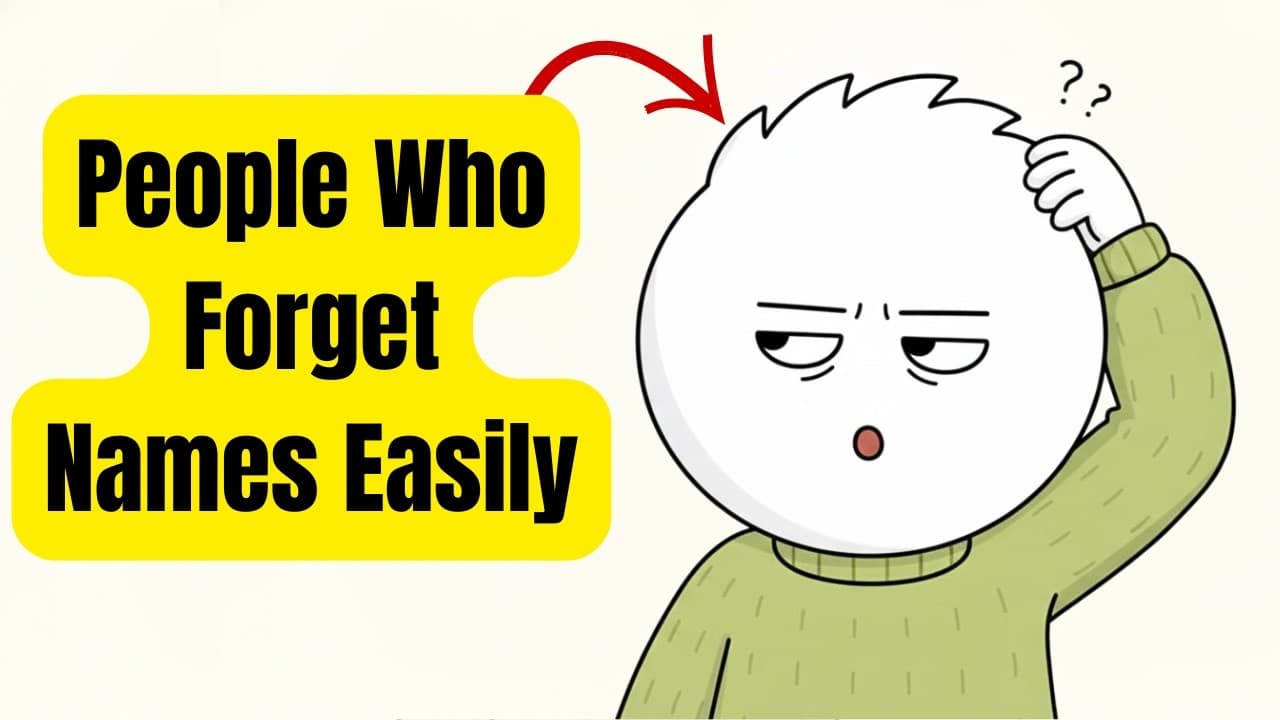
Why Do Some People Forget Names So Easily?
TL;DR
People often forget names because names are arbitrary labels with few built-in associations, making them difficult to encode during busy social encounters. Cognitive overload, self-consciousness, and preparing what to say next can divert attention when a name is introduced, while deliberate repetition and linking the name to a familiar image or person can improve retention.
Transcript
You've done it again. You're standing directly in front of someone you've met at least three times, maybe four, and their name is just gone. Not even hovering at the tip of your tongue, just completely cleanly absent, like it was never filed anywhere in the first place. And the worst part isn't even the forgetting. It's the next 12 seconds of pure ... Read More
Key Insights
- Names are semantically sparse labels that may not automatically activate concepts, images, emotions, or existing knowledge. Because memory favors meaningful and connected information, a newly heard name can remain isolated and disappear quickly, even when other details about the person remain memorable.
- Working memory is heavily occupied during a first meeting by facial cues, vocal tone, social context, self-presentation, and planning a response. A name introduced during this cognitive activity may receive too little attention to be encoded effectively for later retrieval.
- The Baker Baker paradox shows that identical words can be remembered differently depending on meaning. In a 1987 study by McWeeny and Ellis, participants retained baker as an occupation more readily than Baker as a surname because the occupation activated a network of familiar associations.
- The next in line effect is reduced memory for what someone says when a listener is already preparing to speak. Malcolm Brener documented the phenomenon in 1973, showing how anticipation of one’s own turn can interfere with attention to the person speaking immediately beforehand.
- Social anxiety and hyperactive self-awareness can redirect attention toward eye contact, handshakes, interruptions, and upcoming responses. Chronic name forgetting may therefore represent a preoccupation problem during encoding rather than a broad inability to remember information.
- Memory stores prioritized impressions, emotions, patterns, and fragments rather than preserving every experience like a complete recording. Emotional, surprising, and previously connected details may persist, while an arbitrary name delivered during a demanding social moment may be lost.
- Highly associative thinkers may remember stories, feelings, clothing, expressions, laughter, or meaningful remarks while forgetting the label attached to the person. This pattern suggests richly contextual memory that favors personal texture over mechanically retaining a name.
- Deliberate association can improve name retention by giving an otherwise isolated label a connection to existing memory. Repeating the person’s name immediately and linking it with a familiar image or known person constructs a mental bridge that supports later recall.
Install to Summarize YouTube Videos and Get Transcripts
Explore YouTube Video Summarizer or Get YouTube Transcript Extractor
Questions & Answers
Q: Why do some people forget names so easily?
Some people forget names because a name is often an arbitrary sound with no immediate concept, image, emotion, or association attached to it. During an introduction, working memory is also processing the person’s face, tone, social context, and possible responses. With attention divided among these demands, the name may not be encoded strongly enough to remain available later.
Q: Does forgetting someone’s name mean you do not care about them?
Forgetting a name does not necessarily mean that the person was ignored or considered unimportant. Someone may remember the conversation, a story about the person’s sister, an unusual opinion, a laugh, or a meaningful facial expression while losing the name itself. The memory system may preserve contextual and emotional details while failing to retain the arbitrary verbal label.
Q: What is the Baker Baker paradox in name memory?
The Baker Baker paradox describes how the same word can produce different levels of recall depending on its meaning. In a 1987 study by McWeeny and Ellis, people who learned that a photographed person worked as a baker remembered the information better than people told the person’s surname was Baker. The occupation activated associations, while the surname did not.
Q: How does social anxiety make names harder to remember?
Social anxiety can fill an introduction with internal questions about eye contact, handshake pressure, interruptions, appearance, and what to say next. That self-focused internal narration competes with the attention needed to encode a name. The name may enter working memory briefly, but preparation and self-monitoring can displace it before a stable association is formed.
Q: What is the next in line effect?
The next in line effect occurs when people remember less of what another person says because they are anticipating their own turn to speak. Psychologist Malcolm Brener documented it in 1973. A listener may already be planning, editing, or rehearsing a response, which reduces attention to information presented by the person speaking immediately before them, including a name.
Q: Why are occupations easier to remember than surnames?
An occupation is easier to remember when it activates a network of meaningful associations. The word baker can evoke flour, bread, warmth, and early mornings when it describes someone’s work. Used only as a surname, the same word may connect to nothing about the individual. Memory more readily retains information that links with concepts already present in the mind.
Q: How can you remember a person’s name more reliably?
Repeat the person’s name immediately after hearing it, then connect it to a visual detail or to someone you already know. These actions give the name meaning and create links to information that already has a place in memory. The technique manually builds the association that an arbitrary name may not generate automatically during a busy social introduction.
Q: Can someone have a good memory but still forget names?
A person can forget names while retaining stories, emotions, clothing, facial expressions, laughter, and meaningful remarks from an encounter. The transcript characterizes such people as highly associative thinkers whose memories are richly contextual. Their difficulty may be specific to isolated labels presented under social pressure, rather than evidence that their general memory is weak or that they were not listening.
Summary & Key Takeaways
-
Meeting someone new places several demands on working memory, including interpreting facial expressions, tone, social context, and possible responses. A name arrives amid this cognitive activity as an arbitrary sound with little inherent meaning, so it may never be encoded strongly enough to become accessible during the next encounter.
-
The Baker Baker paradox illustrates why meaningful information is easier to retain than an isolated name. Participants remembered that someone worked as a baker more readily than they remembered Baker as the same person’s surname. The occupation activated associations such as bread and early mornings, while the surname remained semantically disconnected.
-
Chronic name forgetting can reflect anxious self-preoccupation rather than indifference or poor intelligence. People may focus on eye contact, their handshake, or what they should say next instead of encoding the introduction. Repeating the name immediately and connecting it to familiar information manually creates the associations that support later recall.
Read in Other Languages (beta)
Share This Summary 📚
Summarize YouTube Videos and Get Video Transcripts with 1-Click
Try YouTube Summary with ChatGPT & Claude or YouTube Transcript Generator
Explore More Summaries from Psychology Simplified 📚





Summarize YouTube Videos and Get Video Transcripts with 1-Click
Try YouTube Summary with ChatGPT & Claude or YouTube Transcript Generator