How Do Higher-Dimensional Sphere Volumes Work?
TL;DR
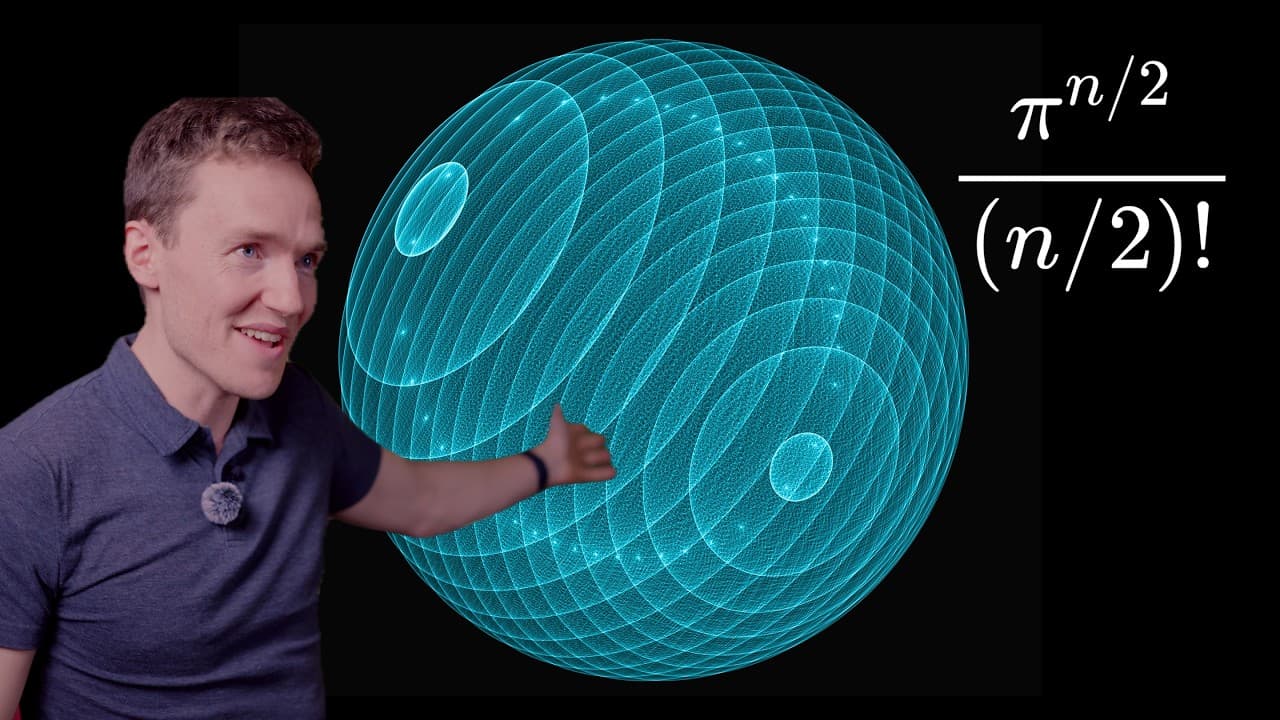
Higher-dimensional sphere volumes turn probability questions about long lists of random numbers into geometric calculations. The central method treats each list as a point in a space, then compares the volume of a unit ball with its surrounding cube, while warning that familiar geometric intuition becomes unreliable beyond three dimensions.
Transcript
[Submit subtitle corrections at criblate.com] Thank you very much. It is good to be here. I don't know if you people realize what a beautiful campus you have and how you basically just study in heaven. Today, I want to talk with you about what I think is one of the most underappreciated formulas, not because those who know it don't appreciate it, b... Read More
Key Insights
- A pair of independent random numbers can be represented as a point in two-dimensional space. When both numbers are chosen uniformly between negative 1 and positive 1, their possible pairs fill a 2 by 2 square centered at the origin.
- The inequality X squared plus Y squared is at most 1 defines the unit circle and its interior. The Pythagorean theorem connects this algebraic condition to distance from the origin, making the requested probability equal to an area ratio.
- The two-dimensional probability is pi divided by 4. The favorable region is a unit circle, while the complete sample space is a 2 by 2 square, so geometric measurement answers a question that could otherwise be expressed through integrals.
- The three-number version corresponds to a unit sphere inside a 2 by 2 by 2 cube. Adding the squared coordinate Z changes the picture's dimension, but the basic strategy remains a comparison between the favorable ball and the complete cubical sample space.
- A question involving 100 squared random numbers naturally asks for the volume of a 100-dimensional unit ball. Although such a space cannot be pictured like ordinary physical space, the underlying probability question remains empirical and mathematically meaningful.
- Higher-dimensional geometry is useful whenever an object is represented by a long list of numbers. Large language models, for example, turn pieces of text into long numerical lists that researchers can fruitfully interpret as points in a high-dimensional space.
- High-dimensional intuition can fail even when the distance rule follows directly from the ordinary Pythagorean theorem. The nested-circle puzzle begins with an inner radius of square root of 2 minus 1 in two dimensions and square root of 3 minus 1 in three dimensions.
- The video's broader investigation connects the general volume formula with half factorials, Archimedes-style reasoning, the unusually large size of 5D spheres, concentration near the surface, and a unit-free interpretation. These topics reveal behavior that ordinary three-dimensional experience does not reliably predict.
Install to Summarize YouTube Videos and Get Transcripts
Explore YouTube Video Summarizer or Get YouTube Transcript Extractor
Questions & Answers
Q: How can a probability problem become a geometry problem?
A list of random numbers can be interpreted as the coordinates of a point. Two numbers chosen uniformly between negative 1 and positive 1 produce a random point in a 2 by 2 square. If their squared sum must be at most 1, the acceptable points lie inside a unit circle, so the probability becomes the circle's area divided by the square's area.
Q: Why is the probability for two random numbers pi divided by 4?
The complete set of possible pairs fills a square extending from negative 1 to positive 1 along both axes, giving a 2 by 2 sample space. The condition X squared plus Y squared is at most 1 selects the unit circle and its interior. Comparing that circle's area with the square's area produces pi divided by 4.
Q: How does the random-number puzzle extend to three dimensions?
Introduce a third independent number, Z, also chosen uniformly between negative 1 and positive 1. Each triple becomes a point in a 2 by 2 by 2 cube. The inequality X squared plus Y squared plus Z squared is at most 1 selects the unit sphere and its interior, so the probability is determined by a volume ratio.
Q: What does a 100-dimensional unit ball represent?
A 100-dimensional unit ball represents all lists of 100 coordinates whose squared values add to at most 1. In the video's probability setup, every coordinate is a random number between negative 1 and positive 1. Asking how often their squared sum stays below the limit is therefore equivalent to comparing that ball with its surrounding high-dimensional cube.
Q: Why is higher-dimensional geometry useful without physical higher dimensions?
Higher-dimensional geometry provides a way to reason about objects described by long lists of numbers. Each list can be treated as a point, allowing geometric language and methods to simplify analytical problems. The probability example shows this directly: a large collection of integrals can be replaced conceptually by the volume of a ball inside a cube.
Q: How are large language models connected to high-dimensional geometry?
Large language models break text into small chunks and turn those chunks into long lists of numbers. Those lists do not have to be viewed geometrically, but interpreting them as points in a high-dimensional space is fruitful when researchers try to understand model behavior. The video's comparison illustrates why geometric thinking can clarify complicated numerical systems.
Q: What is the radius of the inner circle in the two-dimensional puzzle?
The distance from the square's center to a corner is square root of 2 because both legs of the relevant right triangle have length 1. The corner circle has radius 1, so the centered circle reaches tangency when its radius is square root of 2 minus 1. The transcript describes this value as approximately 0.4.
Q: Why should geometric intuition be treated cautiously in higher dimensions?
Ordinary intuition is trained by two-dimensional pictures and three-dimensional physical experience, while higher-dimensional configurations can behave very differently. The circle-and-sphere puzzle demonstrates that the same Pythagorean distance rule continues to apply, yet its consequences become increasingly counterintuitive. Reliable reasoning therefore depends on extending proven formulas carefully instead of assuming that familiar pictures remain accurate.
Summary & Key Takeaways
-
A probability question about independent numbers can be translated into geometry. For two numbers chosen uniformly between negative 1 and positive 1, the condition that their squared sum is at most 1 describes a point inside a unit circle. The probability is therefore the circle's area divided by the square's area.
-
The same translation extends from two numbers to three, four, or 100 numbers. A sum-of-squares constraint defines a unit ball in the corresponding dimension, so the original probability depends on its volume relative to a surrounding cube. Geometry replaces a potentially unwieldy collection of integrals with one spatial interpretation.
-
Higher-dimensional geometry is useful even when it does not describe literal physical space. Long numerical lists can be interpreted as points, including the numerical representations used inside large language models. However, higher dimensions produce counterintuitive behavior, so formulas derived from distance, volume, and probability deserve more trust than unaided visual intuition.
Read in Other Languages (beta)
Share This Summary 📚
Summarize YouTube Videos and Get Video Transcripts with 1-Click
Try YouTube Summary with ChatGPT & Claude or YouTube Transcript Generator
Explore More Summaries from 3Blue1Brown 📚
Summarize YouTube Videos and Get Video Transcripts with 1-Click
Try YouTube Summary with ChatGPT & Claude or YouTube Transcript Generator