How Does OpenAI Scale AI Research Toward AGI?
TL;DR
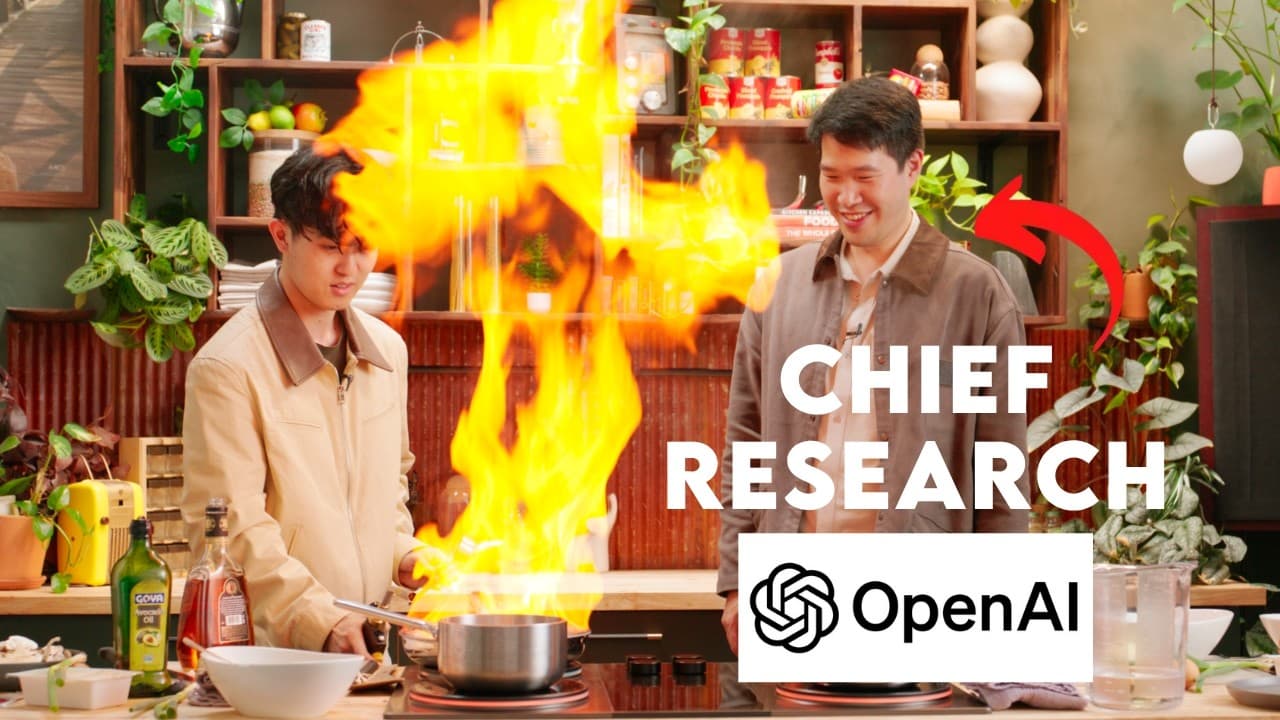
OpenAI advances model capabilities by combining continued pre-training scale, reasoning research, careful data and systems engineering, and evaluations grounded in difficult real-world work. Mark Chen argues that objective feedback makes reinforcement learning especially effective in math and coding, while replication, creative problem-solving, and attention to detail can help researchers succeed without traditional machine learning credentials.
Transcript
Yeah, I was like >> That one that [music] I know. >> That feels like Corey, the situation I'm in. >> [laughter] >> Cheers. >> Cheers. >> Hey guys, welcome to the Latent Space cooking series where we invite founders and researchers [music] and just let them cook. Today, we have a very special guest, the chief research officer of OpenAI, Mark [music]... Read More
Key Insights
- Research ability is not limited to people with formal machine learning training. OpenAI has trained researchers from other backgrounds, and Chen identifies creative problem-solving and unconventional thinking as central abilities, while acknowledging that doctoral study can still provide a valuable set of research skills.
- Replication is a practical method for developing research taste. Reproducing respected papers, matching their training curves, and reaching the reported loss or perplexity exposes implementation techniques that may remain unstated until a researcher examines the work several layers beneath its published description.
- Trading experience can transfer to AI research through attention to detail, rigorous optimization, and respect for outcomes that cannot be manipulated. Chen describes trading as an environment with hard metrics, where practitioners must carefully extract performance from systems rather than rely on ambiguous measures of success.
- Reinforcement learning works best when outcomes can be graded objectively. Mathematics and computer science provide clear signals because solutions can be proved right or wrong, while creative writing creates headwinds because qualified judges can reach substantially different conclusions about the same output.
- Superhuman evaluation increasingly depends on interaction with real-world work. As models move beyond programming contests and difficult academic questions, useful tests include novel theorem discovery, scientific contributions, cross-field relationships, high-context coding collaboration, and meaningful tasks that require sustained effort over long horizons.
- Scaling laws remain a central research conviction for Chen. He rejects bearish claims about model progress because earlier scaling bottlenecks have repeatedly been overcome through improved engineering, new research insights, better data engineering, and more deliberate management of the scaling process.
- Pre-training is not dead because apparent barriers have historically produced new techniques rather than permanent ceilings. Chen characterizes continued progress as the result of careful research engineering, data engineering, and scaling, each of which can unlock another opportunity to expand model capabilities.
- AI agents are beginning to perform long-horizon work across professional fields. Chen compares surprising advances in mathematics, computer science, and coding to AlphaGo's unexpected moves, while the interview frames coding collaboration as a test of whether models can learn within complex, information-rich, real-world environments.
Install to Summarize YouTube Videos and Get Transcripts
Explore YouTube Video Summarizer or Get YouTube Transcript Extractor
Questions & Answers
Q: How can someone develop AI research taste without a PhD?
A strong starting point is to replicate research papers that you admire. The goal should be precise reproduction, including matching training curves and reaching the loss or perplexity reported by the authors. This process reveals implementation choices and techniques that papers may not state directly. Creative problem-solving and thinking beyond conventional approaches also matter, while formal doctoral training remains useful rather than mandatory.
Q: Why can trading experience be useful in AI research?
Trading can cultivate attention to detail, disciplined optimization, and respect for unforgiving real-world measurements. Chen describes it as difficult to hack because performance is governed by a hard metric. Researchers face a similar need to examine systems carefully and extract incremental gains. He does not treat trading as uniquely privileged, noting that mathematicians, physicists, and people from other technical backgrounds can also become strong researchers.
Q: Why is reinforcement learning effective in math and coding?
Reinforcement learning is particularly effective when a task has an objective result that can be checked. Mathematics and computer science often provide this cold, hard truth because a proposed solution can be proved correct or shown to be wrong. That reliable grading signal supports direct optimization. By contrast, subjective tasks provide less consistent feedback, making the same reinforcement learning approach harder to apply effectively.
Q: Why is creative writing difficult for reinforcement learning?
Creative writing is difficult to optimize with reinforcement learning because quality is subjective. Two experts can examine the same pair of texts and form very different judgments about which is better. Without a stable standard for grading outcomes, the training signal becomes less direct than it is in mathematics or coding. Chen notes that researchers are developing techniques for these settings, but objective fields currently offer clearer opportunities.
Q: How should superhuman AI systems be evaluated?
Evaluation should move beyond saturated contests and connect models with demanding real-world work. The interview points to novel theorem discovery, contributions to hard sciences, insightful relationships between fields, and coding collaboration in high-context environments. These tasks test more than isolated problem solving. They examine whether a model can absorb complex context, sustain useful work over a long horizon, and contribute meaningfully at a research frontier.
Q: Why does Mark Chen believe AI scaling laws still matter?
Chen believes model development remains on an exponential trajectory and strongly disagrees with bearish interpretations of scaling. His reasoning is historical: whenever researchers have encountered an apparent limit, better engineering or a new research insight has helped them move past it. More careful research engineering, data engineering, and scaling can continue unlocking additional capacity, so temporary bottlenecks should not automatically be treated as permanent limits.
Q: Why does Mark Chen argue that pre-training is not dead?
Claims that pre-training has reached its end resemble earlier predictions that scaling could not continue beyond a particular bottleneck. Chen says those obstacles have repeatedly yielded to improved engineering, new research techniques, stronger data work, and more careful scaling. His argument is not that progress happens automatically. It depends on researchers identifying each constraint and developing the methods required to move beyond that boundary.
Q: What qualities make a strong AI researcher?
A strong AI researcher needs the ability to solve problems creatively and think outside established patterns. Formal machine learning education and doctoral training can provide valuable skills, but Chen does not present them as strict prerequisites. Careful replication can build technical judgment, while attention to detail and disciplined optimization help researchers understand why systems behave as they do and locate improvements that broader analysis might overlook.
Summary & Key Takeaways
-
Mark Chen argues that scaling laws remain reliable and that pre-training is not dead. When apparent limits emerge, better engineering, new research insights, stronger data practices, and more careful scaling can remove bottlenecks. This repeated ability to overcome constraints supports his confidence that model capabilities will continue advancing along an exponential trajectory.
-
Reinforcement learning progresses most readily in domains with objective answers, including mathematics and computer science, because results can be proved correct or incorrect. Subjective domains such as creative writing remain harder because experts can disagree sharply. Evaluating increasingly capable systems therefore requires real-world research, high-context collaboration, and long-horizon tasks beyond conventional contests.
-
Aspiring researchers can develop research taste by replicating admired papers and matching their reported training curves, losses, or perplexity. Deep replication reveals practical techniques that papers may not discuss explicitly. Chen also emphasizes creative problem-solving, attention to detail, and rigorous optimization, arguing that formal machine learning training is valuable but not an absolute prerequisite.
Read in Other Languages (beta)
Share This Summary 📚
Summarize YouTube Videos and Get Video Transcripts with 1-Click
Try YouTube Summary with ChatGPT & Claude or YouTube Transcript Generator
Explore More Summaries from Latent Space 📚




Summarize YouTube Videos and Get Video Transcripts with 1-Click
Try YouTube Summary with ChatGPT & Claude or YouTube Transcript Generator