What Happens During a 200K Token AI Inference?
TL;DR
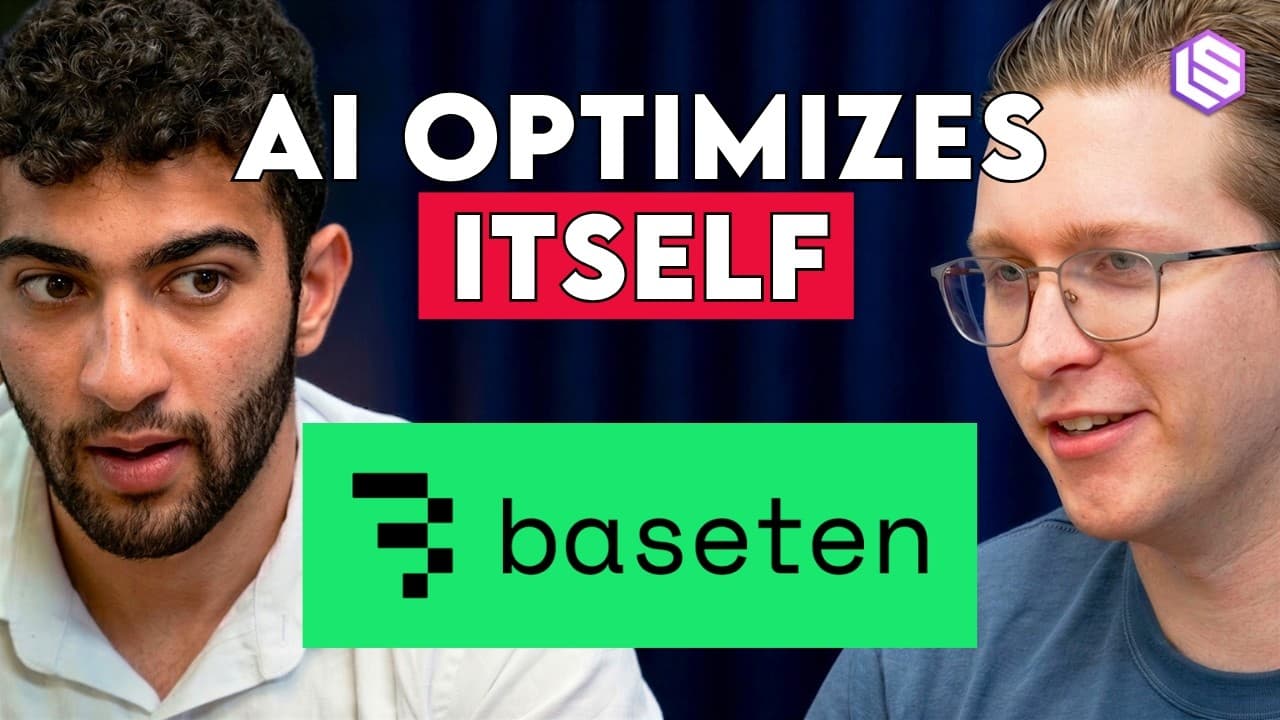
A 200K token inference is routed to multiple GPU instances using cache aware routing, prefilling, and decoding to speed up response time. The system may use a speculator model for coding tasks and relies on KV cache movement, model parallelism, and disaggregated prefill and decode to reduce latency and improve throughput.
Transcript
JLM52 is very very good at writing GPU kernels. It was very funny internally. We had a GLM52 endpoint that we're using to like that we plugged in in our cloud code harness. So every engineering team uses like our JLM52 and it will do a forward pass on the JLM52 instance of the you know the node and then it will get the profile trace and it will ana... Read More
Key Insights
- Cache aware routing selects the first available prefill worker and any cached input to minimize prefill work for long prompts.
- Prefill and decode can be disaggregated to run on different GPU sets to speed up token generation.
- Speculative decoding uses a fast predictor to draft tokens which are then verified by the main model to improve throughput.
- KV cache movement and model parallelism are essential for efficient handling of long-context inputs across GPUs.
- Quantization and careful calibration can yield speedups while mitigating errors, depending on workload specifics.
- Tool calling and structured outputs help constrain model output to a predictable format, reducing output variability and possible errors.
- Eligibility for specialized endpoints depends on traffic, reliability, and the ability to tailor models to specific tasks, such as coding or long-form content generation.
- The architecture integrates training and inference considerations, persistent KV caches, and feedback loops to continually optimize infrastructure for AI workloads.
Install to Summarize YouTube Videos and Get Transcripts
Explore YouTube Video Summarizer or Get YouTube Transcript Extractor
Questions & Answers
Q: How does cache aware routing improve long prompt processing?
Cache aware routing improves long prompt processing by prioritizing endpoints that already hold input data or have prefilled KV caches ready for use. This minimizes the initial work needed to generate the first tokens, reducing latency and lowering compute cost. The approach relies on having multiple replicas and selecting the most suitable one for the current workload.
Q: Why is prefill split from decode in some setups?
Prefill is split from decode to separate the work of constructing the KV cache from the actual token generation. This allows specialized GPU sets to handle input processing and caching while another set focuses on turning cached context into new tokens. The separation can increase throughput and enable better resource utilization.
Q: What role does speculative decoding play in inference speed?
Speculative decoding uses a fast, auxiliary model to predict a draft of upcoming tokens. These drafts are then validated by the main model, allowing many tokens to be produced with reduced latency. If the drafts are inaccurate for a given task, the main model corrects them, preserving correctness.
Q: How does KV cache movement influence performance across GPUs?
KV cache movement distributes and synchronizes the cached key and value states across GPU workers, enabling faster reuse of prior computations. Efficient KV cache handling reduces redundant processing, accelerates token generation, and improves overall throughput, especially for long-context or multi-turn prompts.
Q: What is the trade-off when choosing between shared and dedicated endpoints?
Shared endpoints are easier to deploy and scale for varying workloads, while dedicated endpoints offer higher reliability and task-specific optimization. The choice depends on traffic volume, required latency targets, and whether specialized models or quantization settings are needed for a given use case.
Q: How can structured outputs help tool calling reliability?
Structured outputs constrain the model to a defined format, reducing ambiguity in tool calls and downstream processing. By enforcing a predictable JSON-like structure or grammar, the system minimizes misinterpretations and errors, improving reliability in tool integration and downstream automation.
Q: Why might developers prefer GPU and kernel optimization in inference?
GPU and kernel optimization lowers latency and increases throughput by making core compute steps more efficient. Optimizations can include faster kernel code, better memory access patterns, and workload-specific tuning, which collectively enable higher token rates and more cost effective inference at production scales.
Q: When is a dedicated deployment more suitable than a public API?
A dedicated deployment is preferable when an organization has very high volume, strict latency requirements, or unique model adaptations. It provides more predictable performance, easier customization, and better isolation from external traffic, which helps meet reliability, security, and compliance needs for large-scale applications.
Summary & Key Takeaways
-
A long prompt is split across GPUs with cache aware routing to pick an available prefill worker and any cached input to speed up processing. The workflow also modularizes prefill and decode, enabling faster token generation and reduced latency. These techniques collectively boost throughput and responsiveness in production AI APIs.
-
The use of speculative decoding, KV cache sharing, and quantization are discussed as methods to increase speed and efficiency, along with decisions about when to deploy dedicated endpoints versus shared endpoints depending on traffic and reliability needs. This covers the balance between throughput and latency.
-
The conversation covers how tool calling and structured outputs can constrain model behavior to reduce hallucinations and improve reliability, and notes the broader ecosystem including GPUs, kernels, and hardware accelerators in sustaining high-performance AI inference.
Read in Other Languages (beta)
Share This Summary 📚
Summarize YouTube Videos and Get Video Transcripts with 1-Click
Try YouTube Summary with ChatGPT & Claude or YouTube Transcript Generator
Explore More Summaries from Latent Space 📚




Summarize YouTube Videos and Get Video Transcripts with 1-Click
Try YouTube Summary with ChatGPT & Claude or YouTube Transcript Generator