What Are Large Language Models and Their Applications?
TL;DR
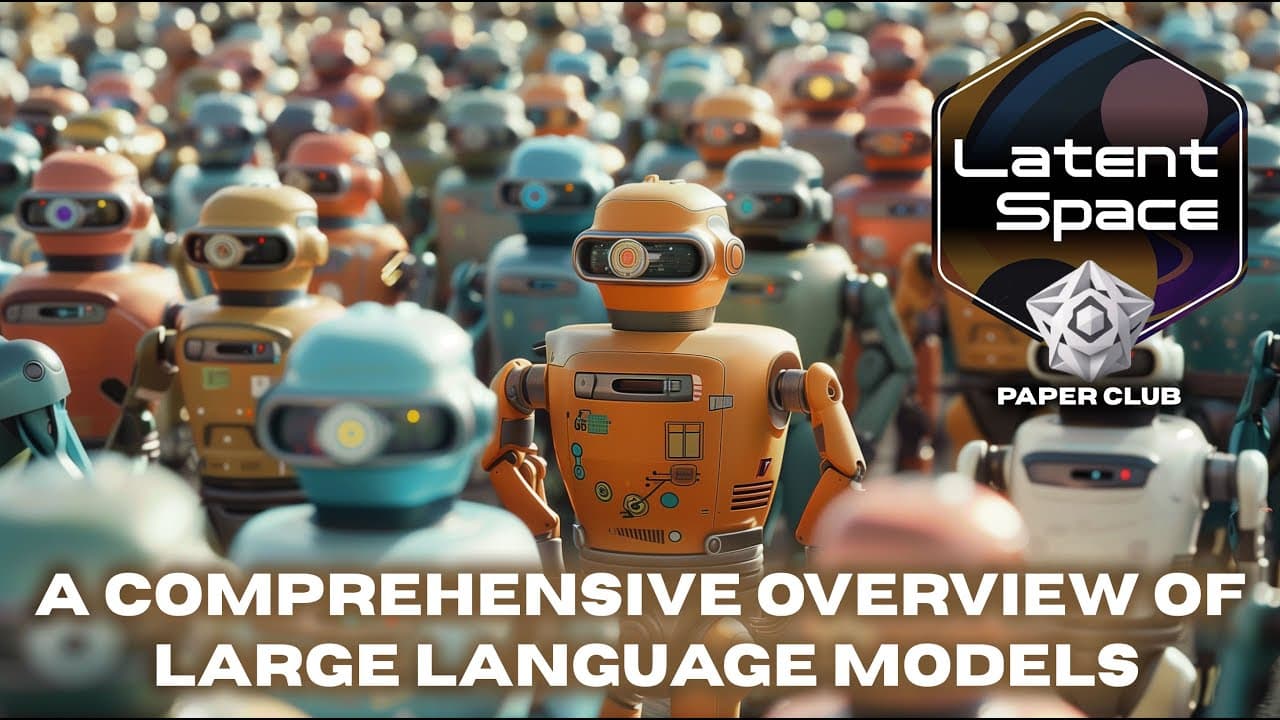
Large language models, such as GPT-3, excel at performing various tasks without fine-tuning, highlighting their versatility. They employ pre-training methods like masked and full language modeling to learn from data sequences. Evaluations utilize multiple benchmarks like GLUE and SuperGLUE, assessing their performance across a wide array of applications beyond basic language understanding.
Transcript
all right that's cool all right cool so hey guys thanks so much for coming by the uh paper Club as usual um this is a paper club we run out Asia where we go through one paper every week uh so today we're just recording it for the first time and uh we hope that you benefit from it so as usual if you guys got any questions you can either like let me ... Read More
Key Insights
- 🌥️ Large language models like GPT-3 can perform tasks without the need for fine-tuning, showcasing their generalization abilities.
- 😑 Pre-training objectives like masked language modeling and full language modeling enable models to learn from input sequences effectively.
- 🔂 Evaluation of language models involves single-task and multitask evaluations using diverse datasets.
Install to Summarize YouTube Videos and Get Transcripts
Explore YouTube Video Summarizer or Get YouTube Transcript Extractor
Questions & Answers
Q: What are some popular tasks that large language models can perform without fine-tuning?
Large language models like GPT-3 can perform tasks such as question answering, summarization, translation, sentiment analysis, and reasoning without the need for fine-tuning.
Q: How are language models trained in terms of pre-training objectives?
Language models are trained using objectives like masked language modeling, where the model predicts masked tokens, and full language modeling, where the model predicts subsequent tokens given a partial sequence.
Q: What are some commonly used evaluation datasets for language models?
Some commonly used evaluation datasets for language models include GLUE, SuperGLUE, SQuAD, CoLA, MNLI, and STS-B. These datasets cover tasks like natural language inference, sentiment classification, and question answering.
Q: How are large language models applied in specific domains, like finance or chatbots?
Large language models can be fine-tuned for specific domains, allowing them to specialize in tasks like financial analysis, customer support, or chatbot interactions. This improves their performance and relevance in these domains.
Summary & Key Takeaways
-
Large language models like GPT-3 have the ability to perform tasks without fine-tuning, showcasing their impressive capabilities.
-
Different models use variations of pre-training objectives like masked language modeling and full language modeling to learn from input sequences.
-
Evaluation of language models includes single-task evaluations and multitask evaluations, with datasets like GLUE and SuperGLUE being commonly used.
-
Applications of these models range from general-purpose models to task-specific models like music generation and code generation.
Read in Other Languages (beta)
Share This Summary 📚
Summarize YouTube Videos and Get Video Transcripts with 1-Click
Try YouTube Summary with ChatGPT & Claude or YouTube Transcript Generator
Explore More Summaries from Latent Space - The AI Engineer Podcast (Video Podcast) 📚



Summarize YouTube Videos and Get Video Transcripts with 1-Click
Try YouTube Summary with ChatGPT & Claude or YouTube Transcript Generator