How Do Language Agents Reason and Use Tools?
TL;DR
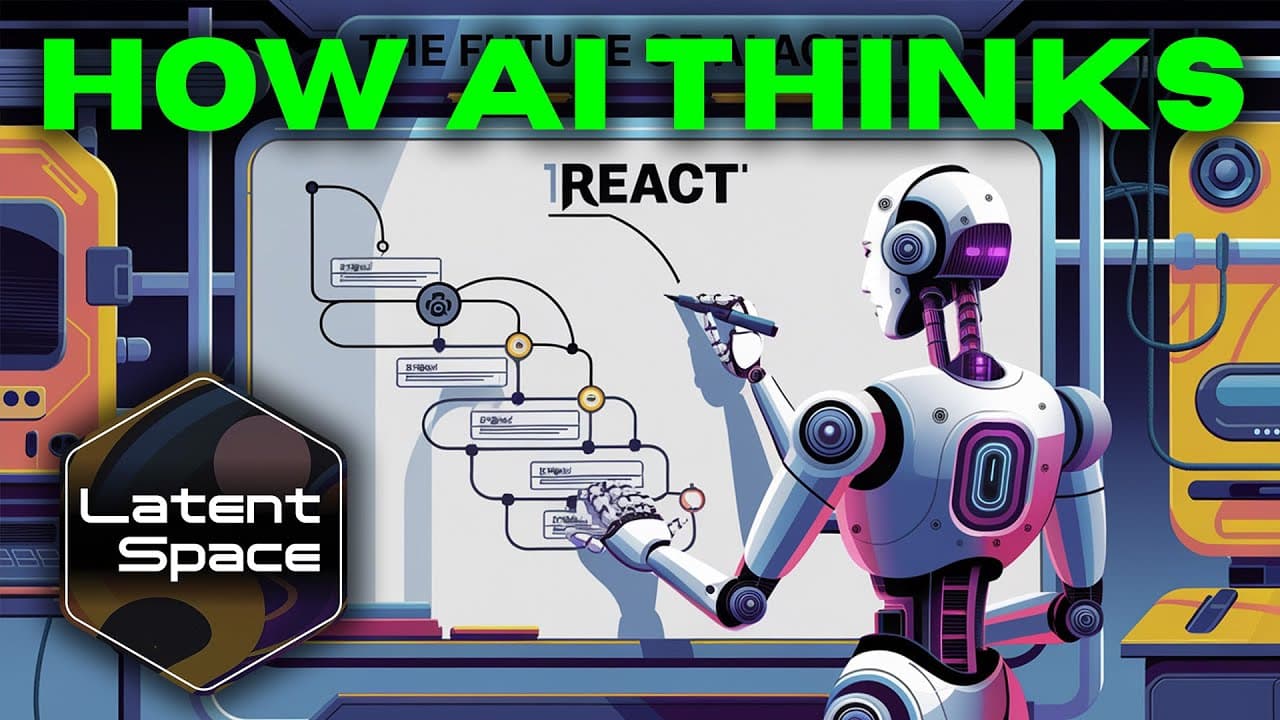
Language agents become more capable when reasoning is treated as an internal tool and alternated with actions in an external environment. The ReAct approach gives models new observations through search, calculators, browsers, code interpreters, and application-specific tools, improving how they gather context and decide what to do next without requiring changes to the surrounding tools.
Transcript
hey everyone welcome to the laden space podcast this is alesio partner in CTO and residents at deible partners and I'm joined by my co-host swix founder of small AI hey and today we have a super special episode I actually almost wanted to take like a selfie and go like you know POV you're about to revolutionize the world of Agents because we have u... Read More
Key Insights
- ReAct is a general pattern that interleaves language-model reasoning with actions in an external environment. Its appeal comes from a simple structure that helps models decide what information they need, call an appropriate tool, observe the result, and continue reasoning.
- Thinking is an additional tool for a language agent because it changes the model’s internal context even when it does not alter the external environment. Intermediate reasoning can organize observations, identify prerequisites, and guide the next action toward a goal.
- Language-agent research connects two historical branches of AI: reinforcement learning focused on agents in game environments, while natural language processing focused on separate tasks such as summarization and question answering. Language agents seek more general methods across language-based environments.
- Text-adventure games exposed the limitations of trial-and-error reinforcement learning. An agent might interact for millions of steps and overfit to one game, while a person can interpret a textual scene, infer prerequisites, and form a short sequence of purposeful actions.
- ReAct grew from the idea that an agent should reason through dependencies before acting. If defeating a monster requires a sword located in another room, the agent can infer that it must reach the room, obtain the sword, and then confront the monster.
- Practical environments helped demonstrate ReAct more effectively than difficult text games. During an internship at Google, Yao reapplied the core idea to Wikipedia, question answering, and simpler text environments, where the reasoning-and-action pattern produced useful experimental results.
- Early LangChain demonstrations paired language models with search and calculator tools. The framework was designed to let developers add their own tools, supporting a broad range of applications rather than limiting agents to a fixed collection of predefined capabilities.
- Production agents commonly depend on application-specific tools, although browsers, search tools, and code interpreters form a recurring general-purpose set. Tool design therefore involves both reusable capabilities and interfaces tailored to the data, actions, and constraints of a particular application.
Install to Summarize YouTube Videos and Get Transcripts
Explore YouTube Video Summarizer or Get YouTube Transcript Extractor
Questions & Answers
Q: What is the ReAct approach for language agents?
ReAct is an approach that combines reasoning and acting in a repeated process. A language model thinks about the current problem, chooses an action such as searching Wikipedia or using a calculator, receives an observation, and uses that new information in its next reasoning step. The approach was notable for being simple, general, and applicable beyond a single natural-language task.
Q: How does reasoning help a language agent act?
Reasoning helps an agent identify goals, prerequisites, and suitable next actions before it interacts with an environment. It does not necessarily modify the outside world, but it changes the model’s internal context by adding structured thoughts and tool observations. That evolving context can help the model choose more relevant actions and respond to information that was not originally present.
Q: Why were text-adventure games important to ReAct?
Text-adventure games provided an environment where observations and actions were expressed through language. They highlighted the difference between reinforcement-learning agents that relied on extensive trial and error and people who could interpret a scene, infer dependencies, and plan. Yao’s attempt to give text agents this capacity to think became a prototype for the reasoning-and-action pattern later demonstrated by ReAct.
Q: How does ReAct differ from traditional reinforcement learning agents?
The comparison presented in the discussion centers on methodology and environment. Traditional reinforcement-learning work often associated agents with games and trained them through repeated trial and error, sometimes for millions of steps. ReAct instead uses a language model’s reasoning within its context to guide tool calls and actions, offering a method that does not depend on learning a separate fixed pipeline for every task.
Q: What tools can a language agent use with ReAct?
The discussion identifies search, calculators, browsers, and code interpreters as useful tools for language agents. Wikipedia also served as an external information environment in ReAct experiments. LangChain allowed developers to define additional tools, and Harrison Chase noted that production applications generally rely on their own specialized tools, sometimes combined with one or more of the recurring general-purpose capabilities.
Q: Why did ReAct move from text games to practical tasks?
The earliest experiments applied reasoning to text-based games, but those environments remained very difficult and did not produce strong enough results. During Yao’s internship at Google, the idea was reapplied to more practical or manageable settings, including Wikipedia, question answering, and simpler text games. These domains made it easier to demonstrate that alternating reasoning with external actions could work effectively.
Q: How did ReAct influence early LangChain applications?
ReAct showed a general way for language models to call external tools while reasoning about what to do next. Harrison Chase described it as an important step toward more reliable API and tool use. Early LangChain demonstrations used tools such as search and a calculator, while the framework made it straightforward for developers to create and connect tools for their own applications.
Q: Why are custom tools important for production agents?
Custom tools are important because production applications usually need access to their own data, APIs, operations, and workflows. Chase observed that developers commonly write specialized tools rather than relying entirely on a shared catalog. Browsers, search tools, and code interpreters are recurring general capabilities, but the long tail of agent use cases requires interfaces designed for each application’s particular environment.
Summary & Key Takeaways
-
Shunyu Yao’s path to language agents began with computer vision, shifted after encountering the Transformer paper, and developed during his PhD under Karthik Narasimhan. He questioned whether language models could replace rigid, task-specific methods and reinforcement-learning systems in environments where understanding instructions, observations, and goals is essential for effective action.
-
ReAct combines reasoning with actions that obtain information from an external environment. Although reasoning does not directly change that environment, it changes the model’s internal working context by incorporating observations and intermediate thoughts. This simple, general pattern helped demonstrate how language models could use Wikipedia, search, calculators, and other tools more reliably.
-
Early text-adventure experiments motivated ReAct because conventional agents often learned through millions of trial-and-error steps without demonstrating strong language understanding. Later experiments moved toward more practical and manageable environments, including Wikipedia and simpler text games. LangChain subsequently made the pattern extensible through common tools and application-specific integrations for production use.
Read in Other Languages (beta)
Share This Summary 📚
Summarize YouTube Videos and Get Video Transcripts with 1-Click
Try YouTube Summary with ChatGPT & Claude or YouTube Transcript Generator
Explore More Summaries from Latent Space 📚

Summarize YouTube Videos and Get Video Transcripts with 1-Click
Try YouTube Summary with ChatGPT & Claude or YouTube Transcript Generator