How Positron AI Accelerates Transformer Inference
TL;DR
Transformer inference is often constrained by memory bandwidth and capacity rather than raw arithmetic throughput, so efficient hardware must prioritize moving model data instead of merely adding more compute. Positron AI applies experience from semiconductor design and AI cloud infrastructure to build inference accelerators focused on performance per dollar, performance per watt, and practical deployment.
Transcript
Hey everyone, welcome back to another latest baseling pod. This is Allesio, partner and CTI decible and I'm joined by Swixs, founder of Small AI. Hello. Hello. Uh, today we are joined by Mitesha and Thomas from Posatron AI. Welcome. Thanks Sean. Thanks for having us. Good to be here. And also special shout out to Maxim from DFj for putting us in to... Read More
Key Insights
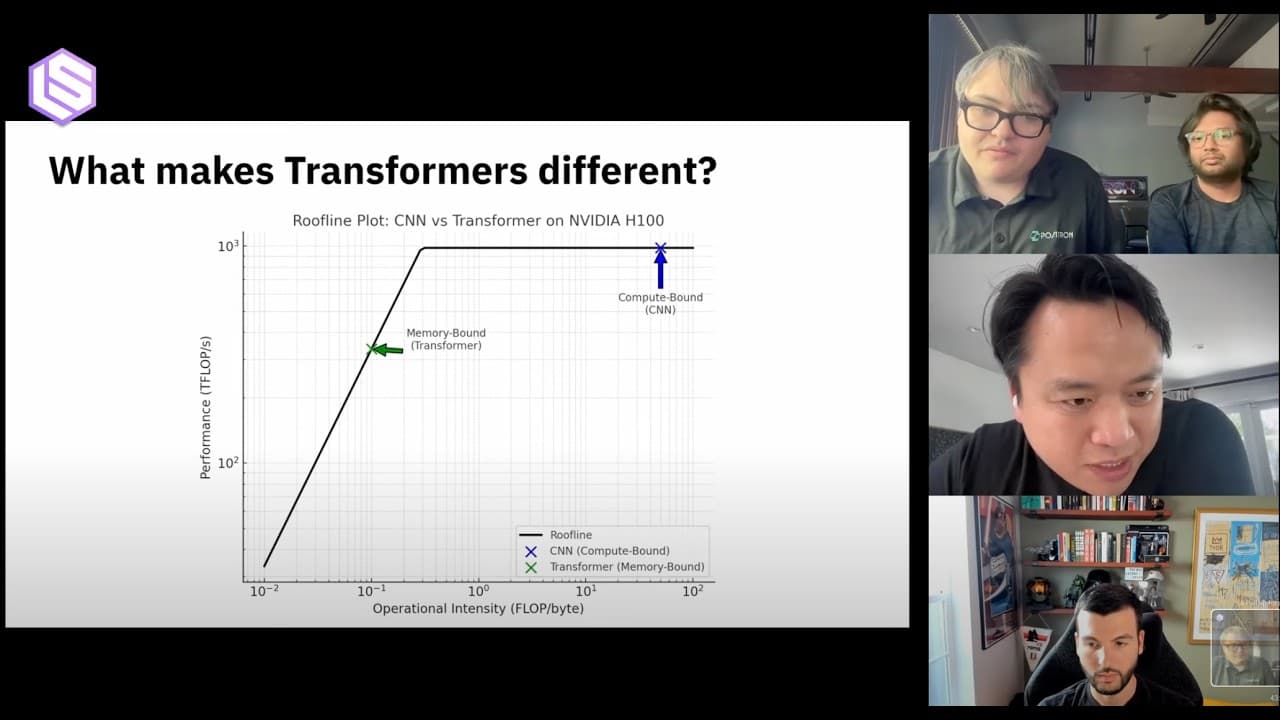
- Transformer inference is frequently memory-bound because attention and related operations must move model data continually while generating tokens. Increasing arithmetic throughput alone cannot remove this constraint when the processor spends much of its time waiting for information to arrive from memory.
- Memory bandwidth and memory capacity are central design priorities for Positron AI's accelerator architecture. The company argues that much of the chip industry continued optimizing for the compute-heavy requirements of earlier neural networks rather than the data-movement patterns of transformer inference.
- Convolutional neural networks and transformers place different demands on hardware. Inner-product matrix multiplication can perform extensive computation on reused data, while matrix-vector multiplication during transformer inference has a much tighter relationship between arithmetic work and the amount of data moved.
- Positron AI's founding thesis is that AI distribution is limited partly by the financial and electrical costs of deployment. The company therefore evaluates architecture through performance per dollar and performance per watt, not solely through peak floating-point performance.
- The founders' experience combines semiconductor development with AI cloud operations. Thomas Sohmers previously designed silicon and worked in processor strategy, while Mitesh Agrawal managed growth, cloud infrastructure, data-center capacity, vendor procurement, engineering, and customer requirements at Lambda.
- Efficient inference hardware can support continued software progress by making more compute practically available. Mitesh Agrawal argues that better hardware does not imply software has reached a limit, because model developers can use greater, more efficient compute to pursue additional intelligence and utilization.
- Positron AI's architecture draws on lessons from bandwidth-intensive signal processing. Thomas Sohmers recognized similarities between transformer data movement and workloads previously handled with specialized digital signal processors and FPGAs, which informed the company's approach to neglected areas of processor architecture.
- Positron AI focuses particularly on token generation, also called decode, where transformer inference repeatedly accesses model data. Its market strategy emphasizes operational deployment, power efficiency, FPGA utilization, an eventual transition to ASIC technology, and competition with established accelerator providers.
Install to Summarize YouTube Videos and Get Transcripts
Explore YouTube Video Summarizer or Get YouTube Transcript Extractor
Questions & Answers
Q: Why is memory bandwidth a bottleneck for transformer inference?
Memory bandwidth becomes a bottleneck because transformer inference repeatedly moves model data while producing tokens. Attention and other matrix-vector operations provide less opportunity to reuse each piece of data for extensive computation than compute-heavy matrix-matrix operations. When data movement dominates execution, adding more floating-point units does not automatically improve useful performance because those units still depend on information arriving from memory.
Q: How does Positron AI approach transformer inference hardware?
Positron AI designs its hardware around the memory-bound characteristics of transformer inference. Its approach prioritizes memory bandwidth, memory capacity, efficient data movement, and token generation instead of treating peak arithmetic throughput as the only important metric. The company measures its goals through practical outcomes such as performance per dollar, performance per watt, power consumption, and the ability to deploy inference economically at scale.
Q: What is different about convolutional and transformer hardware requirements?
Convolutional neural networks often use matrix-matrix operations that can perform substantial arithmetic work after data has been loaded, creating relatively high operational intensity. Transformer inference often relies on attention and matrix-vector operations that require model data to be moved repeatedly. This lower reuse makes transformer execution more dependent on memory bandwidth, so hardware optimized mainly for convolutional workloads may allocate resources poorly for inference.
Q: Why did the Positron AI founders focus on hardware instead of software?
The founders focused on hardware because their experience and interests center on semiconductor design, physical systems, cloud infrastructure, and large-scale compute deployment. They also viewed the cost and power required to distribute AI applications as major limitations. Their decision does not assume that software development has reached a ceiling. Instead, they believe more efficient underlying compute can give model developers greater resources for continued improvement.
Q: What experience did Thomas Sohmers bring to Positron AI?
Thomas Sohmers brought direct experience creating semiconductor products, including founding Rex Computing, producing an early chip, working on cryptocurrency ASICs, building early data centers as Lambda's principal hardware architect, and serving in technology strategy at Groq. Although his first semiconductor company did not achieve commercial success, it gave him practical experience producing silicon from scratch and studying architectures for demanding signal-processing workloads.
Q: What experience did Mitesh Agrawal bring to Positron AI?
Mitesh Agrawal brought experience scaling Lambda's business and cloud operations from an early stage. His responsibilities included engineering, sales, support, revenue operations, data-center capacity, megawatts, vendor relationships, procurement, and engineering headcount. Working with frontier model laboratories, enterprises, and AI startups also exposed him to changing model architectures and their growing memory-capacity and memory-bandwidth requirements, which motivated his move into underlying compute technology.
Q: How do FPGAs fit into Positron AI's accelerator strategy?
FPGAs fit the strategy because the founders saw parallels between transformer inference and bandwidth-intensive signal-processing workloads that have used FPGAs and specialized digital signal processors. The discussion presents FPGA utilization as part of Positron AI's current operational approach, including attention to power consumption and deployment. The longer-term roadmap involves moving from FPGA-based implementation toward an ASIC designed more directly for the company's inference architecture.
Q: How does Positron AI plan to compete with established accelerator companies?
Positron AI plans to compete by concentrating on transformer inference requirements that it believes established designs have not prioritized sufficiently. Its differentiation centers on memory bandwidth, memory capacity, efficient token generation, power consumption, performance per dollar, and performance per watt. The broader market approach emphasizes operational deployment and specialized inference hardware, with domestic production also presented as part of the company's accelerator proposition.
Summary & Key Takeaways
-
Positron AI emerged from the founders' experience in semiconductor startups, AI cloud infrastructure, data centers, and processor strategy. Their shared thesis is that broader AI deployment depends on reducing both the financial and power costs of inference through hardware designed specifically for the behavior of transformer workloads.
-
The architectural argument centers on the difference between convolutional networks and transformer inference. Convolutional workloads can reuse data across substantial matrix operations, while transformer attention and related matrix-vector operations require frequent data movement. Consequently, memory bandwidth and capacity can matter more than simply increasing floating-point throughput.
-
Positron AI focuses on efficient token generation and practical accelerator deployment. Its approach draws from architectures used for other bandwidth-intensive signal-processing workloads, initially employs FPGA technology, and anticipates a transition toward custom silicon. The company positions efficiency, power consumption, domestic production, and inference specialization as central competitive priorities.
Read in Other Languages (beta)
Share This Summary 📚
Summarize YouTube Videos and Get Video Transcripts with 1-Click
Try YouTube Summary with ChatGPT & Claude or YouTube Transcript Generator
Explore More Summaries from Latent Space 📚





Summarize YouTube Videos and Get Video Transcripts with 1-Click
Try YouTube Summary with ChatGPT & Claude or YouTube Transcript Generator