How does RL verify science data in wet labs?
TL;DR
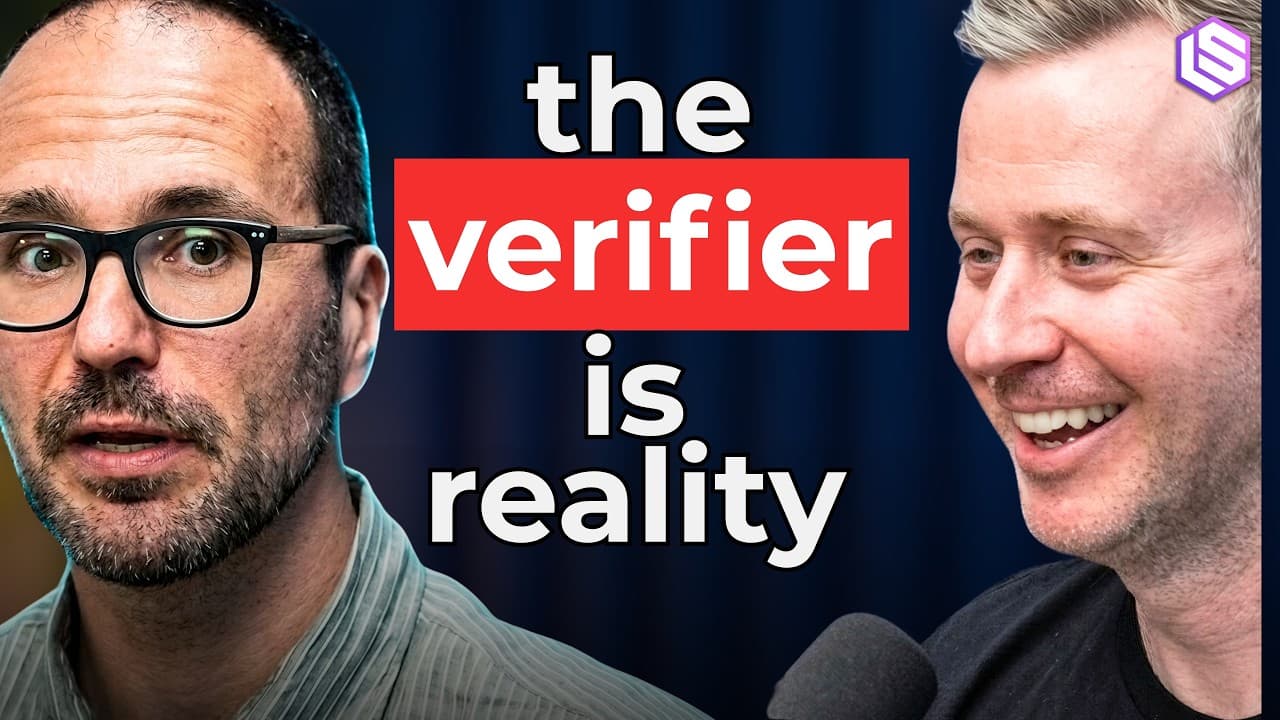
RL uses verifiable rewards by treating the wet lab as a verifier, turning scientific experiments into data tokens for model training. Lila envisions the lab as a data center where instruments form an integrated graph, enabling scalable, generalizable reasoning across biology, chemistry, and materials science. This breadth drives depth in scientific AI.
Transcript
But not just techbio, what do you do in terms of science? We are all in on the bitter lesson in scale. We think that methods that scale and that are general beat those that are not. As Ilya said at NeurIPS last year, we have but one internet. It's the fossil fuel. We fracked. We got every ounce of data that we could out of the internet, but it's go... Read More
Key Insights
- RL with verifiable rewards uses the lab as the verifier and generates data tokens from experiments.
- Science data becomes the next internet scale data source, collected through scalable lab experiments.
- The lab is described as a data center, with instruments as nodes and the transport between them as edges.
- Lila builds AI Science Factories that provide scaled verifiers for post-training improvements.
- Breadth in model training across biology, chemistry, and materials yields deeper capabilities.
- The platform prioritizes generalizability and flexible experimentation over raw throughput.
- A CAR-T candidate was designed in six months by two or three people, illustrating rapid, small-team efficacy.
- The bitter lesson favors scalable, general methods over non scalable specialized approaches
Install to Summarize YouTube Videos and Get Transcripts
Explore YouTube Video Summarizer or Get YouTube Transcript Extractor
Questions & Answers
Q: What is the core idea of using reinforcement learning in science verification?
The core idea is to treat scientific experiments as a source of data the model can learn from, where the lab provides verifiable rewards to reinforce good data and penalize bad data. This turns the scientific method into a scalable feedback mechanism, allowing a model to improve its reasoning across multiple scientific domains by learning from verified experimental results.
Q: How does Lila envision the lab in terms of data infrastructure?
Lila envisions the lab as a data center where instruments are connected like nodes in a graph, with a physical transport layer between them enabling data flow. This setup allows rapid, instrument-to-instrument data exchange, enabling scalable experimental pipelines and the ability to assemble diverse data streams for model training and verification.
Q: What is meant by an integrated vision of scientific reasoning across modalities?
The integrated vision means building models that can reason across multiple scientific domains and data modalities, including biology, chemistry, and materials science, validated in the lab. The approach seeks a unified model capable of understanding, designing, and interpreting experiments across these fields rather than specializing in one domain.
Q: Why is breadth considered to yield depth in this approach?
Breadth provides depth because a single general model trained on diverse, experimentally verified reasoning tokens across multiple sciences can learn transferable principles and representations. This broad exposure helps the model generalize better, making it capable of solving problems that are not limited to a single domain and reducing the need for narrowly specialized models.
Q: What does the phrase infinite token generator imply in this context?
It implies that the model can continually generate and be trained on new, experimentally verified data tokens from ongoing research. By treating every verified experiment as a token, the model expands its knowledge base over time, scaling its capabilities as more data is produced and verified by the lab.
Q: How does Lila address the challenge of varying experiment runtimes?
Lila plans to generate different kinds of data on different timescales and synchronize training accordingly. By multiplexing data collection across varying runtimes, they can maximize data per unit time while ensuring that the model receives timely feedback, even when some experiments take longer to complete than others.
Q: What is the significance of the CAR-T candidate mentioned in the discussion?
The CAR-T candidate example demonstrates the potential for rapid, small-team achievement within this framework. It illustrates that a complex biological design can be produced in a relatively short timeframe by a minimal number of people, highlighting the efficiency and practical impact of integrating AI with wet lab experimentation.
Q: What is meant by the phrase 'scientific superintelligence' in this talk?
Scientific superintelligence refers to a model capable of robust, generalized scientific reasoning across multiple domains, guided by verifiable experimental feedback. The speakers argue that merely being good at tests is not enough; true progress requires scale, generality, and the ability to design and execute new experiments with dependable verification.
Summary & Key Takeaways
-
A broad AI system is trained with data generated from experiments verified in the lab, creating a scalable feedback loop for scientific reasoning.
-
The lab is reimagined as a data center where instruments are connected like a PCI bus, enabling rapid data collection and feedback.
-
The approach emphasizes generalizable methods over mere throughput, aiming to design and run new experiments autonomously.
Read in Other Languages (beta)
Share This Summary 📚
Summarize YouTube Videos and Get Video Transcripts with 1-Click
Try YouTube Summary with ChatGPT & Claude or YouTube Transcript Generator
Explore More Summaries from Latent Space 📚

Summarize YouTube Videos and Get Video Transcripts with 1-Click
Try YouTube Summary with ChatGPT & Claude or YouTube Transcript Generator