What is information theory for language models and embeddings
TL;DR
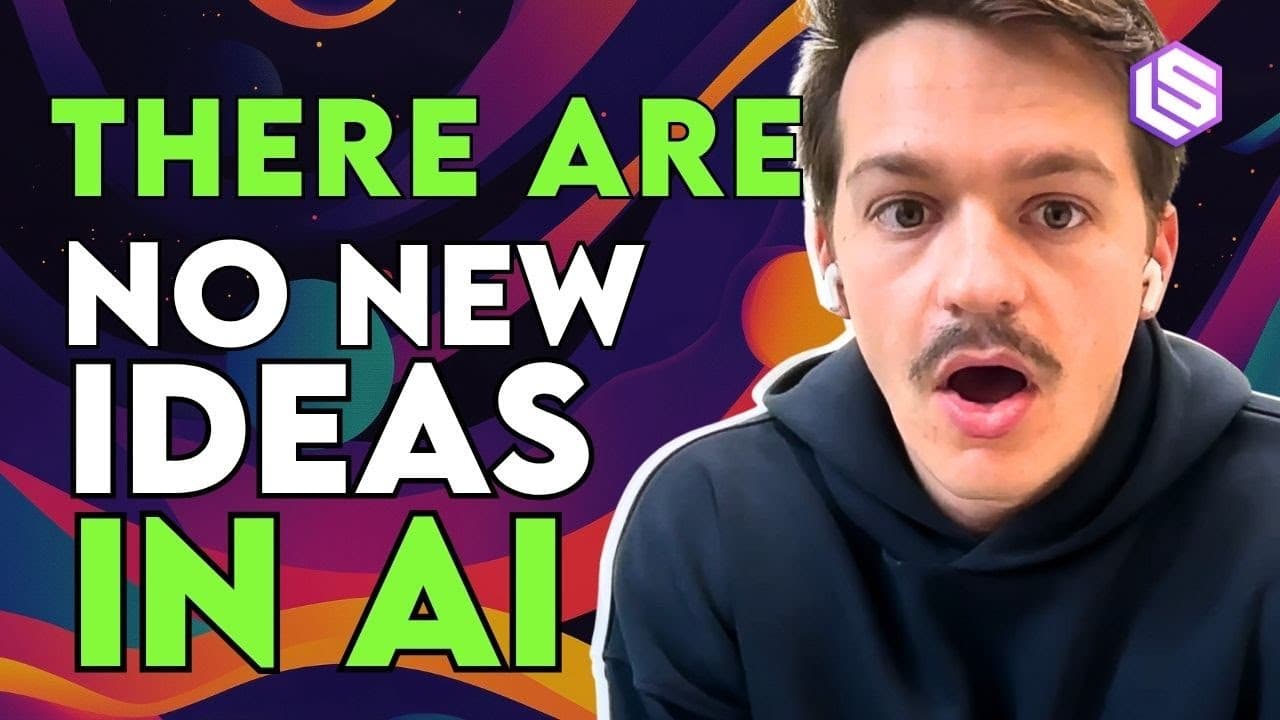
Information theory helps explain how embeddings and latent spaces relate to language models. The field has shifted from small to large scale models and from academic emphasis to industry products, affecting how research is conducted and what questions are asked. The talk also covers practical aspects of training, distributed computing, and how researchers adapt to rapid paradigm shifts.
Transcript
Hello, this is L in space just switch today with uh our special guest Jack Morris I guess from Colombia. That's your affiliation right now? Cornell. It's actually confusing because I go I'm in a the New York City outpost of of Cornell. So you have the city, right? But it's Cornell Tech, which is like a small uh Cornell campus in New York. I just y... Read More
Key Insights
- Information theory helps interpret language model embeddings and latent space representations, connecting theory to practical model behavior.
- The scale of models changes what is learnable, enabling knowledge like world capitals and presidents to emerge at larger parameter counts.
- The shift from academia to industry in AI research was accelerated by products such as ChatGPT and by the availability of consumer level interest.
- Research questions now span data, evaluation, and training schemes, not just model architecture, due to new capabilities and constraints.
- Distributed training becomes essential as models grow to billions of parameters, yet graduate programs often do not provide formal HPC training.
- Researchers often learn multi-node training techniques informally through online resources and collaboration, highlighting a gap in formal education.
- Jumping on new paradigm shifts quickly can be advantageous for research relevance, but it may not always be the best scientific approach for long term inquiry.
- Embeddings research and latent space geometry are described as important areas that can be pursued without necessarily following hottest trends in agents or benchmarks.
- More videos from this channel:
- More from this channel: Latent Space
Install to Summarize YouTube Videos and Get Transcripts
Explore YouTube Video Summarizer or Get YouTube Transcript Extractor
Questions & Answers
Q: What is information theory in the context of language models?
Information theory in language models provides a framework to understand how information is represented and transformed inside embeddings and latent spaces. It helps explain why certain representations emerge as models scale up, and how these representations relate to the model's ability to memorize facts, transfer knowledge, and perform reasoning tasks. This perspective guides how researchers analyze representations beyond superficial performance metrics.
Q: How has model scale affected what researchers can study?
As models reach billions of parameters, the model acquires richer world knowledge, such as capitals and presidents, enabling new lines of inquiry about emergent capabilities and representation quality. Scale changes what is feasible to study, shifting focus from small parameter benchmarks to understanding how large-scale representations encode information and how to train and fine-tune such models effectively.
Q: What impact did ChatGPT have on AI research directions?
ChatGPT brought consumer level interest into AI, changing the questions researchers ask and the visibility of AI capabilities. It signaled a shift from purely academic inquiries to questions about productization, data choices, evaluation methods, and training regimes, as researchers and companies respond to rapid demand for usable AI systems.
Q: Why is there a shift from open to non open research in AI?
The rise of practical AI products and commercial incentives has led to more research moving into industry settings where data, compute, and deployment constraints are central. This shift affects what questions are asked, what data is accessible, and how research is validated, influencing the balance between open academic work and proprietary development.
Q: What training challenges do grad students face with large-scale models?
Grad students often lack formal training in multi-node distributed training and GPU cluster management. They typically learn through online resources and peer collaboration rather than coursework. This gap can slow progress on large-scale experiments, necessitating reliance on external tools, communities, and company partnerships for practical HPC skills.
Q: What practical resources were recommended for learning distributed training?
The speaker suggests using the GPU mode Discord where the PyTorch team offers help and the Fast AI community for distributed training guidance. Additionally, contacting teams like the DeepSpeed group at Microsoft can be helpful, as they are accessible and can provide technical support for scaling training across multiple GPUs or nodes.
Q: What is the strategic advice for younger grad students in AI today?
A pragmatic strategy is to wait for the next paradigm shift and then move quickly to reimplement and explore the new approach. This approach prioritizes staying relevant in a fast changing field, testing new ideas rapidly, and keeping pace with industry developments, even if it may not be the ideal long term scientific workflow.
Q: How does information theory relate to embeddings research specifically?
Embeddings research focuses on how vector representations capture semantic and structural information about data. Information theory provides tools to quantify and compare the information content within embeddings, helping to evaluate how well these representations preserve meaning, relationships, and contextual cues, and how they support downstream tasks like retrieval and reasoning in language models.
Summary & Key Takeaways
-
In this interview, Jack Morris discusses how information theory provides a lens for understanding language model representations and embeddings, and how this perspective informs research directions in modern AI.
-
The conversation covers the evolution from small to large models, the impact of products like ChatGPT on research questions, and the changing landscape of open versus non open research in AI.
-
The host and guest explore practical training considerations, compute infrastructure, and advice for grad students navigating a fast changing field of AI research and industry opportunities.
Read in Other Languages (beta)
Share This Summary 📚
Summarize YouTube Videos and Get Video Transcripts with 1-Click
Try YouTube Summary with ChatGPT & Claude or YouTube Transcript Generator
Explore More Summaries from Latent Space 📚


Summarize YouTube Videos and Get Video Transcripts with 1-Click
Try YouTube Summary with ChatGPT & Claude or YouTube Transcript Generator