How Does Factory AI Automate Enterprise Coding?
TL;DR
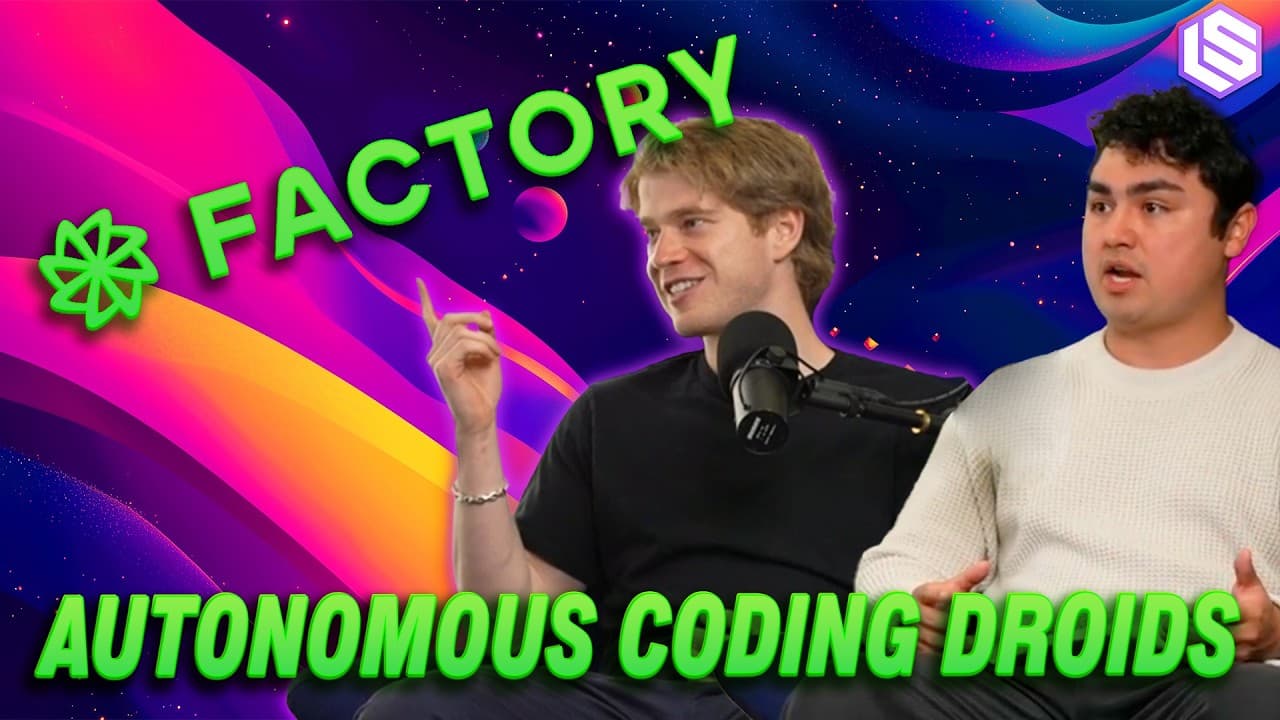
Factory AI automates enterprise coding through browser-based droids that receive delegated tasks and use project context, engineering tools, integrations, tests, and verification loops to complete work across the software development life cycle. Its scope includes code generation, migrations, refactoring, project understanding, and production incident response, including work on codebases more than 30 years old. Read on to understand its enterprise focus, founding story, and approach to autonomous engineering.
Transcript
Hey everyone, welcome to the latest space podcast. This is Allesio, partner and CTO at Desible and I'm joined by my co-host Swixs, founder of Small AI. Hey, and today we're very blessed to have both founders of Factory AI. Welcome. Thank you for having us. Thank you. Matan and Eno, my favorite story about the founding of factory is that you met at ... Read More
Key Insights
- Factory AI is focused on autonomous systems spanning the complete software development life cycle for enterprises. Its droids are intended to handle delegated engineering work beyond code generation, including large refactors, migrations, project understanding, verification, and incident response during production outages.
- The company began after Eno Reyes and Matan Grinberg met at a LangChain hackathon in 2023. Despite attending Princeton and having about 150 mutual friends, they had never held a one-on-one conversation before discovering their shared obsession with AI-assisted software development.
- Code is a foundational capability for language models because stronger coding ability can correspond with stronger performance on other tasks. Matan Grinberg also found code compelling because generated programs can be executed and evaluated against ground truth, creating a practical feedback and verification loop.
- The founders committed to Factory quickly after their initial collaboration produced encouraging progress. Within eight days of meeting, Matan Grinberg left his theoretical physics PhD path at Berkeley, while Eno Reyes left his work at Hugging Face to build the company.
- Early language models were not sufficient for fully autonomous engineering, but scaffolding made the direction promising. The founders believed a harness could connect a model with relevant information, tools, and integrations, gradually expanding the range of engineering tasks that could be automated.
- Enterprise software development is often dominated by old, complicated, and messy codebases rather than visually appealing new projects. Factory targets this underserved environment, where some developers work with systems more than 30 years old and where successful automation can provide substantial practical value.
- Delegation is different from collaboration because the developer assigns tasks to autonomous systems instead of using AI only to write individual lines faster. Factory views this workflow as the enterprise objective, while many existing coding tools remain centered on incremental assistance within an IDE.
- A browser-based platform avoids some constraints associated with local, IDE-centered assistants. The founders identify latency, low-priced consumer plans, and restricted inference budgets as factors that can limit the quality and volume of model computation devoted to producing each engineering outcome.
Install to Summarize YouTube Videos and Get Transcripts
Explore YouTube Video Summarizer or Get YouTube Transcript Extractor
Questions & Answers
Q: How does Factory AI automate enterprise software development?
Factory AI uses autonomous systems called droids to perform delegated work across the software development life cycle. The droids combine model reasoning with project context, tools, integrations, clarification, testing, and verification. Their stated scope extends from code generation and refactoring to migrations and production incident response.
Q: What is the difference between delegation and collaboration in AI coding?
Collaboration keeps developers closely involved while an AI assistant helps them write code or complete actions within their existing workflow. Delegation means assigning an entire engineering task to an autonomous system and then managing the outcome. Factory views delegation as the enterprise objective rather than only helping developers write individual lines 15% or 20% faster.
Q: Why does Factory AI focus on enterprise codebases?
Factory targets enterprises because many developers maintain complicated, aging codebases rather than starting visually impressive projects from scratch. Some of these systems are more than 30 years old and can be messy or difficult to understand. The founders believe automating work in this environment can provide substantial practical value.
Q: Why is code generation suitable for autonomous AI systems?
Generated code can be executed and checked against concrete outcomes, giving an autonomous system a practical feedback and verification loop. Matan Grinberg considered this ability to evaluate output against ground truth especially important. He also described coding capability as fundamental to language-model performance across downstream tasks.
Q: How did Eno Reyes and Matan Grinberg start Factory AI?
Eno Reyes and Matan Grinberg met at a LangChain hackathon in 2023 after attending Princeton and sharing about 150 mutual friends without previously having a one-on-one conversation. Their discussion quickly turned to code generation, followed by roughly 72 hours of building together. Within eight days, Grinberg left his theoretical physics PhD path at Berkeley and Reyes left his work at Hugging Face to build Factory.
Q: Why did Factory AI begin before models could engineer autonomously?
The founders acknowledged that the available models were not sufficient for fully autonomous engineering. Their early work indicated that a surrounding harness could provide the integrations, context, and information used by human engineers. They expected improvements in reasoning, context capacity, capability, and cost efficiency to expand the range of tasks that could be automated.
Q: Why is Factory AI browser-based instead of centered on an IDE?
Factory's founders argue that IDEs were designed primarily for humans writing code, making them naturally suited to collaborative assistance. They also identify latency, low-priced consumer plans, and restricted inference budgets as constraints on local IDE products. A browser-based platform gives Factory more freedom to design around autonomous delegation and devote more computation to each engineering outcome.
Q: How do testing and project context improve Factory AI's droids?
Project context gives droids the information and integrations that human engineers use when working on a codebase. Testing and verification let the system execute generated code and compare the result with concrete outcomes. Together, these capabilities support an autonomous loop that goes beyond producing unverified text.
Summary & Key Takeaways
-
Factory AI began after Eno Reyes and Matan Grinberg met at a LangChain hackathon in 2023. Although they had attended Princeton and shared about 150 mutual friends, they had never spoken individually. Their shared interest in code generation led to intense collaboration, and they committed to the company within eight days.
-
The founders saw code as an unusually valuable AI domain because generated results can be executed and checked against concrete outcomes. They expected models to improve in reasoning, context capacity, capability, and cost efficiency. Their early work therefore concentrated on constructing a harness that could supply models with the information and integrations used by engineers.
-
Factory focuses on autonomous systems for enterprise software development rather than only helping individual developers create new projects. Its browser-based droids support a delegative workflow across complex, aging codebases and broader engineering operations. The product vision includes project understanding, clarification, testing, verification, migrations, refactoring, observability, and production incident response.
Read in Other Languages (beta)
Share This Summary 📚
Summarize YouTube Videos and Get Video Transcripts with 1-Click
Try YouTube Summary with ChatGPT & Claude or YouTube Transcript Generator
Explore More Summaries from Latent Space 📚


Summarize YouTube Videos and Get Video Transcripts with 1-Click
Try YouTube Summary with ChatGPT & Claude or YouTube Transcript Generator