The Origin and Future of RLHF: the secret ingredient for ChatGPT - with Nathan Lambert
TL;DR
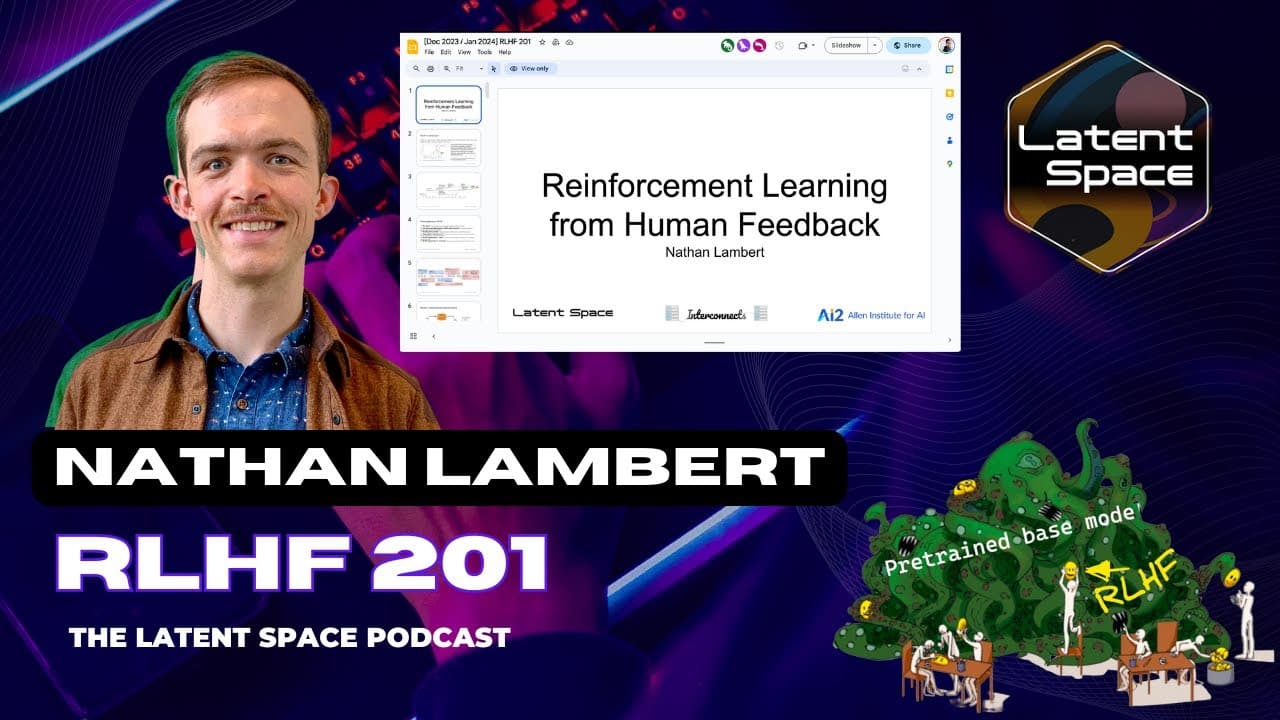
This analysis provides insights into reinforcement learning from human feedback, including instruction tuning, preference data collection, and optimization through the Bradley Terry model.
Transcript
hey everyone welcome to the laden space podcast this is Celestial partner and CTO and residents and deible partners and I'm joined by my co-host swix founder of small AI hey and today we have Dr Nathan Lambert in the house welcome thanks guys uh you are you didn't have to come too far you got your PhD in Berkeley and uh it seems like you've you've ... Read More
Key Insights
- 🪡 Instruction tuning is a crucial step in adapting language models to specific needs and improving their performance.
- ❓ Preference data is collected by comparing model responses and selecting the preferred one, often using the Bradley Terry model.
- 👌 Reinforcement learning optimization involves training a model to generate responses that maximize a reward signal, subject to constraints like the K-divergence.
- 🇨🇷 Synthetic data generated by language models like GPT-4 provides a cost-effective and scalable solution for preference data collection.
- 🦺 Companies and researchers are exploring methods to incorporate safety and other considerations in reinforcement learning from human feedback.
- 👨🔬 The depreciation of preference data and the challenges of aggregating diverse human preferences are ongoing areas of research.
- 🖐️ Language model evaluators play a crucial role in providing feedback and evaluating model responses.
Install to Summarize YouTube Videos and Get Transcripts
Explore YouTube Video Summarizer or Get YouTube Transcript Extractor
Questions & Answers
Q: What is instruction tuning and how does it improve the performance of a language model?
Instruction tuning involves adapting a language model to specific needs by training it to follow instructions and generate desired responses. This process enhances the model's comprehensibility and improves its performance in fulfilling given tasks.
Q: How is preference data collected in reinforcement learning from human feedback?
Preference data is collected by presenting human evaluators with two model responses and asking them to select the preferred one. This data is used to train the model to generate responses that align with human preferences.
Q: What is the Bradley Terry model, and how is it used in reinforcement learning?
The Bradley Terry model is a pairwise preference model used in reinforcement learning. It assigns a probability to the chosen completion being better than the rejected completion, which correlates with the reward. This model is used to compare and rank different model responses based on user preferences.
Q: How does reinforcement learning optimization work in the context of language models?
Reinforcement learning optimization aims to train a language model to generate responses that maximize a reward signal. This is done by iteratively updating the model's parameters to improve its performance in generating desirable responses, while ensuring it does not deviate too much from the primary model.
Summary & Key Takeaways
-
Instruction tuning is the process of adapting a language model to specific needs, improving its comprehensibility and performance.
-
Preference data collection involves comparing two model responses and selecting the preferred one, often using the Bradley Terry model.
-
Reinforcement learning optimization aims to maximize reward by training a model to generate desirable responses, subject to constraints like the K-divergence.
Read in Other Languages (beta)
Share This Summary 📚
Summarize YouTube Videos and Get Video Transcripts with 1-Click
Try YouTube Summary with ChatGPT & Claude or YouTube Transcript Generator
Explore More Summaries from Latent Space - The AI Engineer Podcast (Video Podcast) 📚




Summarize YouTube Videos and Get Video Transcripts with 1-Click
Try YouTube Summary with ChatGPT & Claude or YouTube Transcript Generator