What is ARC AGI V3 interactive benchmark design?
TL;DR
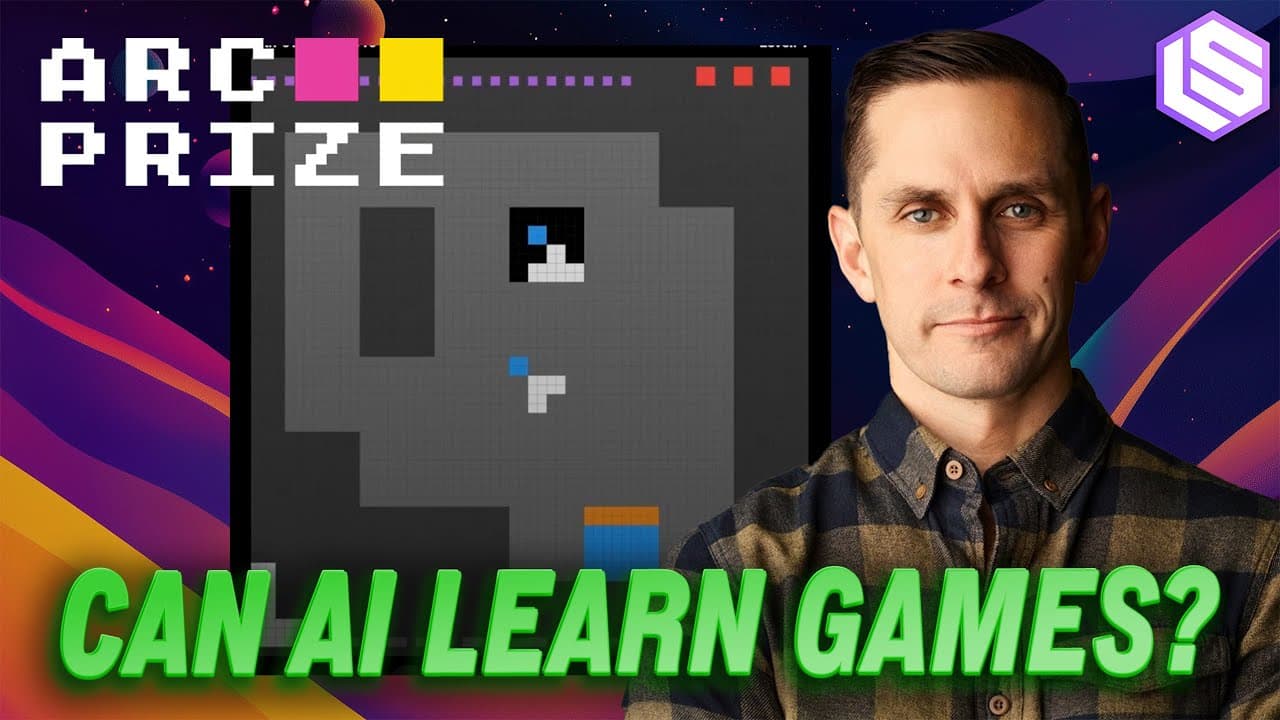
ARC AGI Foundation positions benchmarks as the northstar of AGI and argues a good benchmark must measure ability to learn new tasks efficiently. RKGI3 adds 100 novel interactive environments to stress generalization, energy cost, and training data needs, plus a 30-day agent competition and a $10,000 prize to reward progress.
Transcript
Hey everyone, welcome to another latest in space learning pod. This is Allesio, partner and CT at Desible and I'm joined by Spix, founder of Small AI. Hello. Hello. We are just all recovering from the Grog 4 live stream. Uh and and uh we're so happy to have Greg Comrade from the ARC AGI Foundation. Is that is that the full name of it? That's exactl... Read More
Key Insights
- ARC AGI defines intelligence as the ability to learn new things and generalize across tasks, with efficiency measured by energy use and data requirements.
- Benchmark design is crucial because it shapes research directions and incentives toward generalizable intelligence.
- RKGI3 shifts from static tests to interactive environments, arguing that real intelligent behavior emerges when agents operate in dynamic settings.
- The proposed 100 novel environments are simple for humans but challenging for AI, highlighting the gap in current generalization capabilities.
- Energy cost and training data scale are core denominators in measuring intelligence, tying biological learning to machine learning efficiency.
- The benchmark ecosystem includes an open platform and an agent competition to accelerate progress and compare approaches.
- ARC AGI aims to be a nonprofit northstar that coordinates research efforts around general intelligence rather than isolated capabilities.
- The roadmap includes previews of platforms and ongoing expansion of benchmarks to keep pace with evolving AI capabilities.
Install to Summarize YouTube Videos and Get Transcripts
Explore YouTube Video Summarizer or Get YouTube Transcript Extractor
Questions & Answers
Q: What is ARC AGI and why is it important for AI research?
ARC AGI is described as a nonprofit aiming to act as the northstar toward AGI by building benchmarks that define and incentivize progress toward general intelligence. The emphasis is on creating measures that reflect a system’s ability to learn new tasks and generalize, rather than excelling at a single predefined task. This approach is intended to guide research and reward broader, transferable capabilities across domains.
Q: How does ARC AGI define intelligence in their framework?
Intelligence is defined as the ability to learn new things and generalize to unseen tasks efficiently. Efficiency is measured by the energy required to learn and the amount of training data needed. This framing contrasts with task-specific performance and seeks to reward systems that adapt to new challenges with minimal resources.
Q: What role do energy and training data play in ARC AGI’s metrics?
Energy cost and training data requirements are the two denominators in ARC AGI’s definition of intelligence. They serve to quantify learning efficiency, allowing comparison between human and machine learning processes. This framing helps assess how quickly and cheaply a system can acquire new capabilities.
Q: What is RKGI3 and how is it different from previous benchmarks?
RKGI3 is a new phase that introduces 100 novel interactive environments or games designed to test generalization in a human-friendly way. Unlike static benchmarks, RKGI3 emphasizes interaction, exploration, and long-horizon planning to better capture intelligent behavior in real-world settings.
Q: Why are interactive benchmarks considered essential for AGI progress?
Interactive benchmarks are believed to be essential because they simulate real-world dynamics, requiring agents to understand goals, plan, and adapt over time. This contrasts with static tests, where outcomes can be optimized through narrow strategies. The interactive format is argued to be closer to the conditions under which true general intelligence would emerge.
Q: What is the prize structure mentioned for ARC AGI initiatives?
The description notes a $10,000 prize associated with the RKGI challenges, intended to reward progress and participation in developing and testing agents within the new interactive benchmark framework. The prize acts as an incentive for teams to contribute and compete using the RKGI3 environments.
Q: What does ARC AGI hope to achieve with the RKGI platform?
ARC AGI aims to provide a platform and roadmap that accelerates progress toward general intelligence by defining clear targets, releasing interactive environments, and enabling a fair comparison of approaches. The long-term goal is to align incentives with building systems that can learn efficiently across varied tasks and environments.
Q: How does ARC AGI view the relationship between benchmarks and real-world AI capabilities?
ARC AGI argues benchmarks should represent a northstar that directs research toward general, transferable intelligence rather than optimizing for narrow tasks. By focusing on learning efficiency, energy use, and data requirements, benchmarks like RKGI3 seek to reflect how AI would perform in more realistic, dynamic settings similar to real-world use cases.
Summary & Key Takeaways
-
ARC AGI positions benchmarks as a guiding target for AGI research and emphasizes measurable general learning ability over single-task performance.
-
RKGI3 introduces interactive environments and a potential platform for evaluating agents in novel tasks with real-time interaction.
-
The initiative includes a 30-day competition and a $10,000 prize to incentivize participation and progress in interactive benchmarking.
Read in Other Languages (beta)
Share This Summary 📚
Summarize YouTube Videos and Get Video Transcripts with 1-Click
Try YouTube Summary with ChatGPT & Claude or YouTube Transcript Generator
Explore More Summaries from Latent Space 📚




Summarize YouTube Videos and Get Video Transcripts with 1-Click
Try YouTube Summary with ChatGPT & Claude or YouTube Transcript Generator