How to Reduce Fable 5 API Costs With Images
TL;DR
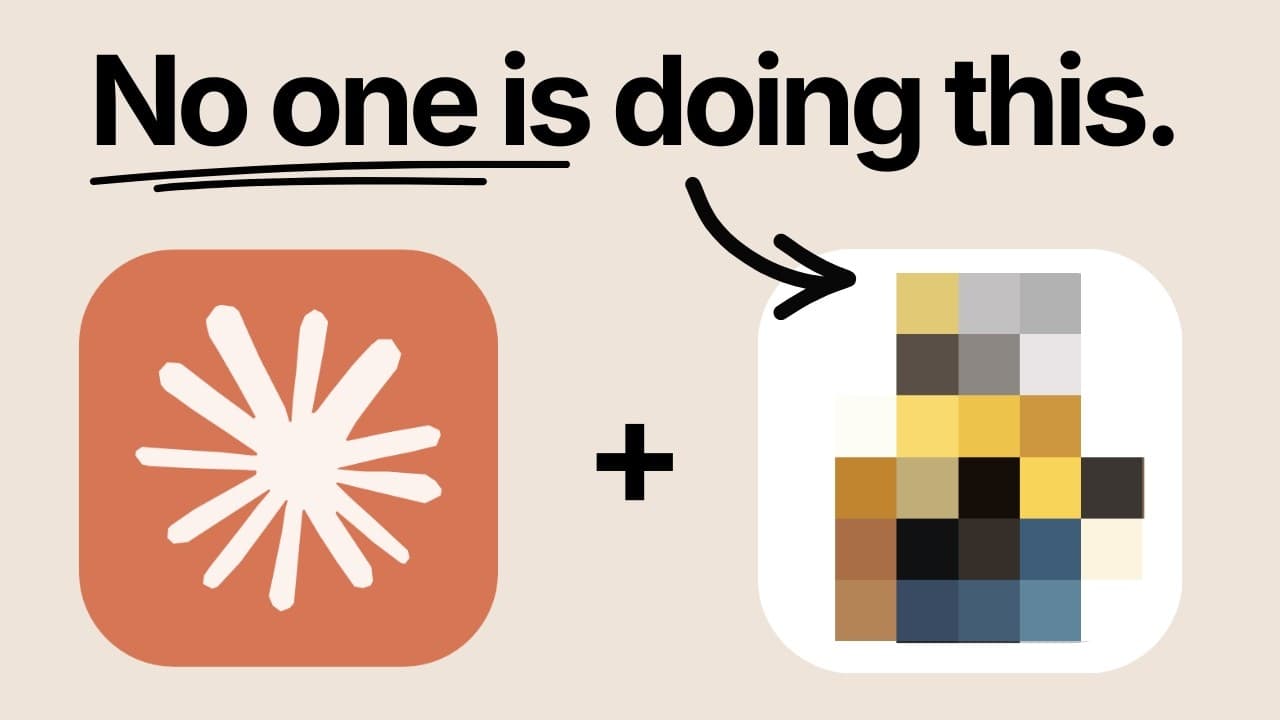
Convert very long text prompts into compact, legible images before submitting them to Fable 5, because image billing is based on pixel dimensions rather than the amount of visible text. The demonstrated tests reported input-token reductions of 30% to 68.7% and a cost reduction as high as 59%, with no observed recall difference in the initial comparison.
Transcript
got a really fun fable usage optimization hack. Takes like 30 seconds and it saves approximately 30% of all Fable usage with next to no downsides. Check this out. So, I'm going to include this down below. You guys can download this and use this in one click. But to make a long story short, this allows you to cut Claude codes input tokens by renderi... Read More
Key Insights
- The optimization works by rendering lengthy textual context as compact images before sending it to Fable 5, allowing the model to process the same system prompt, tool documentation, history, or reference material through its image-reading capability.
- Image billing is described as depending on pixel dimensions rather than the quantity of text inside an image, so reducing the text size while keeping it legible can fit substantially more context into a fixed visual area.
- The initial test reduced cached token usage from 59,822 tokens for text to 38,142 tokens for images, which the presenter characterized as a little more than a 30% reduction in token usage.
- The initial comparison found no observed difference in the model's ability to recall tested components of the source text, even though the image contained highly compressed and unusually small text.
- The suggested pipeline stores a long prompt in a file, runs a Python script to convert the file into one or more images, and then supplies those images to Fable rather than submitting the original text directly.
- The technique is positioned as most useful for prompts containing hundreds of thousands of tokens that will be reused frequently or run for long periods as part of an ongoing business function.
- The knowledge-based test used a large file containing previously uploaded videos and performance information, then asked questions that required locating and combining specific details from that visualized context.
- The second head-to-head test produced a 68.7% reduction in input tokens and a reported 59% cost reduction, suggesting that extraction-heavy, needle-in-a-haystack tasks may benefit more than the initial example.
- More videos from this channel:
- More from this channel: Nick Saraev
Install to Summarize YouTube Videos and Get Transcripts
Explore YouTube Video Summarizer or Get YouTube Transcript Extractor
Questions & Answers
Q: How can images reduce Fable 5 API input costs?
Long text can be rendered as very small but legible text inside images and then supplied to Fable 5 as visual context. The transcript says an image's token cost is fixed by its pixel dimensions rather than by how much text appears inside it. This creates a pricing difference that can reduce input-token usage while retaining the prompt information for optical character recognition.
Q: What cost savings did the image prompt tests produce?
The initial demonstration reported a text-prompt cost of $1.3 and stated that the image prompt cost 69, with the unit not clarified in the transcript. Cached tokens fell from 59,822 to 38,142, described as a reduction of more than 30%. A later knowledge-based test reported 68.7% fewer input tokens and a 59% reduction in cost.
Q: How do you build the text-to-image prompt pipeline?
The demonstrated architecture accepts a long prompt, stores it in a file, and runs a script that renders the text into an image before passing that image to Fable. The generated script is identified as pxpipe.py. The presenter asked Fable itself to examine the referenced repository and build the pipeline, with the goal of enabling one-step conversion of extremely long prompts.
Q: When is image-based prompt compression most useful?
Image-based prompt compression is presented as most useful for extremely long prompts, including inputs containing hundreds of thousands of tokens, especially when the same context will run for a long time or be reused frequently for a business function. The presenter says it may not be worthwhile for every query, but it can produce larger savings for extraction-heavy, needle-in-a-haystack tasks.
Q: Does converting prompt text to images reduce recall quality?
The initial head-to-head test found zero observed difference in Fable's ability to recall the components that were tested. The presenter attributes this result to the model's optical character recognition and its ability to understand very small text. This is a report about the demonstrated tests, not a claim that every font size, image layout, or task will preserve recall equally.
Q: What image characteristics make the strategy economical?
The strategy depends on placing a large amount of text into an image with fixed pixel dimensions while keeping every character legible enough for Fable to interpret. The demonstration discusses a 1928 by 1928 image and shows compressed text that can be inspected by zooming in. The presenter also suggests that layout improvements, such as justifying the text, could optimize the image further.
Q: What kind of data was used in the larger test?
The larger test used a massive text file containing every video the presenter said he had uploaded, along with some performance information. Equivalent image versions were created, and Fable was asked questions about strategies, individual members, and patterns within that knowledge. Because the task emphasized finding and combining isolated details, it served as a needle-in-a-haystack comparison between text and image inputs.
Q: What are the limitations of this token-reduction method?
The transcript identifies several practical limits. The text must remain legible even when compressed, the method is not proposed for every query, and its value is greatest for unusually large or repeatedly used prompts. The presenter also expects the billing difference to be patched quickly. Results varied between demonstrations, with the first showing more than 30% token reduction and the later test showing larger savings.
Summary & Key Takeaways
-
The proposed optimization converts bulky prompt context, including system prompts, tool documentation, and conversation history, into small but legible text rendered inside images. Because the described image charge depends on pixel dimensions rather than text density, this approach can reduce billed input tokens while preserving the information available to Fable 5.
-
The first comparison reported that the text prompt cost $1.3, while the image version cost 69, as stated in the transcript. Cached token usage fell from 59,822 to 38,142, which the presenter described as a reduction of more than 30%, with no observed difference in recalling tested details.
-
A Python pipeline called pxpipe.py stores long prompts in files, renders their contents as images, and submits those images to Fable 5. In a knowledge-based, needle-in-a-haystack test using archived video and performance data, the presenter reported 68.7% fewer input tokens and a 59% cost reduction.
Read in Other Languages (beta)
Share This Summary 📚
Summarize YouTube Videos and Get Video Transcripts with 1-Click
Try YouTube Summary with ChatGPT & Claude or YouTube Transcript Generator
Explore More Summaries from Nick Saraev 📚





Summarize YouTube Videos and Get Video Transcripts with 1-Click
Try YouTube Summary with ChatGPT & Claude or YouTube Transcript Generator