How to Build an Automated LinkedIn Outreach System
TL;DR
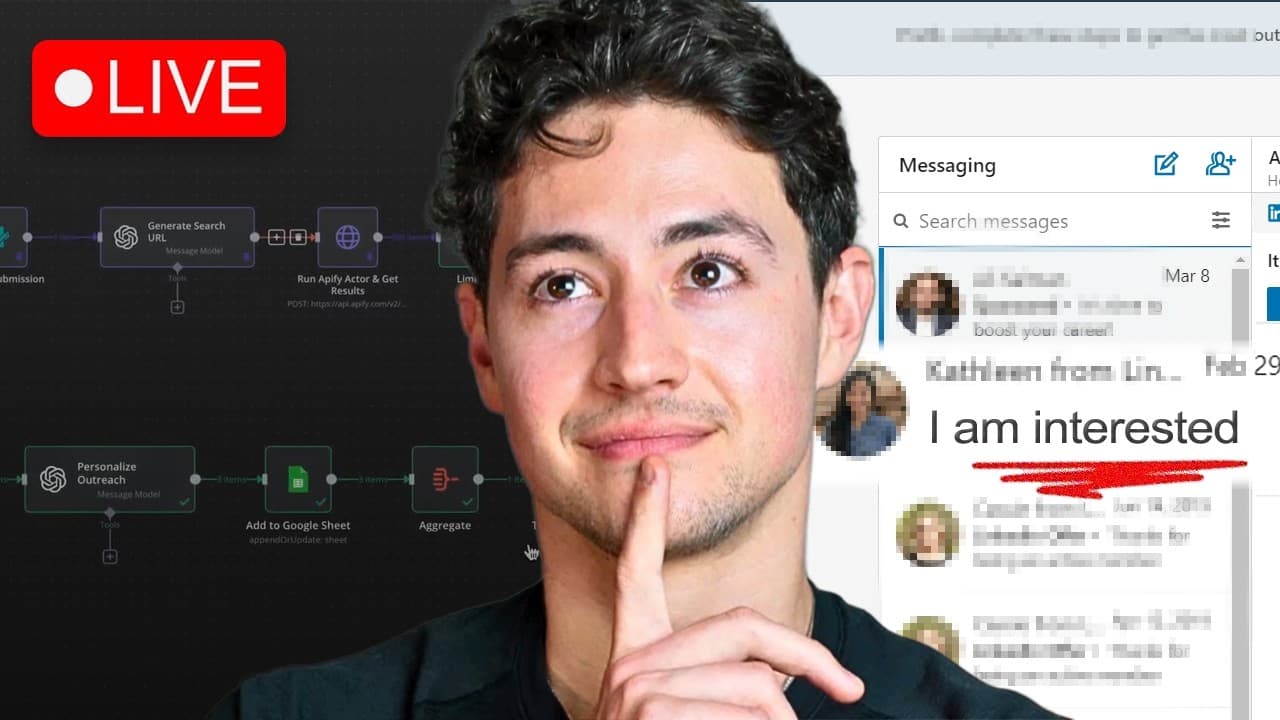
The video shows how to build an automated LinkedIn outreach workflow using n8n, Apollo, Apify, and Phantom Buster. It enriches leads with AI generated personalizations, stores data in Google Sheets, and automates connection requests and follow ups, all while testing the workflow end to end.
Transcript
hey everybody today I'm going to show you how to build your very own LinkedIn Outreach system in naden this video is perfect for anybody that wants to automate their LinkedIn Outreach with a system that creates a targeted lead list in Apollo using just natural language enriches those leads with detailed profile data uses AI to generate personalized... Read More
Key Insights
- Lead search parameters are defined in plain language to generate a targeted Apollo URL automatically.
- An App.online style scraper (Apify) is used to extract leads from Apollo and retrieve emails and profiles.
- AI is used to personalize messages by combining lead data with generated icebreakers.
- A limit node is used to control API calls during testing to prevent overwhelming services.
- A Google Sheet acts as the central database for IDs, names, titles, URLs, email status, and icebreakers.
- Phantom Buster integrates with Google Sheets to execute LinkedIn DMs and track status.
- The system is demonstrated end to end but not yet fully built, highlighting real world development challenges.
- The overall flow is Apollo leads > Apify scrape > AI personalization > Google Sheets storage > Phantom Buster sending DMs.
- More videos from this channel:
- More from this channel: Nick Saraev
Install to Summarize YouTube Videos and Get Transcripts
Explore YouTube Video Summarizer or Get YouTube Transcript Extractor
Questions & Answers
Q: How does the video propose generating Apollo search URLs automatically?
The video shows a form that defines search parameters in plain English and an AI system that generates a large Apollo search URL from those parameters. This URL is then used to pull a targeted list of decision makers within a specified audience, enabling scalable lead collection without manual keyword crafting.
Q: What role does Apify play in the workflow?
Apify is used as an autonomous scraping tool to process the Apollo search URL and identify individual leads. It extracts key data such as emails and adds additional profile information. This step is essential to assemble a rich dataset that can be used for personalization and outreach automation.
Q: How is AI used to personalize outreach messages?
AI is employed to create customized icebreakers and outreach messages by analyzing lead data such as location, title, and interests. The system feeds this data into an AI model to output natural sounding, personalized messages that are more likely to engage the recipient without sounding generic.
Q: What is the function of the Google Sheets database in this setup?
Google Sheets acts as the central logging and workspace for the campaign. It stores the LinkedIn ID, first and last names, full name, LinkedIn URL, title, email status, photo URL, and the generated icebreaker. The sheet then feeds data to Phantom Buster for message execution.
Q: How does Phantom Buster fit into the process?
Phantom Buster is used to perform the actual LinkedIn outreach actions. It can simulate human activity to send connection requests and messages based on the data provided in the Google Sheet. This enables automated publishing of outreach steps while maintaining a human-like interaction pattern.
Q: Why does the speaker emphasize live builds over finished products?
The speaker stresses live builds to reveal the actual development process, including detours and testing challenges. This approach helps viewers understand practical constraints, decision points, and the iterative nature of creating functional automation that can generate revenue, rather than presenting a polished, non-reproducible end product.
Q: What safeguards are demonstrated when testing the workflow?
A limit node is shown to throttle API calls during testing, preventing API overload and potential account restrictions. This demonstrates responsible testing practices and helps ensure that the automation can scale safely before full deployment.
Q: What is the end-to-end flow of the outreach system as described?
The end-to-end flow starts with defining search parameters to generate an Apollo URL, uses Apify to scrape leads and gather emails, enriches data with AI-generated personalization, stores everything in Google Sheets, and finally triggers Phantom Buster to send LinkedIn DMs. The process is designed to be repeatable and scalable while staying testable.
Summary & Key Takeaways
-
The video walks through creating an outreach pipeline that starts with a natural language lead search and ends with automated LinkedIn messages, using a mix of tools to scrape and enrich data, then trigger Phantom Buster to send DMs.
-
The presenter emphasizes showing the live build process with detours and adjustments rather than a finished product, to illustrate practical automation development for money-making systems.
-
The workflow logs lead data in Google Sheets, uses an AI model to generate icebreakers, and automates outreach through Phantom Buster, aiming for scalable, semi autonomous outreach while acknowledging safeguards and testing steps.
Read in Other Languages (beta)
Share This Summary 📚
Summarize YouTube Videos and Get Video Transcripts with 1-Click
Try YouTube Summary with ChatGPT & Claude or YouTube Transcript Generator
Explore More Summaries from Nick Saraev 📚





Summarize YouTube Videos and Get Video Transcripts with 1-Click
Try YouTube Summary with ChatGPT & Claude or YouTube Transcript Generator