How to Fine-Tune OpenAI Models Without Code Using ChatGPT
TL;DR
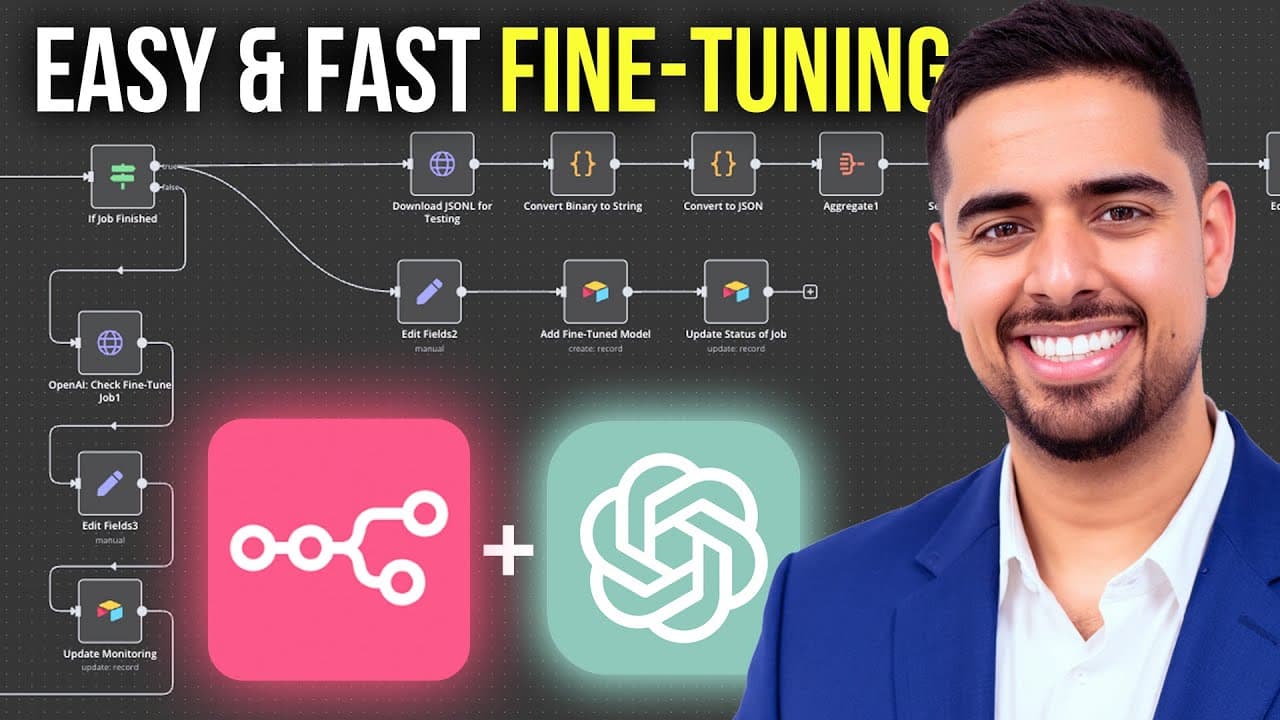
Fine-tuning becomes accessible by using a two-method approach. First, generate JSONL data with ChatGPT and fine-tune in the OpenAI Playground; second, use Airtable with n8n to monitor training in real time and run automated tests. You will learn JSONL basics, epochs, batch sizes, and how to validate improvements.
Transcript
fine-tuning opening ey models used to feel like launching a rocket super complex and daunting but today I'm going to show you a ridiculously easy way to fine-tune custom models in minutes with zero code if you've never heard of fine-tuning think of it as giving a model a PhD in a specific area instead of just having a master's degree in everything ... Read More
Key Insights
- JSONL is a line-delimited JSON format used for training data and is preferred for fine tuning because it keeps every component on a single line for clarity.
- The two main methods are designed to be approachable; the first focuses on quick setup with ChatGPT data generation, while the second adds real-time monitoring and testing through Airtable and n8n.
- Validation of the training file is important to ensure correct structure, and the OpenAI Playground can be used to start the fine tuning after a successful upload.
- Fine tuning requires multiple examples to be effective, with a recommended range of about 50 to 75 examples to achieve a strong signal for the model.
- Model selection matters; for large JSONL datasets, smaller models like 03 mini high or 03 mini can work better for handling output and context requirements.
- The process includes creating a new model in the playground after training, which can then be interacted with to test brand voice or domain-specific behavior.
- Testing prompts should reflect the target tasks and desired responses to clearly measure improvement versus the baseline model.
- A well-constructed prompt structure uses roles (system, user, assistant) to guide responses and helps generate consistent training data for better fine-tuning outcomes.
- More videos from this channel:
- More from this channel: Mark Kashef
Install to Summarize YouTube Videos and Get Transcripts
Explore YouTube Video Summarizer or Get YouTube Transcript Extractor
Questions & Answers
Q: What is the basic idea behind JSONL for fine tuning and why is it preferred over plain JSON in this workflow?
JSONL, or JSON Lines, stores each training example on its own line, making it easy to stream, validate, and process large datasets. This format reduces parsing complexity, supports incremental additions, and aligns with many machine learning data pipelines. In a fine-tuning workflow, JSONL helps ensure consistent structure across examples so the model can learn from clearly defined user prompts and ideal responses without syntactic errors.
Q: How do the two methods differ in terms of setup and visibility of training progress?
The first method emphasizes speed and simplicity by generating training data with ChatGPT and running the fine tuning directly in the OpenAI Playground, providing immediate results with minimal setup. The second method adds visibility by integrating Airtable with n8n to monitor training in real time, track outputs, and run automated tests to compare new model performance against the baseline.
Q: Why is it recommended to have 50 to 75 examples for fine tuning in this guide?
Having 50 to 75 examples provides enough coverage of the target task and voice to give the model a robust signal for learning. Too few examples may lead to overfitting to the limited data, while too many can increase training time and complexity. This range balances practicality with effectiveness for most business use cases.
Q: What are the key concepts like epochs and learning rate multipliers that the video explains, and why do they matter?
Epochs determine how many times the training data is passed through the model, affecting convergence and learning stability. Learning rate multipliers adjust how aggressively the model updates its weights during training. Understanding these factors helps you tune training behavior to achieve better generalization and faster convergence without overshooting optimal parameters.
Q: How does the Airtable and n8n workflow enhance the fine-tuning process?
Airtable serves as a centralized data store and dashboard for training data, while n8n automates workflow tasks such as triggering tests, collecting outputs, and updating progress. This combination gives clear, real-time visibility into training status, enabling quicker iteration and more reliable validation of improvements over the baseline model.
Q: What is the role of the system, user, and assistant prompts in generating training data for fine tuning?
The prompts provide a structured template that defines the desired behavior of the assistant, the tasks to perform, and the expected responses. By consistently applying a system message to set the context, user messages to pose tasks, and assistant messages as ideal outputs, you create high-quality, repeatable training pairs that help the model learn a specific voice or style.
Q: What do you do after you finish a JSONL file to start the fine-tune in the OpenAI Playground?
After generating the JSONL file you save it with the proper file name and extension, then upload it to the OpenAI Playground as the training data for fine tuning. You verify the structure, ensure the file is valid, and initiate the training process. The Playground will then produce a new model variant with a unique suffix you can use for testing and deployment.
Q: What is the expected outcome once the fine-tune process completes in the Playground?
The expected outcome is a brand new model derived from the base model, configured with the training data to reflect the custom voice or behavior. You can then interact with this fine-tuned model in the Playground or via API, testing prompts to confirm it responds in the targeted style and handles the specified tasks effectively.
Summary & Key Takeaways
-
This section explains a no-code method to generate training data with ChatGPT and upload it to OpenAI for fine tuning, plus how to validate the results. It emphasizes JSONL formatting and practical steps to create a usable dataset. The goal is to make fine tuning approachable and repeatable.
-
The second method introduces a real-time monitoring workflow using Airtable and n8n to track training progress, outputs, and tests. It provides a hands-on, end-to-end workflow for observing improvements and comparing model behavior.
-
The video covers core concepts like JSONL structure, epochs, batch sizes, and learning rate multipliers in plain terms, with examples and practical tips for applying these ideas to brand voice or business use cases.
Read in Other Languages (beta)
Share This Summary 📚
Summarize YouTube Videos and Get Video Transcripts with 1-Click
Try YouTube Summary with ChatGPT & Claude or YouTube Transcript Generator
Explore More Summaries from Mark Kashef 📚

Summarize YouTube Videos and Get Video Transcripts with 1-Click
Try YouTube Summary with ChatGPT & Claude or YouTube Transcript Generator