How to Automate Meeting Prep with AI Workflow
TL;DR
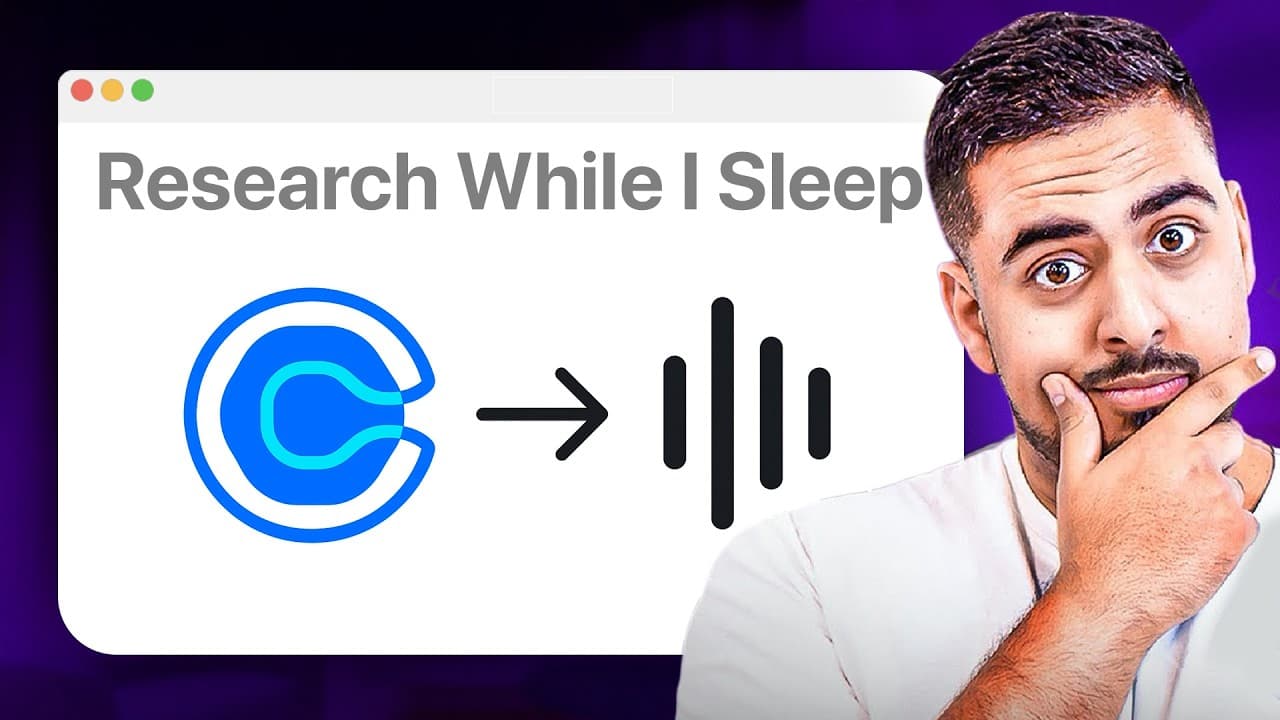
Automate your meeting preparation by using an n8n workflow that transforms a simple booking into an AI-generated voice note with personalized insights. This process captures booking data, performs deep research on attendees and their companies, and synthesizes a briefing through OpenAI's models, significantly reducing prep time while enhancing meeting effectiveness.
Transcript
Imagine showing up to a meeting so well prepared that the other person is just blown away. You know their background, their company, and exactly what they care about, as if you've done hours of research. All you had to do was listen to a very short audio message generated by AI and you were good to go. In this video, I'm going to walk you through h... Read More
Key Insights
- An n8n workflow can automate meeting preparation by converting booking details into AI-generated voice notes.
- The workflow uses Calendly to capture booking information, which is then used for research.
- Perplexity API conducts deep research on the meeting attendee and their company.
- OpenAI's o3-mini model synthesizes the research into a comprehensive briefing.
- The final output is a personalized audio briefing created using OpenAI's Text-to-Speech.
- This automation dramatically reduces preparation time while enhancing meeting readiness.
- Users can customize research depth and voice options to suit different meeting styles.
- The process integrates multiple tools like Calendly, Perplexity API, and Gmail for seamless automation.
Install to Summarize YouTube Videos and Get Transcripts
Explore YouTube Video Summarizer or Get YouTube Transcript Extractor
Questions & Answers
Q: How to automate meeting preparation with AI?
Automating meeting preparation with AI involves using a workflow that captures booking information, conducts research on attendees and their companies, and synthesizes this into an audio briefing. Tools like Calendly, Perplexity API, and OpenAI's Text-to-Speech are integrated to streamline the process, significantly reducing preparation time while enhancing meeting effectiveness.
Q: What is the role of Perplexity API in this workflow?
The Perplexity API is used to conduct deep research on the meeting attendee and their company. It gathers relevant information such as professional background, company history, and recent developments. This data is crucial for generating personalized insights and questions, which are then synthesized into a briefing for the meeting.
Q: Why use OpenAI's o3-mini model in the workflow?
OpenAI's o3-mini model is used for its balance of speed and reasoning capabilities. It processes the research data to create a comprehensive and structured briefing report, which is essential for generating a coherent and informative audio briefing for the meeting. This model helps maintain a high level of efficiency without compromising on quality.
Q: How does the workflow integrate with Gmail?
The workflow integrates with Gmail by assembling the research data and audio briefing into an email package. This is done through n8n's automation, which uses the Gmail API to authenticate, format, and send the email with the briefing attached. This ensures that the user receives all necessary information in a convenient format before the meeting.
Q: What customization options are available in the workflow?
Users can customize various aspects of the workflow, including the depth of research conducted by the Perplexity API, the choice of voice for the audio briefing, and the styling of the email output. These options allow users to tailor the automation to fit different meeting styles, budgets, and personal preferences, enhancing flexibility and user experience.
Q: How does the workflow enhance meeting effectiveness?
The workflow enhances meeting effectiveness by providing users with a detailed and personalized briefing that includes insights about the attendee and their company. This preparation allows users to enter meetings with tailored talking points and questions, increasing engagement and productivity, and ultimately leading to more successful outcomes.
Q: What are the benefits of using AI for meeting preparation?
Using AI for meeting preparation offers numerous benefits, including significant time savings, improved accuracy of information, and enhanced personalization of insights. AI can quickly process large amounts of data to generate comprehensive briefings, allowing users to focus on strategic aspects of meetings rather than manual research and preparation.
Q: What tools are integrated into the n8n workflow for meeting prep?
The n8n workflow integrates several tools to automate meeting preparation, including Calendly for booking data capture, Perplexity API for deep research, OpenAI's o3-mini model for data synthesis, and OpenAI's Text-to-Speech for audio briefing generation. These tools work together seamlessly to streamline the entire preparation process.
Summary & Key Takeaways
-
The n8n workflow automates meeting preparation by transforming a Calendly booking into an AI-generated voice note. It captures booking data, conducts deep research on attendees and their companies using Perplexity API, and synthesizes a briefing with OpenAI's models. This reduces preparation time and enhances meeting effectiveness.
-
Calendly captures booking details, which are used to perform deep research on the attendee and their company. The information is processed through OpenAI's o3-mini model to create a comprehensive briefing. The final output is an audio briefing generated via OpenAI's Text-to-Speech, streamlining meeting preparation.
-
The workflow integrates tools like Calendly, Perplexity API, and Gmail to automate meeting prep. Users can customize research depth and voice options, significantly reducing prep time while ensuring they enter meetings with tailored insights and questions, enhancing overall productivity.
Read in Other Languages (beta)
Share This Summary 📚
Summarize YouTube Videos and Get Video Transcripts with 1-Click
Try YouTube Summary with ChatGPT & Claude or YouTube Transcript Generator
Explore More Summaries from Mark Kashef 📚



Summarize YouTube Videos and Get Video Transcripts with 1-Click
Try YouTube Summary with ChatGPT & Claude or YouTube Transcript Generator