How to use AI models as reality simulators for business
TL;DR
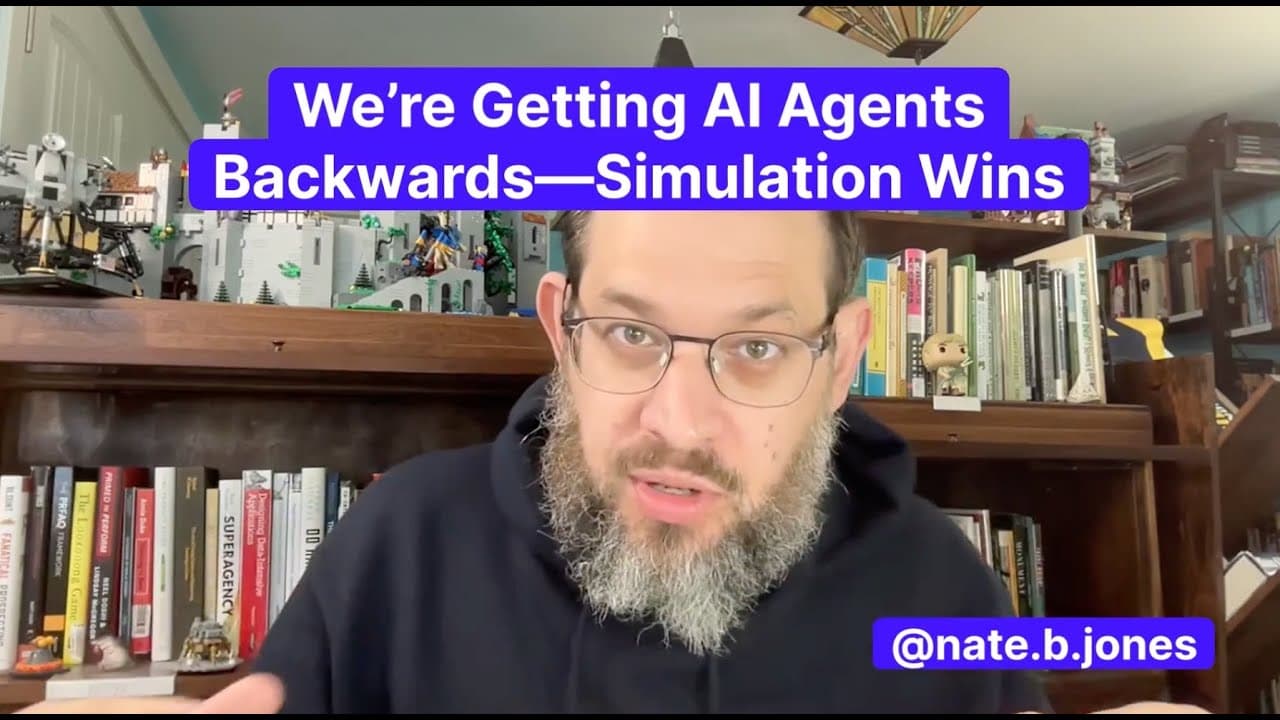
The main benefit is shifting from AI agents that execute tasks to AI agents that model and simulate reality. This enables alternate-timeline exploration and time compression to accelerate decision making. Real-world examples show substantial development and strategy gains when using digital twins and simulated worlds.
Transcript
I think we're focusing on agents at their most underleveraged point. Let me explain what I mean. Fundamentally, we are focused on AI agents as executors. AI agents as doers writing emails, answering tickets, codegen demos, and we are spending ink and we are spending pixels and we are spending tokens figuring out as a community how to get AI agents ... Read More
Key Insights
- AI agents can be used as modelers, not just executors, by adding a reality simulator to the stack.
- Alternate-timeline exploration lets you test multiple future scenarios before committing resources.
- Time compression through simulation enables 300 iterations versus 3 for rivals on wall clock time.
- Simulations can bound distributions and avoid over fixing on single outcomes.
- Calibrated simulations with feedback loops reduce garbage in, garbage out risks.
- Compute costs can be justified by breakthrough potential and decision quality gains.
- Culture and incentives must align to reward decision quality and disaster avoidance.
- Real world examples show tangible gains from digital twins and simulated planning in manufacturing and motorsports.
- More videos from this channel:
- More from this channel: AI News & Strategy Daily | Nate B Jones
Install to Summarize YouTube Videos and Get Transcripts
Explore YouTube Video Summarizer or Get YouTube Transcript Extractor
Questions & Answers
Q: What is the core shift proposed in the video regarding AI agents
The core shift is moving from viewing AI agents as mere executors that perform tasks to viewing them as modelers and reality simulators. By adding a simulated world, agents can explore alternate timelines, compress time, and improve decision making. This shift creates nonlinear value and can outperform traditional execution focused approaches.
Q: What are alternate-timeline exploration and time compression
Alternate-timeline exploration is testing multiple potential futures within a simulated environment to compare outcomes before committing resources. Time compression means running many iterations in simulated time rather than real time, enabling rapid learning and faster iteration than competitors relying on wall clock time.
Q: Why are digital twins important in this framework
Digital twins provide a simulated world that mirrors real systems, allowing AI agents to model and forecast outcomes without real world costs. They enable rapid scenario testing, calibration of models, and the creation of priors that improve decision quality and reduce risk, as demonstrated by enterprise use cases mentioned in the video.
Q: What real world examples illustrate the value of simulation
Renault uses digital twins to cut vehicle development time and predict crash outcomes pre-prototype. BMW built a virtual factory to test thousands of line change permutations overnight. Formula 1 uses real-time pit strategy simulations to optimize energy allocation during a race. Ad networks can pre-estimate creative mixes to predict uplift without spending.
Q: How does the video address concerns about accuracy in simulations
The video acknowledges that simulations may not be perfectly accurate but argues they can still be very useful if they outperform not thinking about options. It suggests using calibration loops and probabilistic thinking to bound distributions and avoid overreliance on single point projections.
Q: What is meant by nonlinear value in AI modeling
Nonlinear value refers to gains that grow disproportionately as simulations improve priors and understanding of the system. By simulating a wide range of scenarios and edge cases, organizations can discover hidden segments, pricing cliffs, and breakthrough opportunities that simple execution-focused AI cannot reveal.
Q: What objections are anticipated and how are they countered
Objections include garbage in, garbage out, false confidence, high compute costs, and culture change. These are countered by calibration loops, backtesting, using distributions rather than single point estimates, weighing costs against potential breakthroughs, and aligning incentives to reward decision quality.
Q: What is the main takeaway about where the exponential edge lies
The main takeaway is that the exponential edge comes from agents operating in simulated worlds, not just agents that execute tasks. Early movers who adopt reality modeling and simulation will outpace pure automation players by expanding the reach and quality of strategic decisions.
Summary & Key Takeaways
-
This video argues that the real value of AI agents comes from treating them as reality simulators rather than just executors. It explains how simulating timelines, constraints, and world models can compress decision cycles and reveal nonlinear growth opportunities. It provides enterprise examples and addresses common objections with calibration and probabilistic thinking.
-
Renault, BMW, Formula One and ad networks are cited as proving the payoff of simulation, including reduced vehicle development time and optimized pit strategies. The discussion emphasizes non linear value from world models over linear execution gains.
-
The takeaway is that the exponential edge in AI is in modeling and simulation, not only task automation, and early adopters can outpace pure automation players by building and using simulated worlds.
Read in Other Languages (beta)
Share This Summary 📚
Summarize YouTube Videos and Get Video Transcripts with 1-Click
Try YouTube Summary with ChatGPT & Claude or YouTube Transcript Generator
Explore More Summaries from AI News & Strategy Daily | Nate B Jones 📚






Summarize YouTube Videos and Get Video Transcripts with 1-Click
Try YouTube Summary with ChatGPT & Claude or YouTube Transcript Generator