Why Does Pi Appear in the Normal Distribution?
TL;DR
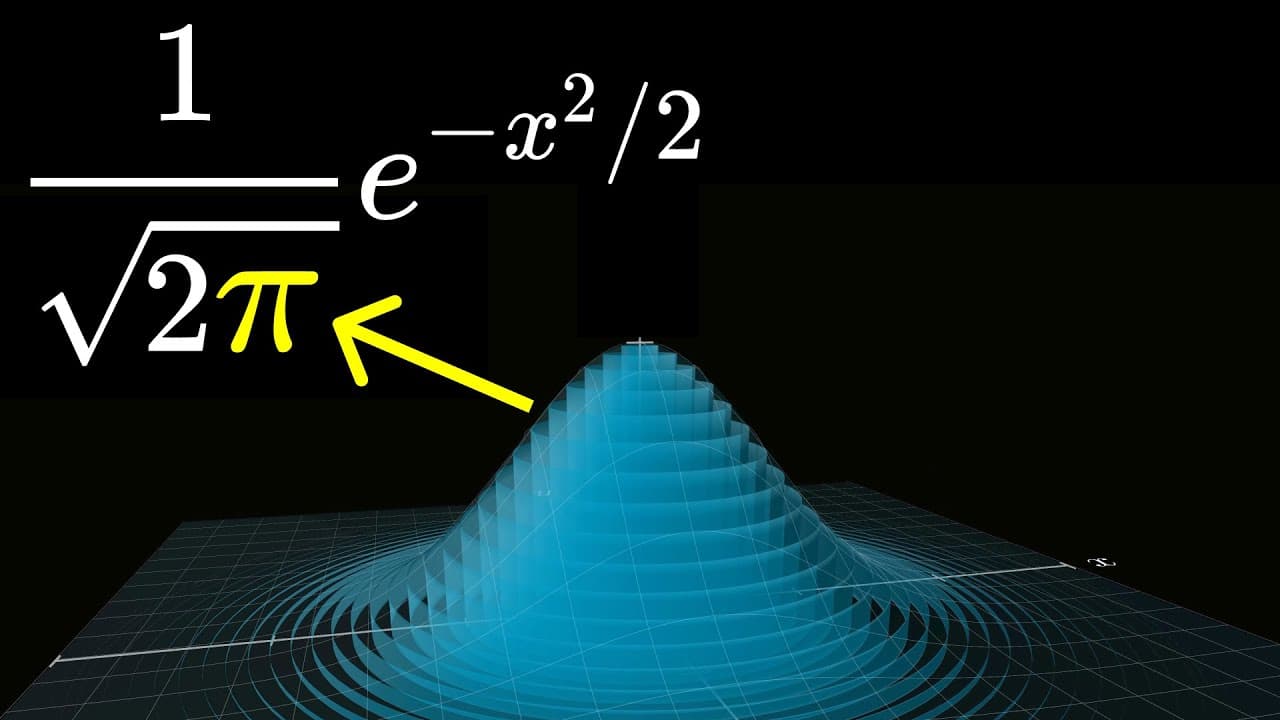
Pi appears in the normal distribution because the area under the basic bell curve, e to the negative x squared, is the square root of pi, so normalization requires dividing by that value. The classic proof reveals pi by extending the curve into a rotationally symmetric surface, whose volume can be calculated using circular cylindrical shells.
Transcript
You may have heard the phrase, the unreasonable effectiveness of mathematics in the natural sciences. This was the title of a paper by the physicist Eugene Wigner, but even more fun than the title is the way that he chooses to open it. The paper begins, quote, "There is a story about two friends who were classmates in high school talking about thei... Read More
Key Insights
- Pi enters the normal distribution through normalization: the area under e to the negative x squared is the square root of pi, so dividing by that area makes the total probability equal to one.
- The basic bell-curve function is e to the negative x squared after the normal distribution's parameters and constants are stripped away. Explaining pi therefore requires explaining the total area under this particular curve.
- The Gaussian integral cannot be evaluated by finding an antiderivative expressible through the usual polynomial, trigonometric, and exponential tools. The classic proof succeeds by replacing the original area problem with a related volume problem.
- The higher-dimensional surface is defined by e to the negative quantity x squared plus y squared. Because x squared plus y squared equals r squared, the function depends only on distance from the origin and consequently has circular symmetry.
- Cylindrical shells respect the rotational symmetry of the bell surface. A shell at radius r has circumference two pi r, height e to the negative r squared, and a small thickness represented by dr.
- The extra radial factor makes the lifted integral easier. The expression inside the integral has negative e to the negative r squared as an antiderivative, allowing the volume to be evaluated by standard calculus.
- The volume under the rotationally symmetric bell surface equals pi. Pi is natural in this calculation because every cylindrical shell contains a circumference, and circumference is two pi times its radius.
- The broader explanatory goal is to connect the circular integral proof with the statistical importance of e to the negative x squared. Calculating the area alone does not yet explain why Gaussian distributions arise in population statistics or nature.
Install to Summarize YouTube Videos and Get Transcripts
Explore YouTube Video Summarizer or Get YouTube Transcript Extractor
Questions & Answers
Q: Why does pi appear in the normal distribution?
Pi appears because a probability distribution must have total area one. The core bell-shaped function is e to the negative x squared, and its area from negative infinity to infinity equals the square root of pi. The normal distribution therefore includes a factor that divides out this area, with that factor combining with other constants in the full statistical formula.
Q: What is the Gaussian integral used for in probability?
The Gaussian integral measures the total area under e to the negative x squared from negative infinity to infinity. That area is the square root of pi. Because the area under a probability density must equal one, this result determines the normalization factor needed to turn the bell-shaped function into a valid probability distribution.
Q: Why can the Gaussian integral not be solved with a usual antiderivative?
An antiderivative of e to the negative x squared exists as a well-defined function, but it cannot be expressed using the usual collection of polynomial expressions, trigonometric functions, exponentials, or combinations of those tools. The classic evaluation therefore requires a different strategy rather than the ordinary procedure of writing an elementary antiderivative and evaluating it at the bounds.
Q: How does adding another dimension help evaluate the Gaussian integral?
The method replaces the area under a one-dimensional bell curve with the volume under a two-input bell surface. The new function is e to the negative quantity x squared plus y squared. Although this initially appears more complicated, its circular symmetry permits a cylindrical-shell calculation whose integrand gains a radial factor and therefore has a convenient antiderivative.
Q: Where does circular symmetry enter the Gaussian integral proof?
For a point with coordinates x and y, the Pythagorean theorem gives x squared plus y squared equal to r squared, where r is the distance from the origin. The lifted function can therefore be written as e to the negative r squared. Every point on the same circle has the same height, making the surface rotationally symmetric around the vertical axis.
Q: How do cylindrical shells calculate the Gaussian bell surface volume?
Each thin cylindrical shell has circumference two pi times its radius, while its height is e to the negative r squared. Giving the shell a small thickness dr produces an approximate volume. Adding shells for radii from zero to infinity creates an integral, and the radial factor makes the expression directly manageable with standard antiderivative methods.
Q: Why is the volume under the Gaussian bell surface equal to pi?
After expressing the volume as an integral of cylindrical shells, the circumference contributes a factor involving pi and the radius. The remaining integral has negative e to the negative r squared as an antiderivative. Its limiting value at infinity is zero, while its value at zero is negative one, leaving the outside factor and producing a total volume of pi.
Q: Does the classic Gaussian integral proof fully explain the normal distribution?
The calculation explains why pi appears once e to the negative x squared has been chosen, but it does not by itself explain why that function is statistically special. A complete response to the statistician's skeptical friend must also connect the function to the central limit theorem, which addresses when a normal distribution can be expected to arise in nature.
Summary & Key Takeaways
-
The normal distribution contains pi because its probability density must have total area one. After removing parameters and constants, its bell-shaped core is e to the negative x squared. The area under that curve is the square root of pi, so the formula must divide by that quantity to become a probability distribution.
-
The classic proof avoids searching for an elementary antiderivative of e to the negative x squared, because none can be expressed with the usual combinations of polynomials, trigonometric functions, and exponentials. Instead, it raises the problem into two dimensions and studies the surface defined by e to the negative quantity x squared plus y squared.
-
The lifted surface has circular symmetry because x squared plus y squared equals the squared distance from the origin. Dividing its volume into thin cylindrical shells introduces the circumference factor two pi r. The remaining integral has a convenient antiderivative, and the resulting volume is pi, connecting the calculation directly to circles.
Read in Other Languages (beta)
Share This Summary 📚
Summarize YouTube Videos and Get Video Transcripts with 1-Click
Try YouTube Summary with ChatGPT & Claude or YouTube Transcript Generator
Explore More Summaries from 3Blue1Brown 📚


Summarize YouTube Videos and Get Video Transcripts with 1-Click
Try YouTube Summary with ChatGPT & Claude or YouTube Transcript Generator