What Is a Neural Network and How Does It Work?
TL;DR
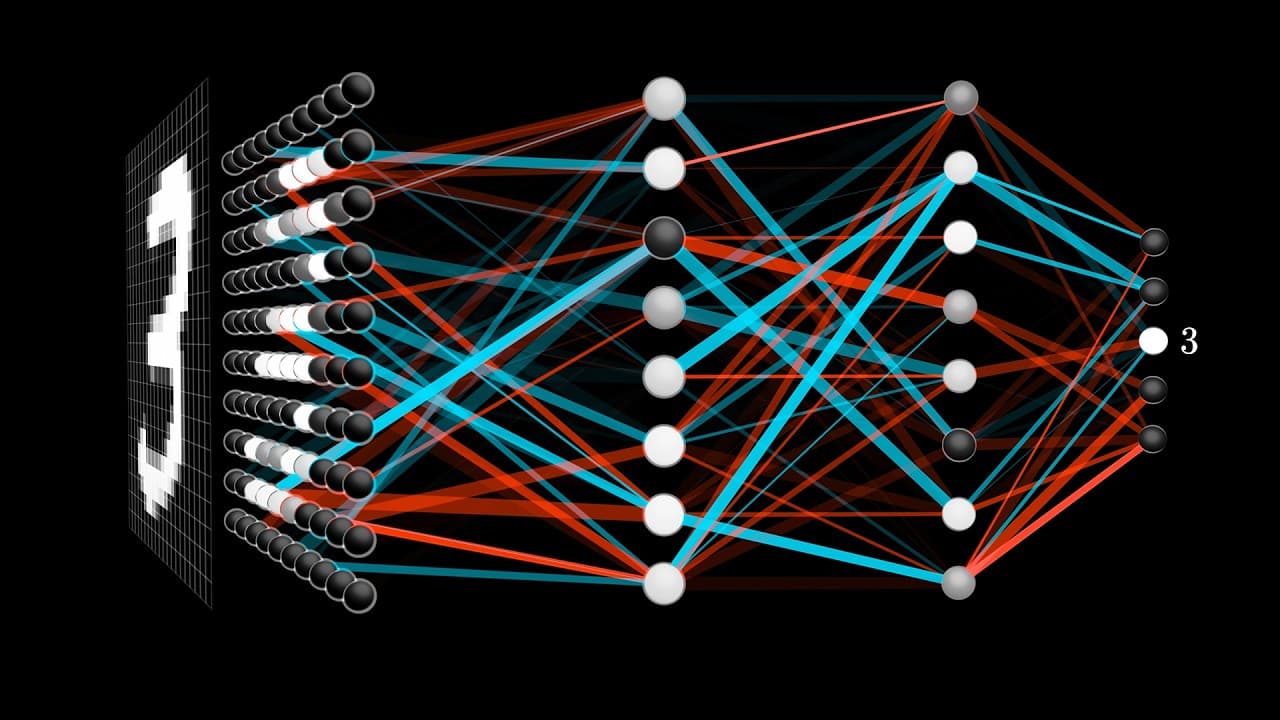
A neural network is a computational model inspired by the human brain, composed of interconnected layers of neurons that process and recognize patterns in data. It consists of an input layer, hidden layers for feature extraction, and an output layer for predictions. Training involves adjusting the weights and biases of the connections to improve accuracy in recognizing inputs, such as handwritten digits.
Transcript
This is a 3. It's sloppily written and rendered at an extremely low resolution of 28x28 pixels, but your brain has no trouble recognizing it as a 3. And I want you to take a moment to appreciate how crazy it is that brains can do this so effortlessly. I mean, this, this and this are also recognizable as 3s, even though the specific values of eac... Read More
Key Insights
- 🛰️ Neural networks can recognize patterns and make predictions based on complex interconnected layers of artificial neurons.
- 🥹 The structure of a neural network is inspired by the human brain, but simplified into neurons that hold numbers and connection weights.
- 🏋️ Training a neural network involves finding the optimal combination of weights and biases to accurately predict the desired output.
- 🔠 Hidden layers in neural networks help identify and extract meaningful features and patterns from the input data.
- 🧡 Different activation functions, like sigmoid and relu, can be used to control the output range of neurons.
- 😄 Modern neural networks often prefer the relu activation function due to its ease of training and better performance.
- 😯 Neural networks have applications beyond image recognition, including speech parsing and other tasks that involve analyzing and interpreting complex information.
Install to Summarize YouTube Videos and Get Transcripts
Explore YouTube Video Summarizer or Get YouTube Transcript Extractor
Questions & Answers
Q: How does the human brain effortlessly recognize different variations of the number 3?
The brain's visual cortex is able to resolve different images as representing the same idea through patterns of firing neurons that respond to specific features.
Q: What is the purpose of hidden layers in a neural network?
Hidden layers help to identify patterns and features in the input data by transforming and combining information from the previous layer.
Q: How do weights and biases affect the activation of neurons in a neural network?
Weights determine the importance of the input from each neuron, while biases introduce a bias towards certain activation levels, thereby influencing how the neuron responds.
Q: Why are sigmoid functions no longer commonly used in modern neural networks?
Sigmoid functions were initially used to map the weighted sum of inputs to a value between 0 and 1, but rectified linear unit (relu) functions have been found to be easier to train and provide better results.
Key Insights:
- Neural networks can recognize patterns and make predictions based on complex interconnected layers of artificial neurons.
- The structure of a neural network is inspired by the human brain, but simplified into neurons that hold numbers and connection weights.
- Training a neural network involves finding the optimal combination of weights and biases to accurately predict the desired output.
- Hidden layers in neural networks help identify and extract meaningful features and patterns from the input data.
- Different activation functions, like sigmoid and relu, can be used to control the output range of neurons.
- Modern neural networks often prefer the relu activation function due to its ease of training and better performance.
- Neural networks have applications beyond image recognition, including speech parsing and other tasks that involve analyzing and interpreting complex information.
- Understanding the structure and function of neural networks can help in experimenting with and improving their performance.
Summary & Key Takeaways
-
Neural networks are capable of recognizing patterns and identifying images, despite variations in the specific pixel values of the input.
-
The structure of a neural network consists of input, hidden, and output layers, with weights and biases assigned to connections between neurons.
-
Training a neural network involves finding the optimal weights and biases to accurately predict the desired outcome.
Read in Other Languages (beta)
Share This Summary 📚
Summarize YouTube Videos and Get Video Transcripts with 1-Click
Try YouTube Summary with ChatGPT & Claude or YouTube Transcript Generator
Explore More Summaries from 3Blue1Brown 📚

Summarize YouTube Videos and Get Video Transcripts with 1-Click
Try YouTube Summary with ChatGPT & Claude or YouTube Transcript Generator