What Is Microsoft Fabric? A Beginner's Guide
TL;DR
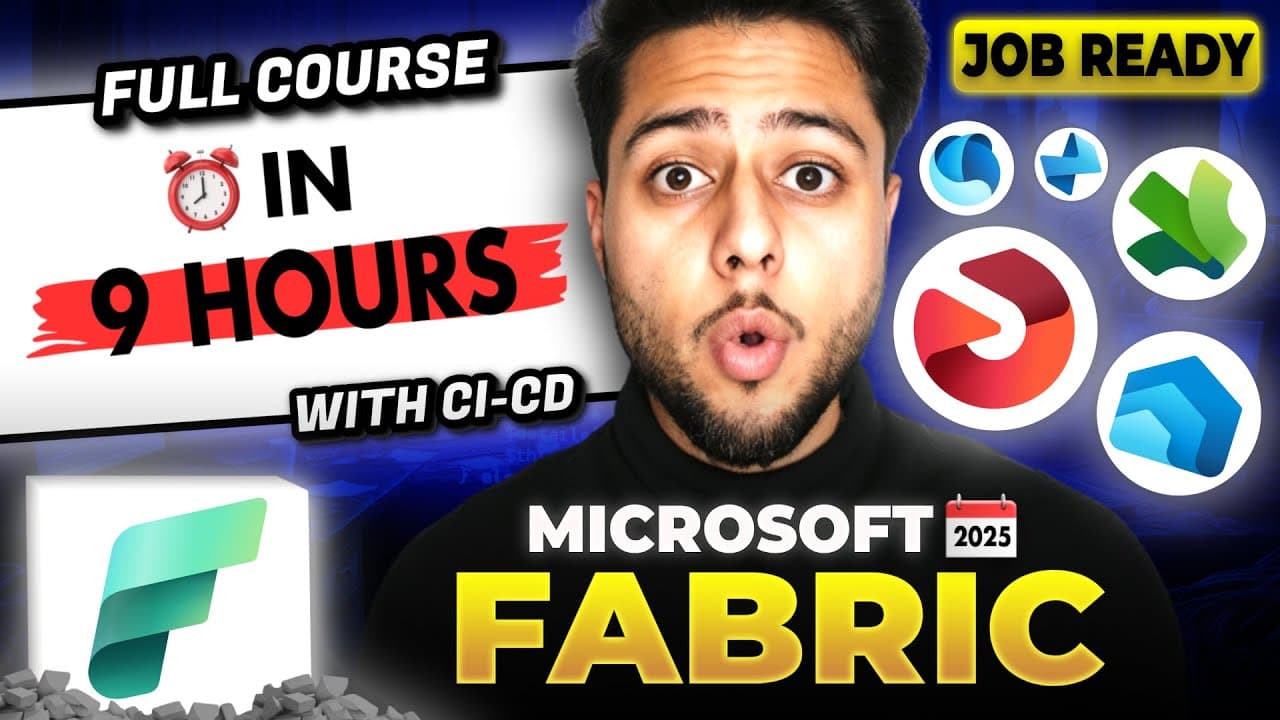
Microsoft Fabric is a unified SaaS product that combines every data service under one roof, so you do not manage servers or integrate tools yourself. It pulls Azure Data Factory, Spark data engineering, Synapse data warehouse, data science, real-time analytics, and Power BI into one platform backed by a single storage layer called OneLake.
Transcript
after completing this 9 hours long video you will become a pro Microsoft fabric developer covering all the components of fabric from scratch because you will learn fabric one L ingesting data from apis using fabric data Factory covering complex real-time scenarios in fabric data Factory and building parameterized end to-end Dynamic pipelines transf... Read More
Key Insights
- Microsoft Fabric is a SaaS product, meaning software as a solution where Microsoft handles all overhead so users do not need to manage any servers or resources themselves.
- Fabric is called unified because it combines every service needed for data work, including analytics, exploratory data analysis, visualization, pipelines, orchestration, monitoring, streaming, data science, and machine learning models.
- Fabric's components are rebranded existing Azure tools: Data Factory is Azure Data Factory, Data Engineering is Spark, Data Warehouse is Synapse, and Real-Time is stream analytics pulled into one place.
- OneLake is Fabric's storage layer that replaces multiple separate storage accounts with a single data lake, inside which you can create multiple containers, folders, and directories.
- Because Fabric unifies services, users no longer worry about integrating Data Factory with Synapse, stream analytics, and storage accounts, or about their networking and integrations.
- Power BI is now part of the Fabric and Azure family, whereas it previously existed as a separate entity outside the cloud family.
- The full course covers OneLake, ingesting API data, Data Flow Gen 2, Medallion architecture, shortcuts, PySpark notebooks, star schema, slowly changing dimensions, machine learning, data governance, and CI/CD with deployment pipelines.
- Demand for Microsoft Fabric developers is expected to grow as companies plan and execute migrations, and limited supply of skilled developers means those who learn it early will be more in demand.
Install to Summarize YouTube Videos and Get Transcripts
Explore YouTube Video Summarizer or Get YouTube Transcript Extractor
Questions & Answers
Q: What is Microsoft Fabric?
Microsoft Fabric is a unified SaaS product for the world of data. SaaS means software as a solution, so Microsoft handles all the overhead and you do not manage servers or resources. It is called unified because it combines every service needed for data operations, including analytics, exploratory data analysis, visualization, charts, pipelines, orchestration, monitoring, streaming, data science, and machine learning models, all in one platform.
Q: Why is Microsoft Fabric called a unified solution?
Fabric is unified because it brings together every service required to perform any operation in the world of data under one roof. Instead of separately setting up analytics, visualization, pipelines, orchestration, monitoring, streaming, and machine learning, Fabric provides them all in one place. You do not need to worry about integrating services, managing their networking, or connecting resources like Data Factory, Synapse, and storage accounts because everything is already integrated for you.
Q: What are the main components of Microsoft Fabric?
The main components shown include Data Factory, Data Engineering, Data Warehouse, Data Science, Real-Time, databases, industry solutions, and Power BI. Most are rebranded existing Azure tools: Data Factory is Azure Data Factory, Data Engineering provides Spark and PySpark capabilities, Data Warehouse is Synapse, and Real-Time is stream analytics. Microsoft pulled these into Fabric so they work together without manual integration.
Q: What is OneLake in Microsoft Fabric?
OneLake is the storage layer used in Microsoft Fabric, similar to a data lake in Azure. Previously, creating storage in Azure required making many separate storage accounts, one after another, for different resources. Fabric replaces this with a single data lake called OneLake, inside which you can create multiple containers, folders, root folders, and directories and store anything, removing the burden of managing many storage accounts.
Q: Why is Microsoft Fabric considered a SaaS product?
Fabric is a SaaS product, which stands for software as a solution. This means the SaaS product takes on all the overhead so users do not need to manage any servers or resources. Because Microsoft offers this product, the company handles the underlying infrastructure. This lets developers focus on data work rather than provisioning, maintaining, and integrating the servers and services themselves.
Q: How does Power BI fit into Microsoft Fabric?
Power BI is now part of the Fabric and Azure cloud family. Before, Power BI existed as a separate entity outside the cloud family, but Microsoft has integrated it directly into Fabric. This means visualization and business intelligence work happens within the same unified platform as data ingestion, engineering, warehousing, and data science, so users do not need to switch to a separate tool for reporting and dashboards.
Q: Why is demand for Microsoft Fabric developers expected to grow?
According to the video, Fabric hype is just the beginning, with expectations of ten times more demand in the coming one to two years. Companies are currently thinking about and planning their migration to Microsoft Fabric, and once they actually migrate, demand for Fabric developers will spike. Because supply of skilled developers is limited, those who learn Fabric early will be much more in demand, following the simple logic of limited supply.
Q: What topics does the 9-hour Microsoft Fabric course cover?
The course covers OneLake, ingesting data from APIs using Data Factory, complex real-time scenarios, parameterized end-to-end dynamic pipelines, transforming data with Data Flow Gen 2, Medallion architecture in data engineering, internal and external shortcuts, big data processing with PySpark notebooks, building star schemas and slowly changing dimensions in the data warehouse, machine learning models, data governance through endorsements and lineage, semantic models, Direct Lake, and CI/CD using deployment pipelines.
Summary & Key Takeaways
-
Microsoft Fabric is a unified SaaS product that consolidates all data services into a single platform. Because it is SaaS, Microsoft manages the servers and resources, removing infrastructure overhead. It unifies analytics, visualization, pipelines, orchestration, monitoring, streaming, data science, and machine learning so users avoid switching between disconnected platforms.
-
Fabric's core components are rebranded Azure services pulled together: Data Factory is Azure Data Factory, Data Engineering uses Spark, Data Warehouse is Synapse, and Real-Time is stream analytics. This unification eliminates the need to manually integrate services, manage their networking, or handle connections between resources, and Power BI is now part of the family too.
-
The 9-hour course teaches Fabric end to end, from OneLake storage and API data ingestion to dynamic pipelines, Data Flow Gen 2, Medallion architecture, shortcuts, PySpark big data processing, star schema warehouses, machine learning models, data governance through endorsements and lineage, and CI/CD using deployment pipelines.
Read in Other Languages (beta)
Share This Summary 📚
Summarize YouTube Videos and Get Video Transcripts with 1-Click
Try YouTube Summary with ChatGPT & Claude or YouTube Transcript Generator
Explore More Summaries from Ansh Lamba 📚
![Apache Spark - The Ultimate Guide [From ZERO To PRO] thumbnail](/_next/image?url=https%3A%2F%2Fi.ytimg.com%2Fvi%2FFNJze2Ea780%2Fhqdefault.jpg&w=750&q=75)
Summarize YouTube Videos and Get Video Transcripts with 1-Click
Try YouTube Summary with ChatGPT & Claude or YouTube Transcript Generator