Was Tartaria an Empire or a Mapmaking Term?
TL;DR
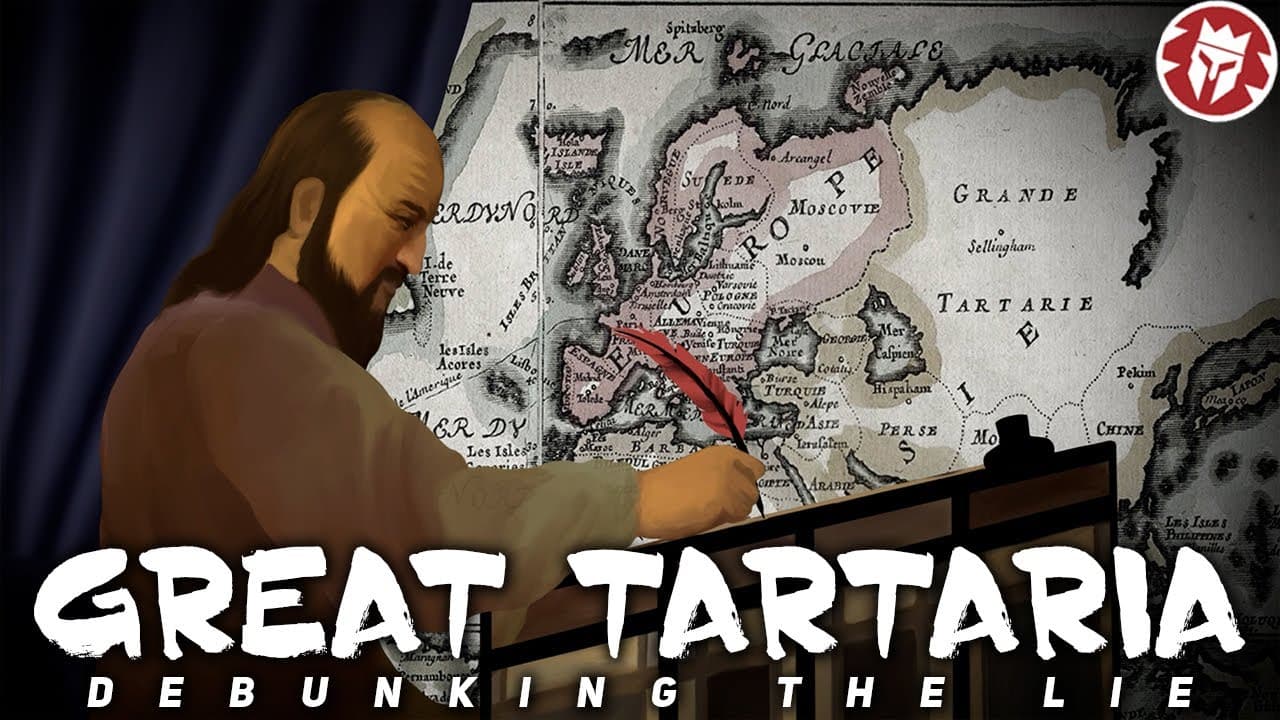
Tartaria was not a unified empire but an ambiguous European geographic label for large parts of Asia, especially Central Asia and Siberia, from the 13th through the 19th century. Historical maps therefore do not prove that a technologically advanced state was erased from history. Confusion arose partly because many outside sources called the Mongols Tatars, while the meanings of Tatar and Mongol changed over time.
Transcript
There is no great controversy in saying that the internet is full of strange beliefs and theories. With a few clicks of your mouse, you can find message boards to share all sorts of nonsense with people all over the world, throwing ideas back and forth to illuminate non-existent problems. One such conspiracy you may have seen around online is t... Read More
Key Insights
- Tartaria was an ambiguous European geographic term for broad parts of Asia, not the recorded name of a unified political empire. From the 13th through the 19th century, it was commonly applied to Central Asia and Siberia, with its boundaries varying significantly among cartographers.
- The Great Tartaria myth claims that most of Eurasia belonged to an advanced empire until roughly 200 years ago. Its advocates disagree about whether the population was Mongolian, East Asian, Tatar, white, or composed of giants, which leaves the supposed empire without a consistent identity.
- The alleged destruction of Tartaria is attributed to incompatible causes across different versions of the conspiracy. Proposed culprits include the British Empire, Jews, and a massive mudflood, while each version assumes that historical records, archaeological evidence, and cultural memory were comprehensively erased.
- Historical maps do not demonstrate the existence of a Tartarian state because cartographers used Tartary as a regional label. Some maps applied it to Turkestan, Moghulistan, Dzungaria, Manchuria, Qing China, or even India, showing that its geographic scope was broad, inconsistent, and often inaccurate.
- The word Tatar originally referred to peoples living in Mongolia and was recorded in the early 8th-century Orkhon inscriptions. During the Mongol Empire, numerous external sources used Tatar for the Mongol conquerors, while some eastern sources distinguished the Mongol state from its Tatar population.
- Mongol initially functioned as the dynastic or political name of the union established by Chinggis Khan in 1206, according to the interpretation presented from historian Stephen Pow. Contemporary usage could therefore call the population Tatars while identifying the state as the Mongol Empire, or yeke Mongqol ulus.
- The preferred identity shifted during the 1240s and 1250s as travelers reported that Mongols objected to being called Tatars. Under Möngke, the Yuan dynasty, and the Ilkhanate, imperial histories increasingly used Mongol for both the state and its people while portraying the Tatars as a rebellious eastern tribe.
- The Golden Horde retained the name Tatar because Mongol never fully replaced it among its population. Europeans had especially close contact with these western steppe communities, so they continued treating Tatar as a broad name for nomadic peoples and extended the related label Tartary across Asian geography.
Install to Summarize YouTube Videos and Get Transcripts
Explore YouTube Video Summarizer or Get YouTube Transcript Extractor
Questions & Answers
Q: Was Tartaria a real empire that ruled Eurasia?
Tartaria was not a unified Eurasian empire in the historical usage examined here. Tartary, Tartaria, and Grand Tartaria were European geographic labels applied ambiguously to large areas of Asia from the 13th through the 19th century. The terms most often covered Central Asia and Siberia, but some cartographers also included Manchuria, Qing China, and even India. A map label for a region does not establish a single political state.
Q: Why does Tartaria appear on old European maps?
Tartaria appears on old maps because European cartographers used Tartary as a broad geographic name for Asian territories that they associated particularly with Central Asia, Siberia, and steppe peoples. Its boundaries overlapped with labels such as Turkestan, Moghulistan, and Dzungaria, and some maps extended it farther east or south. This inconsistent coverage indicates a loosely defined region rather than the borders of a documented empire.
Q: What does the Great Tartaria conspiracy theory claim?
The basic conspiracy theory claims that most of Eurasia belonged to a vast empire called Great Tartaria or Tartary until roughly 200 years ago. It portrays that society as peaceful, prosperous, technologically advanced, and culturally harmonious. Its versions disagree about whether it followed the Mongol Empire or included it, and they also conflict over whether Tartaria's inhabitants or rulers were Mongolian, East Asian, modern Tatars, white people, or giants.
Q: How do Tartaria theories explain the empire's disappearance?
Different Tartaria theories offer incompatible explanations for the supposed empire's destruction. Some blame Europeans, particularly the British Empire, for defeating Tartaria and erasing its documents, archaeology, and cultural memory. Other versions blame Jews, either independently or alongside Britain. Another variation proposes a catastrophic mudflood that buried societies and left sunken buildings behind, after which fabricated history allegedly filled the resulting gap.
Q: Why do historical maps fail to prove the Tartaria theory?
Historical maps fail to prove the theory because their Tartary labels describe geography, not a centralized political entity. The label's changing boundaries could encompass Central Asia, Siberia, Manchuria, China, and on especially ambitious maps, India. The video's comparison is that modern terms such as Africa or Asia designate continents without implying unified governments. The label's survival on maps also conflicts with claims that every trace of Tartaria was deliberately erased.
Q: What did the word Tatar originally mean?
Tatar originally referred to peoples in Mongolia and appears in the early 8th-century Orkhon inscriptions, followed by scattered mentions in Central Asian geographic works and Chinese dynastic sources. During the Mongol Empire, many observers outside the empire called the Mongols Tatars. These included Arabic, Persian, Armenian, Rus’, Byzantine, European, Vietnamese, and Javanese sources, demonstrating that the name once had much broader usage than a single later tribe.
Q: Why were Mongol conquerors often called Tatars?
Many 13th-century sources treated Tatar as the name of the people associated with the Mongol conquests. Some accounts from eastern Asia used Mongol for the state while calling its population Tatar, and Ögedei reportedly referred to himself and his people as Tatars in a demand for Korea's submission. The interpretation presented is that Mongol may initially have been the dynastic name of Chinggis Khan's 1206 political union, while Tatar remained a broader identity.
Q: When and why did Mongol replace Tatar as an identity?
The shift became visible during the 1240s and strengthened in the 1250s, when travelers recorded objections to calling the people Tatars. Under the Toluid line, particularly Möngke, the Yuan dynasty, and the Ilkhanate, official histories increasingly applied Mongol to both the state and population. The precise cause remains unclear, but suggested factors include the Jin dynasty's fall in 1234, generational change, new claims to legitimacy, and active Toluid encouragement.
Summary & Key Takeaways
-
The Great Tartaria conspiracy claims that a peaceful, prosperous, and technologically advanced empire covered most of Eurasia until roughly 200 years ago. Different versions blame the British Empire, Jews, or a catastrophic mudflood for destroying it and erasing its records, archaeology, and cultural memory, while offering conflicting descriptions of its population and rulers.
-
Historical maps labeled broad regions of Asia as Tartary, Tartaria, or Grand Tartaria, but these labels were geographic rather than political. Europeans used Tartary ambiguously for Central Asia, Siberia, and sometimes Manchuria, Qing China, or even India. Like the modern continental names Africa and Asia, the term did not identify one unified government.
-
Tatar originally referred to peoples of Mongolia and appears in the early 8th-century Orkhon inscriptions. During the Mongol conquests, many Arabic, Persian, Armenian, Rus’, Byzantine, European, Vietnamese, and Javanese sources called the conquerors Tatars. From the 1240s onward, Mongol increasingly became the preferred identity, particularly under Toluid dynasties and their imperial historiography.
Read in Other Languages (beta)
Share This Summary 📚
Summarize YouTube Videos and Get Video Transcripts with 1-Click
Try YouTube Summary with ChatGPT & Claude or YouTube Transcript Generator
Explore More Summaries from Kings and Generals 📚
Summarize YouTube Videos and Get Video Transcripts with 1-Click
Try YouTube Summary with ChatGPT & Claude or YouTube Transcript Generator