How Does the Temporal Lobe Process Information?
TL;DR
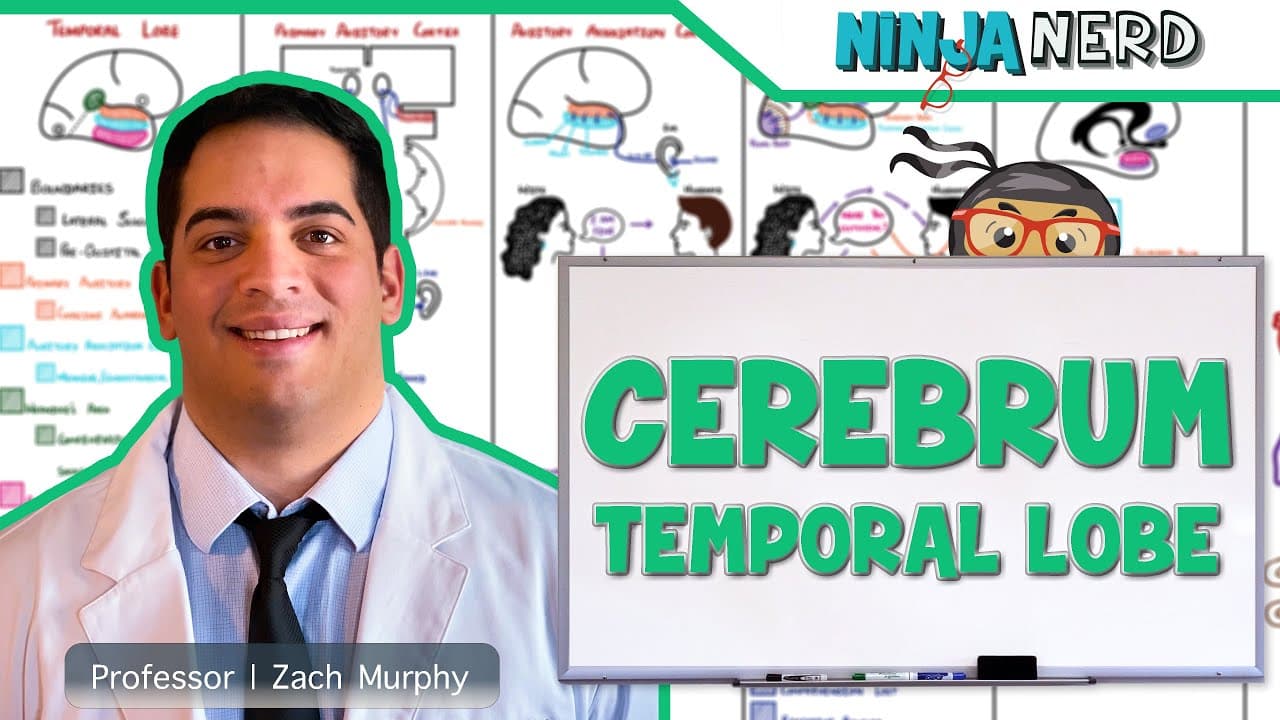
The temporal lobe supports conscious sound perception, language comprehension, smell analysis, memory, and aspects of emotion. Its auditory regions assess frequency, pitch, and sound location, while Wernicke’s area interprets written and spoken language. Deep structures and the insular cortex contribute to memory, emotional processing, taste, visceral sensation, and possibly vestibular sensation.
Transcript
all right ninja nerds in this video today we're going to talk about the cerebral cortex primarily focusing on the temporal lobe we'll also talk a little bit towards the end in more detail about another little mini lobe that's tucked deep inside of the temporal lobe called the insula all right let's go ahead and get started all right so let's first ... Read More
Key Insights
- The lateral sulcus, also called the Sylvian fissure, separates the temporal lobe from the frontal and parietal lobes. A second boundary is formed conceptually by drawing an imaginary line from the preoccipital notch toward the tip of the lateral sulcus.
- The primary auditory cortex creates conscious awareness of auditory stimuli. Its processing helps determine a sound’s frequency and pitch while also localizing whether the sound originates from the right, left, or somewhere between those positions.
- The auditory association cortex gives meaning and understanding to sounds. It works with the primary auditory cortex so that perceived auditory stimuli can be interpreted and recognized rather than experienced only as basic sound characteristics.
- Wernicke’s area is involved in comprehending written and spoken language. Its role is to support understanding of what a person hears or reads, and damage to this language-related region can produce receptive aphasia.
- The primary olfactory cortex supports conscious awareness of smells, while its association cortex analyzes odors and helps recognize smell patterns. Connections with the limbic system can link an odor with positive memories, negative memories, or an emotionally significant warning.
- The insular cortex receives information related to taste and visceral sensations. Vestibular information concerning dynamic and static equilibrium may also reach this cortex, although the lecture notes that this vestibular function is not completely understood.
- The auditory pathway carries signals from the cochlea through the vestibulocochlear nerve to cochlear nuclei in the medulla. After crossing, the pathway ascends to the medial geniculate nucleus of the thalamus and then projects to the primary auditory cortex.
- The temporal lobe contributes to auditory processing, memory, language comprehension, and aspects of emotion. Damage can lead to receptive aphasia, memory impairment, auditory processing disorders, temporal lobe seizures, or impaired recognition of music and nonverbal sounds in the nondominant hemisphere.
Install to Summarize YouTube Videos and Get Transcripts
Explore YouTube Video Summarizer or Get YouTube Transcript Extractor
Questions & Answers
Q: What are the anatomical boundaries of the temporal lobe?
The lateral sulcus, also known as the Sylvian fissure, separates the temporal lobe from the frontal and parietal lobes. Its boundary with the occipital lobe is represented by an imaginary angled line extending from the preoccipital notch toward the tip of the lateral sulcus. Together, these landmarks outline the temporal lobe on the brain’s lateral surface.
Q: What does the primary auditory cortex do?
The primary auditory cortex provides conscious awareness of auditory stimuli. More specifically, it helps process the frequency and pitch of sound and assists with sound localization. Localization allows a person to determine whether a sound is coming from the right side, the left side, or somewhere between those positions. These functions make sound available for further interpretation.
Q: How is the auditory association cortex different from the primary auditory cortex?
The primary auditory cortex supports conscious perception of sound properties such as frequency, pitch, and location. The auditory association cortex gives those perceived sounds meaning and promotes understanding or recognition. The two regions therefore perform connected but distinct functions: one processes fundamental auditory information, while the other helps interpret what the sound represents.
Q: What is the function of Wernicke’s area?
Wernicke’s area supports the comprehension and understanding of both written and spoken language. It enables a person to interpret what is being heard during speech and what is being read in text. Because this region is essential for language comprehension, temporal lobe damage involving it can lead to receptive aphasia, a deficit highlighted in the clinical discussion.
Q: How does the temporal lobe process smells?
The primary olfactory cortex produces conscious awareness of particular smells. The nearby olfactory association cortex then analyzes those smells and helps recognize odor patterns. This association region can also communicate with the limbic system, allowing an odor to become connected with good memories, bad memories, emotional meaning, or recognition that the smell signals something undesirable.
Q: What sensory functions are associated with the insular cortex?
The insular cortex is a small region located deep within the temporal area and is best visualized in a coronal section. It receives information related to taste, also called gustation, and visceral sensations. Vestibular signals involving dynamic and static equilibrium may also reach the insular cortex, although the lecture emphasizes that this possible vestibular role remains incompletely understood.
Q: How do auditory signals reach the primary auditory cortex?
Sound waves activate structures in the cochlea, including the spiral organ of Corti, and the resulting signals travel through the vestibulocochlear nerve, cranial nerve eight. The nerve synapses in cochlear nuclei within the medulla. The pathway then crosses, ascends to the medial geniculate nucleus of the thalamus, and projects from the thalamus to the primary auditory cortex.
Q: What problems can temporal lobe damage cause?
Temporal lobe damage can produce receptive aphasia, memory impairment, auditory processing disorders, and certain seizures, particularly temporal lobe epilepsy. Injury involving the nondominant temporal lobe may also disrupt recognition of music and nonverbal sounds. The exact deficit depends on whether language, auditory, memory, emotional, or other temporal lobe structures are affected.
Summary & Key Takeaways
-
The temporal lobe is separated from the frontal and parietal lobes by the lateral sulcus, also called the Sylvian fissure. An imaginary line extending from the preoccipital notch toward the lateral sulcus separates it from the occipital lobe. These landmarks establish the region’s principal anatomical boundaries.
-
Major temporal lobe regions include the primary auditory cortex, auditory association cortex, Wernicke’s area, and primary and association olfactory cortices. Together, these areas support conscious sound perception, interpretation of sounds, comprehension of spoken and written language, conscious smell perception, recognition of odor patterns, and emotional associations with smells.
-
Auditory signals originate in the cochlea, travel through cranial nerve eight to cochlear nuclei in the medulla, cross through the auditory pathway, and reach the medial geniculate nucleus of the thalamus before entering auditory cortex. Temporal structures also support memory, emotion, taste, visceral sensation, and possibly equilibrium processing.
Read in Other Languages (beta)
Share This Summary 📚
Summarize YouTube Videos and Get Video Transcripts with 1-Click
Try YouTube Summary with ChatGPT & Claude or YouTube Transcript Generator
Explore More Summaries from Ninja Nerd 📚





Summarize YouTube Videos and Get Video Transcripts with 1-Click
Try YouTube Summary with ChatGPT & Claude or YouTube Transcript Generator