How Do the Chain Rule and Product Rule Work? | Chapter 4, Essence of Calculus
TL;DR
The product rule adds two first-order area changes, while the chain rule multiplies the rates at which a change passes through the inside and outside functions. In the rectangle model, the corner area becomes negligible as dx approaches zero. The chapter also shows how addition, multiplication, and composition build complicated functions, so read on for visual explanations of each derivative rule.
Transcript
In the last videos I talked about the derivatives of simple functions, and the goal was to have a clear picture or intuition to hold in your mind that actually explains where these formulas come from. But most of the functions you deal with in modeling the world involve mixing, combining, or tweaking these simple functions in some other way, so our... Read More
Key Insights
- Most complicated functions are layered from addition, multiplication, and composition. Once the derivative rules for these three combinations are understood, even a monstrous expression can be differentiated by working through its structure one layer at a time.
- The sum rule states that the derivative of a sum is the sum of the derivatives. A tiny input nudge changes each component separately, and adding those component changes gives the total change in the combined function.
- The derivative of sine of x plus x squared is cosine of x plus 2x. The sine term changes by approximately cosine of x times dx, while the squared term changes by approximately 2x times dx.
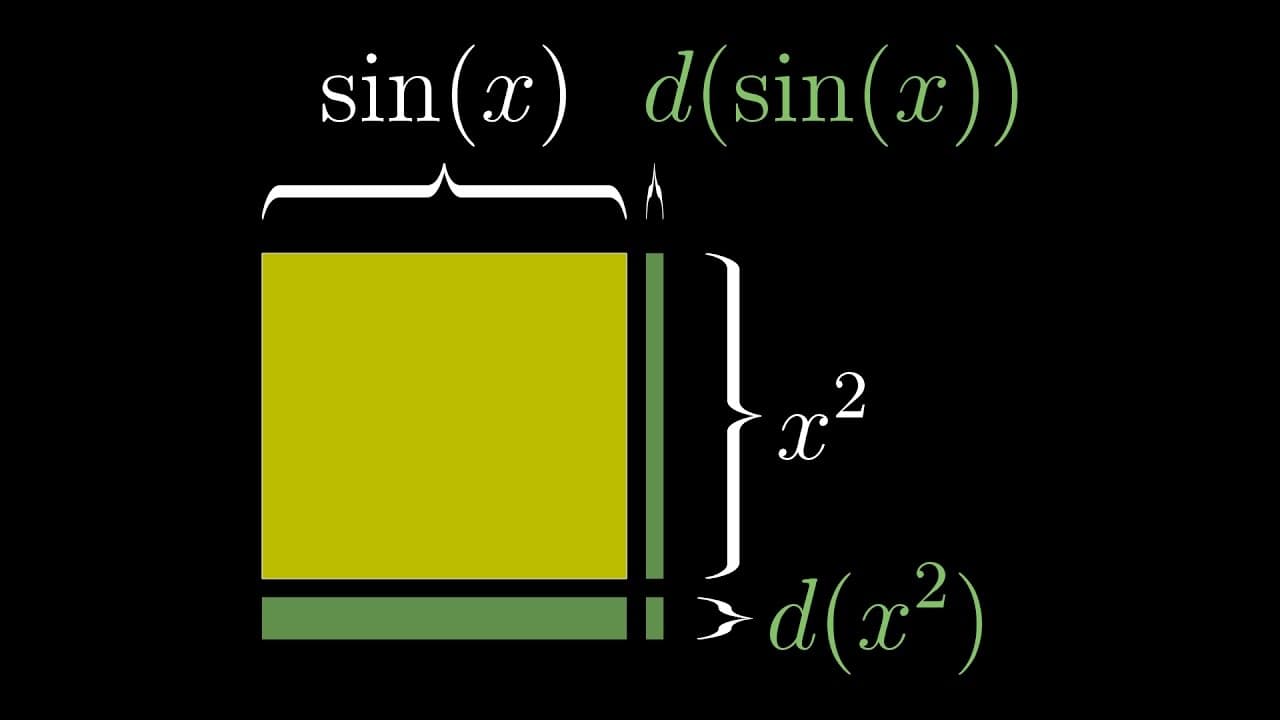
- The product rule comes from interpreting multiplication as the area of an adjustable rectangle. When both side lengths change slightly, the important area increase consists of two thin rectangles, each pairing one original side with the change in the other.
- The tiny corner area in the product-rule diagram becomes negligible as dx approaches zero. That corner depends on the product of two tiny changes, so it does not contribute to the first-order ratio used for the derivative.
- The product rule for g times h is g times the derivative of h plus h times the derivative of g. The mnemonic "left d right, right d left" records the two thin-area contributions in the rectangle model.
- The chain rule describes how a tiny change propagates through a composition. The inside function first converts dx into an intermediate change, and the outside function then converts that intermediate change into the final output change.
- The derivative of g composed with h is the derivative of g evaluated at h, multiplied by the derivative of h. The outside derivative keeps the unaltered inside function as its input because the outside function receives the intermediate value h.
- "Now, this really boils down into three basic ways to combine functions." (0:49)
- "You can add them together, you can multiply them, and you can throw one inside the other, known as composing them." (0:54)
- "The derivative of a sum of two functions is the sum of their derivatives." (1:54)
- "Its area is ultimately proportional to dx squared, and as we've seen before, that becomes negligible as dx goes to zero." (6:14)
Install to Summarize YouTube Videos and Get Transcripts
Explore YouTube Video Summarizer or Get YouTube Transcript Extractor
Questions & Answers
Q: What are the three basic ways to combine functions?
Functions can be added, multiplied, or placed inside one another through composition. Subtraction can be expressed by multiplying the second function by negative one and adding, while division can be built using the function one over x and multiplication.
Q: Why is the derivative of a sum the sum of its derivatives?
A tiny input change produces a change in each function being added, and those changes add to form the total output change. Dividing that total change by the input change gives the sum of the individual derivative ratios.
Q: What is the derivative of sine of x plus x squared?
The derivative is cosine of x plus 2x. The sine term changes by about cosine of x times dx, while the x squared term changes by about 2x times dx.
Q: How is the product rule visualized with a rectangle?
The product of two functions is treated as the area of a rectangle whose side lengths depend on x. A tiny change in x creates two thin rectangles and a tiny corner, with the two thin rectangles supplying the first-order change in area.
Q: What is the product rule for two functions g and h?
The derivative of g times h is g times the derivative of h, plus h times the derivative of g. Each term represents one thin rectangle formed by keeping one original side while changing the other.
Q: Why is the corner area ignored in the product rule?
The corner area is proportional to dx squared because it multiplies two tiny side changes. As dx approaches zero, this second-order area becomes negligible compared with the two thin rectangles that determine the derivative.
Q: How does the chain rule work for composed functions?
The inside function first converts dx into an intermediate change, then the outside function converts that intermediate change into the final output change. The derivative of the composition is the outside derivative evaluated at the unchanged inside function, multiplied by the inside derivative.
Q: Why is the outside derivative evaluated at the inside function?
The outside function receives the value produced by the inside function rather than receiving x directly. Its derivative must therefore be evaluated at that intermediate value, keeping the inside expression unchanged within the outside derivative.
Summary & Key Takeaways
-
Complicated functions can be understood as layers built from three basic combinations: addition, multiplication, and composition. Subtraction can be represented using multiplication by negative one and addition, while division can be represented through composition with one over x and multiplication. Differentiation can therefore proceed by peeling apart these layers step by step.
-
The sum rule follows because a tiny change in a sum equals the sum of the tiny changes in its parts. For sine of x plus x squared, the total change is approximately cosine of x times dx plus 2x times dx, producing the derivative cosine of x plus 2x.
-
The product rule is visualized through the changing area of a rectangle, while the chain rule is visualized with linked number lines. The area model produces two meaningful first-order rectangles, and the composition model shows successive changes multiplying as a nudge passes through the inside function and then the outside function.
Read in Other Languages (beta)
Share This Summary 📚
Summarize YouTube Videos and Get Video Transcripts with 1-Click
Try YouTube Summary with ChatGPT & Claude or YouTube Transcript Generator
Explore More Summaries from 3Blue1Brown 📚
Summarize YouTube Videos and Get Video Transcripts with 1-Click
Try YouTube Summary with ChatGPT & Claude or YouTube Transcript Generator