How to Build and Publish 3D Games With AI
TL;DR
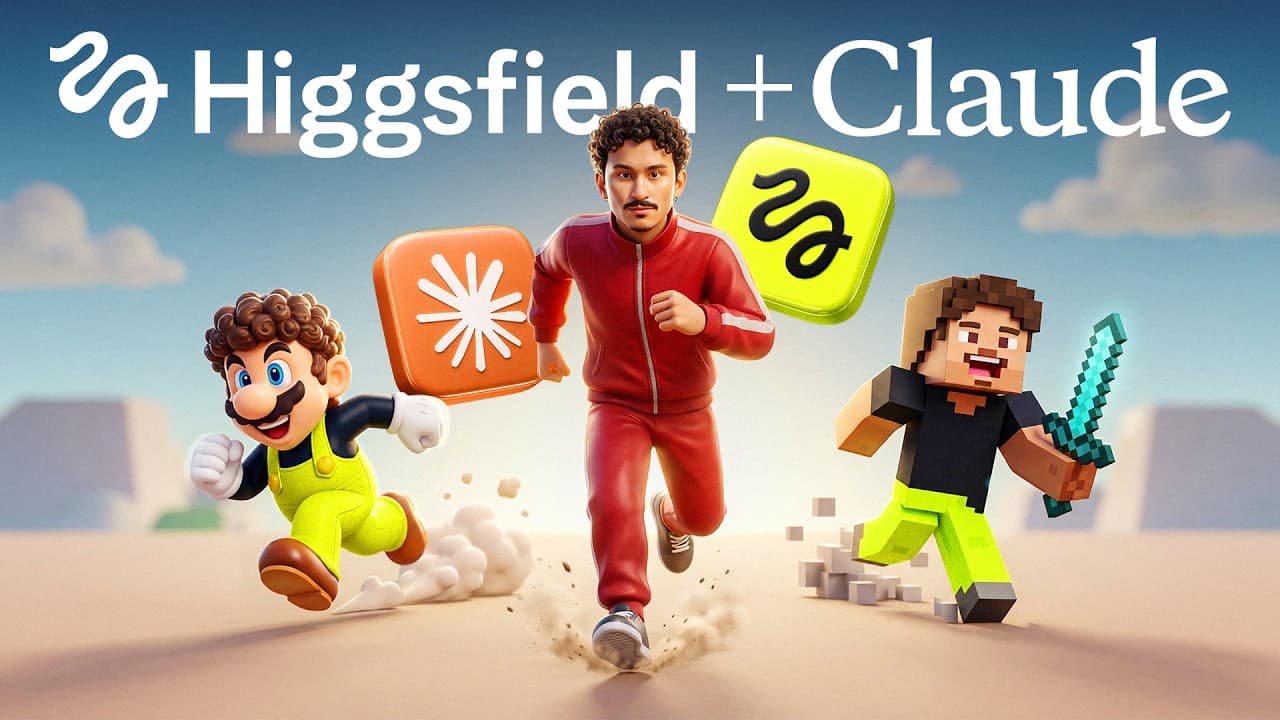
Combine Claude with the Higgsfield MCP and a custom game-design skill to turn short prompts into playable browser games with generated code, textures, characters, animations, audio, hosting, and multiplayer support. Three games were reportedly built and published in one afternoon for $68 total, with the block-world shooter attracting nearly 4,000 players and 121 remixes overnight.
Transcript
Today, I built three real multiplayer games in a single afternoon with zero lines of code. I published them, went to sleep, and woke up to nearly 4,000 players and 120 remixes. A week ago, this was impossible. Today, I'm going to show you the exact AI combo used to do it, and how you can ship and monetize your own games this weekend. Hi, I'm Adil. ... Read More
Key Insights
- Claude is responsible for writing the functioning game code, while the Higgsfield MCP supplies generated characters, textures, environments, animations, audio, hosting, and multiplayer support. This division turns a technically working prototype into a more visually developed game that can be shared through a live browser link.
- The setup consists of connecting the Higgsfield MCP to Claude, signing in, and adding the creator's custom skill. The MCP link, skill, and prompts are provided through the video's description, and the presenter characterizes the initial setup as taking only 30 seconds.
- The custom skill is a planning layer that interviews the creator before coding begins. It converts answers into a studio-style design document covering mechanics, art direction, level structure, and sound, giving Claude a detailed production brief instead of relying solely on the original one-sentence request.
- The pirate game is a first-person experience where players sail a galleon, fire cannons at enemy ships, board opposing vessels, and fight on deck with swords. Its generated presentation includes wooden ship textures, detailed cannons, pirate and navy characters, ocean visuals, animation, and sound.
- The block-world shooter is a multiplayer team game that lets players place and destroy blocks while fighting opponents. Its weapons have distinct behavior, including a slower, harder-hitting sniper rifle with zoom and a bazooka that produces smoke trails and destroys brick and stone blocks.
- The fruit-slicing game is controlled through webcam-based hand tracking instead of a mouse, controller, or touchscreen. It tracks multiple fingertips as separate blades and combines gesture tracking, velocity prediction, physics, fruit slicing, bombs, hearts, and finger-loss penalties inside a browser game.
- Marketplace publication is different from ordinary deployment because published games can be discovered and remixed by strangers. After the three games were listed, the block-world shooter reportedly received nearly 4,000 players overnight without advertising, and 121 people created remixed versions.
- The reported development cost is $68 for all three games, including failed generations. The suggested monetization strategy uses free marketplace hosting and repeat play as validation, then moves a promising game to digital distribution platforms because the creator retains ownership of the code written by Claude.
- More videos from this channel:
- More from this channel: Higgsfield AI
Install to Summarize YouTube Videos and Get Transcripts
Explore YouTube Video Summarizer or Get YouTube Transcript Extractor
Questions & Answers
Q: How can Claude and Higgsfield MCP build a 3D game?
Claude writes the underlying game code, while the Higgsfield MCP generates and integrates assets such as character skins, textures, environments, animations, and audio. The MCP also handles hosting and multiplayer synchronization, allowing the same workflow to produce a browser-based game and a shareable link. A custom skill can first gather requirements and turn them into a detailed design document that guides development.
Q: How do you set up the AI game-building workflow?
The demonstrated setup has two steps. First, paste the Higgsfield MCP connector into Claude and sign in, which gives Claude access to generated game assets and supporting infrastructure. Second, add the custom skill supplied by the creator. That skill interviews the user, prepares the game design brief, and helps coordinate development, deployment, and optional marketplace publication from the same workflow.
Q: What does the custom game-development skill do?
The custom skill turns an initial one-sentence idea into a fuller production specification before code is written. It asks questions similar to those a game studio might ask a client, then creates a design document covering mechanics, visual direction, level structure, and sound. Claude uses that expanded brief to build the game, rather than blindly coding from the short original request.
Q: What games were created with Claude and Higgsfield MCP?
Three games were demonstrated. The first was a first-person pirate game featuring ship sailing, cannon fire, boarding, and sword combat. The second was a two-team block-world shooter with guns and placeable or destructible blocks. The third was a fruit-slicing browser game that used a webcam to track fingertips as blades, with bombs, hearts, physics, and velocity prediction.
Q: How does multiplayer hosting work in this workflow?
The Higgsfield MCP handles hosting and synchronization so another player can join through a shared link. In the demonstrated pirate game, a friend clicked the link and joined the match without the creator manually configuring servers or acting as the deployment middleman. The same prompt-driven process that builds the game can also put it online, making the infrastructure largely invisible to the creator.
Q: How does the webcam fruit-slicing game work?
The fruit-slicing game watches the player's hand through a webcam and converts tracked fingertips into blades. It can follow multiple fingers independently and combines hand tracking with velocity prediction, physics, and complete game rules inside the browser. Slicing bombs causes penalties, including lost hearts and fingers. The demonstration requires no mouse, controller, touchscreen, installation, or additional hardware beyond the webcam.
Q: How much did the three AI-generated games cost?
The presenter reports that all three games cost $68 to create from start to finish. That total includes unsuccessful generations rather than counting only the assets and attempts that appeared in the final games. The workflow also provides free marketplace hosting, letting creators collect real player activity before deciding whether a project is promising enough to move to digital distribution platforms.
Q: How can an AI-generated game be tested and monetized?
The proposed strategy begins by publishing the game to the marketplace, where strangers can discover, play, and remix it. Player activity and repeat engagement provide evidence about whether the concept is enjoyable. Because the creator owns the code written by Claude, a validated game can then be taken to digital distribution platforms. The marketplace serves as free early testing, while larger platforms provide the suggested path to scale.
Summary & Key Takeaways
-
The workflow begins by connecting the Higgsfield MCP to Claude and adding a custom skill. Claude writes the functioning game, while the MCP generates visual assets, animations, environments, textures, sounds, hosting, and multiplayer infrastructure. Together, they produce a more complete experience than the basic gray shapes created by Claude alone.
-
Three browser games demonstrate the workflow: a first-person pirate adventure with sailing and boarding combat, a two-team block-world shooter with construction and destructible terrain, and a webcam-controlled fruit slicer using fingertip tracking. The custom skill interviews the creator and converts brief answers into a detailed design document before coding begins.
-
Publishing transforms a privately shared game into a marketplace listing that strangers can discover and remix. The three games cost $68 in total, including failed generations. The proposed business approach is to test games through free marketplace hosting, use player behavior to identify promising concepts, and move proven projects to digital distribution platforms.
Read in Other Languages (beta)
Share This Summary 📚
Summarize YouTube Videos and Get Video Transcripts with 1-Click
Try YouTube Summary with ChatGPT & Claude or YouTube Transcript Generator
Explore More Summaries from Higgsfield AI 📚



Summarize YouTube Videos and Get Video Transcripts with 1-Click
Try YouTube Summary with ChatGPT & Claude or YouTube Transcript Generator