How Does Matrix Multiplication Compose Transforms?
TL;DR
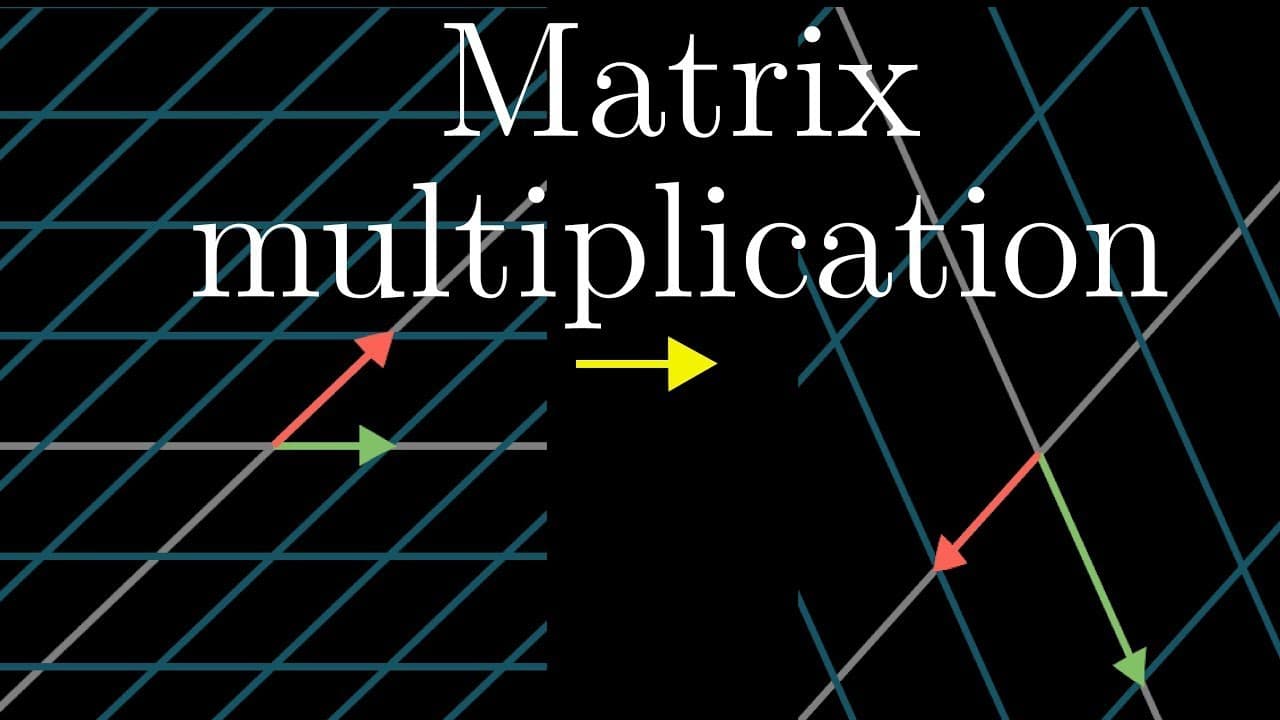
Matrix multiplication represents the composition of linear transformations: the right matrix acts first, followed by the left matrix. The product matrix records where the basis vectors land after both transformations, allowing the same combined effect to be applied in one step. This geometric interpretation also explains why multiplication order matters and why matrix multiplication is associative.
Transcript
Hey everyone, where we last left off, I showed what linear transformations look like and how to represent them using matrices. This is worth a quick recap because it's just really important, but of course if this feels like more than just a recap, go back and watch the full video. Technically speaking, linear transformations are functions with ve... Read More
Key Insights
- • A linear transformation is completely determined by the final locations of the basis vectors because every other vector can be expressed as a linear combination of those basis vectors.
- • A matrix is a record of where the basis vectors land, with the transformed version of i-hat stored in the first column and the transformed version of j-hat stored in the second column.
- • Matrix-vector multiplication is the computational act of applying a linear transformation, because the input coordinates scale the matrix columns to produce the vector's transformed location.
- • Matrix multiplication represents composition, meaning that the product captures the overall effect of applying one linear transformation and then another as a single transformation.
- • The right matrix acts first in a matrix product, and the left matrix acts second, following the right-to-left order used when composing functions.
- • Each column of a product matrix is obtained by multiplying the left matrix by the corresponding column of the right matrix, thereby following each basis vector through both transformations.
- • Matrix multiplication is generally not commutative because reversing two transformations, such as a shear and a rotation, can send the basis vectors to different final locations.
- • Matrix multiplication is associative because changing the parentheses does not change the order in which the transformations act, so the same sequence produces the same overall transformation.
Install to Summarize YouTube Videos and Get Transcripts
Explore YouTube Video Summarizer or Get YouTube Transcript Extractor
Questions & Answers
Q: What does matrix multiplication represent geometrically?
Matrix multiplication geometrically represents applying one linear transformation after another. The matrix on the right transforms the input first, and the matrix on the left transforms the resulting vector second. Their product is a new matrix that captures the complete combined effect, allowing both successive transformations to be performed computationally as one matrix-vector multiplication.
Q: Why does the right matrix act first in a product?
The right matrix acts first because matrices represent functions, and function compositions are written with functions to the left of their inputs. In a product of two matrices applied to a vector, the right matrix is closest to that vector and transforms it first. The left matrix then acts on the intermediate result produced by the right matrix.
Q: How do you calculate the columns of a matrix product?
To find the first column of a product, multiply the matrix on the left by the first column of the matrix on the right. To find the second column, multiply the left matrix by the right matrix's second column. Each calculation tracks the final location of one basis vector after both transformations have been applied.
Q: Why do matrix columns represent transformed basis vectors?
The columns represent transformed basis vectors because any vector with coordinates x and y equals x times i-hat plus y times j-hat. A linear transformation preserves this linear-combination structure. Therefore, knowing where i-hat and j-hat land lets you determine where every vector lands by scaling and adding their transformed versions using the vector's original coordinates.
Q: Why does the order of matrix multiplication matter?
The order matters because applying two transformations in reverse order can produce a different overall transformation. A shear followed by a 90 degree rotation sends the basis vectors to different locations than a 90 degree rotation followed by the shear. Since the product matrix records those final basis-vector locations, reversing the matrices generally creates a different product.
Q: Why is matrix multiplication associative?
Matrix multiplication is associative because changing the grouping of three matrices does not change the sequence of represented transformations. For matrices A, B, and C, either grouping still applies C first, then B, and then A. The same three transformations act in the same order, so their overall effect and resulting product matrix remain unchanged.
Q: How does a product matrix combine two transformations?
A product matrix combines two transformations by recording where the basis vectors ultimately land after passing through both. First, each basis vector lands at the corresponding column of the right matrix. The left matrix then transforms those intermediate vectors. Their final coordinates become the columns of a new matrix representing the entire two-step action as one transformation.
Q: How can geometric thinking improve matrix multiplication understanding?
Geometric thinking connects the numerical procedure to the idea of transforming space. Instead of treating multiplication as a formula to memorize, you can follow the basis vectors through successive transformations and use their final locations as the product's columns. This viewpoint makes multiplication order and associativity easier to understand through the transformations they represent.
Summary & Key Takeaways
-
A linear transformation is completely determined by where it sends the basis vectors. A matrix records the transformed basis vectors as its columns, so multiplying that matrix by a vector computes the corresponding linear combination of those columns and therefore applies the represented transformation to the vector.
-
When two transformations are applied successively, their combined effect is another linear transformation represented by a product matrix. Each column of that product is found by applying the left matrix to the corresponding column of the right matrix, tracking where each basis vector ultimately lands.
-
Matrix products must be interpreted from right to left because they follow function-composition notation. Changing the matrix order generally changes the resulting transformation, but changing only the placement of parentheses does not. Associativity follows because either grouping still applies the same transformations in exactly the same sequence.
Read in Other Languages (beta)
Share This Summary 📚
Summarize YouTube Videos and Get Video Transcripts with 1-Click
Try YouTube Summary with ChatGPT & Claude or YouTube Transcript Generator
Explore More Summaries from 3Blue1Brown 📚


Summarize YouTube Videos and Get Video Transcripts with 1-Click
Try YouTube Summary with ChatGPT & Claude or YouTube Transcript Generator