How to Build Effective Skills for AI Agents
TL;DR
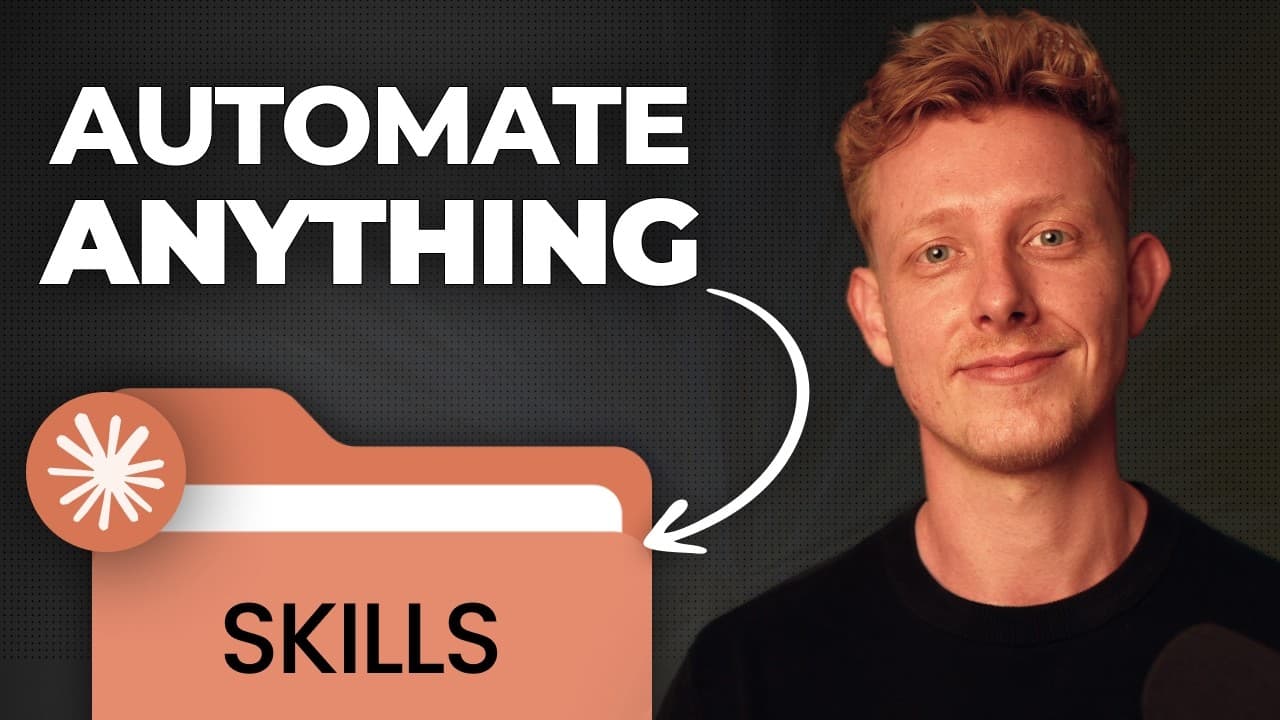
AI agent skills are folders of instructions, scripts, and resources that teach an agent to perform a specific process accurately and efficiently. Strong skills combine a core skill.md procedure with selectively loaded reference files, assets, tool instructions, or code, enabling one general agent to handle many context-dependent workflows while preserving human judgment.
Transcript
With AI agents on cloud code, co-work and codeex becoming more powerful by the day. Building good skills will be one of the most important things to get good at in 2026. Building agent skills allows anyone to automate any workflow by simply prompting it and can even become self-improving. And good skills will likely become monetizable soon. So, in ... Read More
Key Insights
- AI agent skills are folders containing instructions, scripts, and resources that help agents complete specific processes more accurately and efficiently. Their complexity can range from a single procedural document to a software-like package containing context files, media assets, tool guidance, and executable code.
- The skill.md file is the core standard operating procedure for a skill. It can define the execution flow and explain when the agent should consult knowledge files, use connected tools, execute code, or involve specialized subagents during a particular workflow.
- Reference files are contextual resources that improve a skill's output. Examples mentioned include previous outputs, style guides, ideal customer profiles, personal background, brand voice, personality guidance, business context, and instructions for navigating a specific tool such as a CRM.
- Assets are non-text resources that can guide or support skill execution. Images, presentations, videos, and binary files can provide examples of desired layouts or results, while Python or JavaScript scripts can perform functions such as software API calls.
- Progressive disclosure is the mechanism that lets one agent access thousands of potential skills without loading every document at once. The agent keeps skill names and descriptions in memory, then loads detailed instructions and individual references only when they become relevant.
- Skills occupy a middle position between isolated custom assistants and deterministic automation platforms. They preserve human involvement and contextual judgment, can be created or updated through prompting, and allow numerous specialized capabilities to remain accessible through one general agent interface.
- Plugins are bundled packages that can include multiple skills, commands, specialized agent teams, and preset connectors. Commands may trigger several skills in sequence, while versioning allows bundled capabilities to be updated across accounts that use the plugin.
- Skill customization is necessary because companies and individuals have distinct processes, expertise, audiences, brand tones, and working styles. A general sales outreach skill, for example, can be adapted with company context and further personalized to match an individual sales representative's writing style.
Install to Summarize YouTube Videos and Get Transcripts
Explore YouTube Video Summarizer or Get YouTube Transcript Extractor
Questions & Answers
Q: What is an AI agent skill?
An AI agent skill is a folder of instructions, scripts, and resources that helps an agent perform a specific process accurately and efficiently. Its core is usually a skill.md file that functions as a standard operating procedure. The folder may also contain reference documents, media assets, tool instructions, and executable code required by the process.
Q: Why do AI agents need skills?
AI agents need skills because increasing general capability does not supply the specific guardrails, context, and procedures used by every person or business. Many daily workflows also depend on judgment and changing circumstances rather than fixed rules. Skills provide reusable process guidance while preserving human involvement where contextual decisions are important to producing good outputs.
Q: What should a skill.md file contain?
A skill.md file should contain the core instructions for completing a defined process. It can describe an execution flow, such as parsing a request, conducting research, enriching information, and checking a CRM. It may also specify when the agent should read reference files, use connected tools, run code, or involve specialized subagents.
Q: What reference files can be added to an agent skill?
An agent skill can include text references such as example outputs, style guides, ideal customer profiles, personal background, company context, brand voice, and personality guidance. It can also include instructions for using a specific connected tool efficiently. Non-text references may include images, presentations, videos, binary files, and executable Python or JavaScript scripts.
Q: How does progressive disclosure work for AI skills?
Progressive disclosure loads only the context required at each stage. Initially, the agent retains a skill's name and description so it can determine when the skill applies. Once triggered, the agent loads the skill.md process instructions. It then loads a particular reference file only when those instructions require that file, preventing unnecessary context from being added.
Q: What is the difference between skills and plugins?
A skill provides instructions and supporting resources for a particular process. A plugin is a broader packaged bundle that can contain multiple skills, workflow-triggering commands, specialized agent teams, and preset connectors. Plugins can organize capabilities for departments such as sales or marketing and can be versioned so updates reach accounts that use the package.
Q: When should skills be used instead of deterministic automation?
Skills are suited to workflows that are context-dependent, not fully clear-cut, and require human judgment. Deterministic automation platforms remain useful for fixed processes that can run without a human in the loop. Skills sit between those hardcoded workflows and isolated custom assistants by combining reusable guidance, adaptable execution, and continued human involvement.
Q: How can a company customize a general-purpose skill?
A company can customize a general-purpose skill by adding its unique process instructions, brand tone, ideal customer profile, business context, examples, and tool-specific guidance. Individual employees can personalize it further for their own workflows or writing styles. This turns a broadly useful capability into one aligned with company practices and personal domain expertise.
Summary & Key Takeaways
-
AI agents still require specific context, guardrails, and standard operating procedures to follow the unique ways individuals and businesses work. Skills address this need by giving a general agent reusable instructions for particular processes, while retaining human involvement for workflows that depend on context, judgment, or unclear conditions.
-
A skill centers on a skill.md file that describes the process to execute. Its folder may also contain example outputs, style guides, business context, tool instructions, media assets, presentations, videos, and executable scripts. These additions can improve accuracy, efficiency, consistency, and alignment with a company or individual.
-
Progressive disclosure prevents large skill libraries from overwhelming an agent's context window. The agent initially retains only each skill's name and description, loads the skill.md file after the skill is triggered, and accesses individual reference files only when instructed. This approach can support access to thousands of potential skills.
Read in Other Languages (beta)
Share This Summary 📚
Summarize YouTube Videos and Get Video Transcripts with 1-Click
Try YouTube Summary with ChatGPT & Claude or YouTube Transcript Generator
Explore More Summaries from Ben AI 📚
Summarize YouTube Videos and Get Video Transcripts with 1-Click
Try YouTube Summary with ChatGPT & Claude or YouTube Transcript Generator