How to Reduce Claude Token Usage and Costs
TL;DR
Use Fable 5.1 as the orchestrator, but instruct it to run research and transcript-reading subagents on set 5. Also reduce token usage by disabling unused connectors, skills, and plugins, starting clean chats, planning complete prompts before execution, and using medium effort for most well-defined tasks.
Transcript
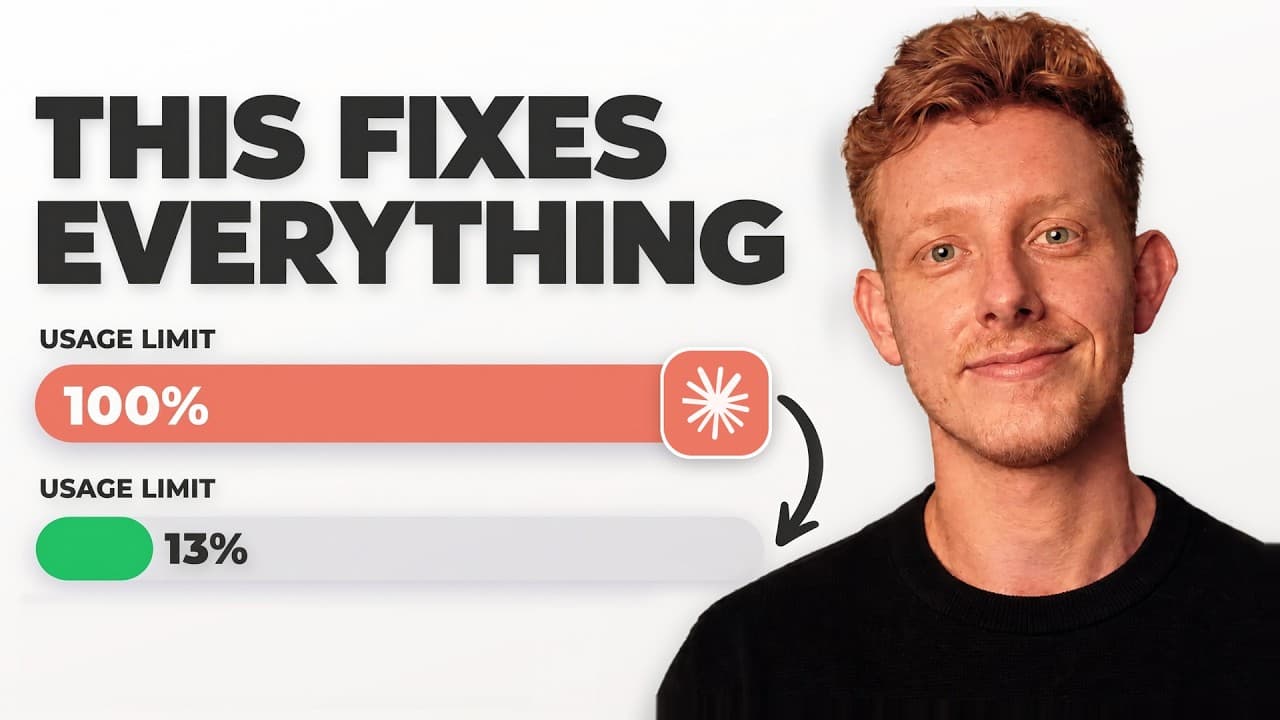
Claude's new models like Fable 5.1 are extremely powerful, but they can also burn through your tokens and hit your limit extremely fast. So, in this video, I'll show you one simple instruction to add to your prompts that can literally save you up to 90% of costs without affecting output quality. And I'll show you five other best practices to use to... Read More
Key Insights
- Fable 5.1 can be reserved for orchestration while less expensive set 5 subagents handle reading, research, and similar routine work. The recommended instruction is to require subagents to run on set 5 whenever the main model delegates those tasks.
- Subagent model selection produced a major cost difference in the presented customer-intelligence example. Using 67 Fable 5.1 subagents cost close to $350, while directing subagents to set 5 produced an almost identical report for $44, approximately 80% to 85% less.
- Subagents preserve the orchestrator's context by reading source material separately and returning summaries. This prevents the main model from consuming much of its 1 million-token context window before it begins the higher-value work of analyzing findings and producing the final report.
- The so-called DOM zone describes the presenter's claim that model performance declines as more tokens accumulate within a chat. Delegating source reading to subagents keeps the orchestrator in the described smart zone until it performs the task that requires stronger analysis.
- A fresh chat can already contain substantial token usage before the first user prompt. The example showed 84,000 tokens consumed by system tools, connectors, MCP tools, skill descriptions, plugins, and related context, although some system-level usage cannot be controlled.
- Unused connectors, MCP tools, skills, and plugins can be disabled to reduce the context loaded into every new chat. Skills do not need to be deleted, and disabling a plugin also prevents all of that plugin's included skills from being loaded.
- Composio is presented as a meta connector that can route Claude to many software services through one connector. Using one routing connector instead of loading 50 separate connectors is suggested as a way to reduce the connector information occupying the chat context.
- Pre-planning reduces repeated context processing because the model rereads the conversation during each iteration. Supplying the whole task, goal, requirements, and intent in the initial prompt can yield an 80% satisfactory result immediately and limit revisions to one or two.
Install to Summarize YouTube Videos and Get Transcripts
Explore YouTube Video Summarizer or Get YouTube Transcript Extractor
Questions & Answers
Q: How can I reduce Claude subagent token costs?
Use the most capable model as the main orchestrator, then explicitly instruct it to run research, transcript reading, and other routine subagent work on set 5. The presented instruction is essentially: when using subagents, always run them on set 5. A more specific version requires set 5 subagents whenever the task involves research or reading transcripts.
Q: How much can using cheaper subagents save?
In the customer-intelligence example, 67 subagents running on Fable 5.1 helped create a comprehensive report but brought the cost close to $350. Repeating the task with an instruction that assigned subagents to set 5 produced an almost identical report for $44. The presenter characterizes that difference as approximately 80% to 85% cheaper.
Q: Why are subagents useful for large research tasks?
Subagents can divide large reading and research workloads across separate contexts, then return compact summaries to the main orchestrator. Without them, the orchestrator would need to read all source material itself, potentially approaching its 1 million-token context limit. It would also spend substantial context before beginning the more important synthesis, prioritization, and report-writing work.
Q: Does using set 5 subagents reduce output quality?
The presenter says the effect on output quality is minimal when subagents perform routine work such as reading transcripts, articles, or websites. In the cited test, set 5 subagents still supported a report containing prioritized problems, product-roadmap suggestions, and a comprehensive customer-profile breakdown. The stronger model remained responsible for orchestration and final analysis.
Q: Why does a fresh Claude chat already use tokens?
A fresh chat loads context before the user enters a prompt. That context can include internal system material, system tools, a clot.md file, MCP tools, connectors, skill descriptions, and plugin skills. The presenter's setup showed 84,000 tokens already in use. Some system material is unavoidable, but optional integrations and user-managed files can be reduced.
Q: How can I reduce the starting context in Claude?
Check the starting context with the /context command in the Claude Code tab, then review the customize settings. Keep the clot.md file clean and disable connectors, MCP tools, skills, and plugins that are not needed for current work. Skills can be disabled instead of deleted, making them available for later reactivation without loading them into every chat.
Q: How can one connector replace many Claude connectors?
The presenter recommends Composio as a meta connector that links to many software services while exposing one connector to Claude. Composio then routes requests to the appropriate connected software. This arrangement is intended to avoid loading information for 50 separate connectors into the chat window, thereby reducing the context consumed before task-specific work begins.
Q: Why should I plan a complete prompt before starting?
A complete initial prompt can reduce the number of follow-up iterations because the model rereads the conversation whenever another prompt is added. The presenter recommends providing the entire job, its goal, requirements, and the reason behind it at the outset. Good planning can deliver an 80% satisfactory initial result, require only one or two revisions, and make medium effort adequate for most tasks.
Summary & Key Takeaways
-
The largest proposed saving comes from reserving Fable 5.1 for orchestration while assigning routine subagent work to set 5. In the example, analyzing customer-support transcripts with 67 expensive subagents cost nearly $350, while adding the lower-cost subagent instruction produced an almost identical report for $44.
-
Every fresh chat can consume tokens before the user submits a prompt because system instructions, tools, connectors, skills, and plugins are loaded into context. The presenter recommends checking usage with /context in the Claude Code tab, keeping the clot.md file clean, and disabling integrations that are not actively needed.
-
Detailed pre-planning can reduce costly prompt iterations because the model rereads the conversation whenever another prompt is submitted. A strong initial request should communicate the complete job, its goal, and the intent behind it. This approach can produce an 80% satisfactory first result and often makes medium effort sufficient.
Read in Other Languages (beta)
Share This Summary 📚
Summarize YouTube Videos and Get Video Transcripts with 1-Click
Try YouTube Summary with ChatGPT & Claude or YouTube Transcript Generator
Explore More Summaries from Ben AI 📚



Summarize YouTube Videos and Get Video Transcripts with 1-Click
Try YouTube Summary with ChatGPT & Claude or YouTube Transcript Generator