Trigeminal Nerve (CN V): Anatomy, Branches, and Function
TL;DR
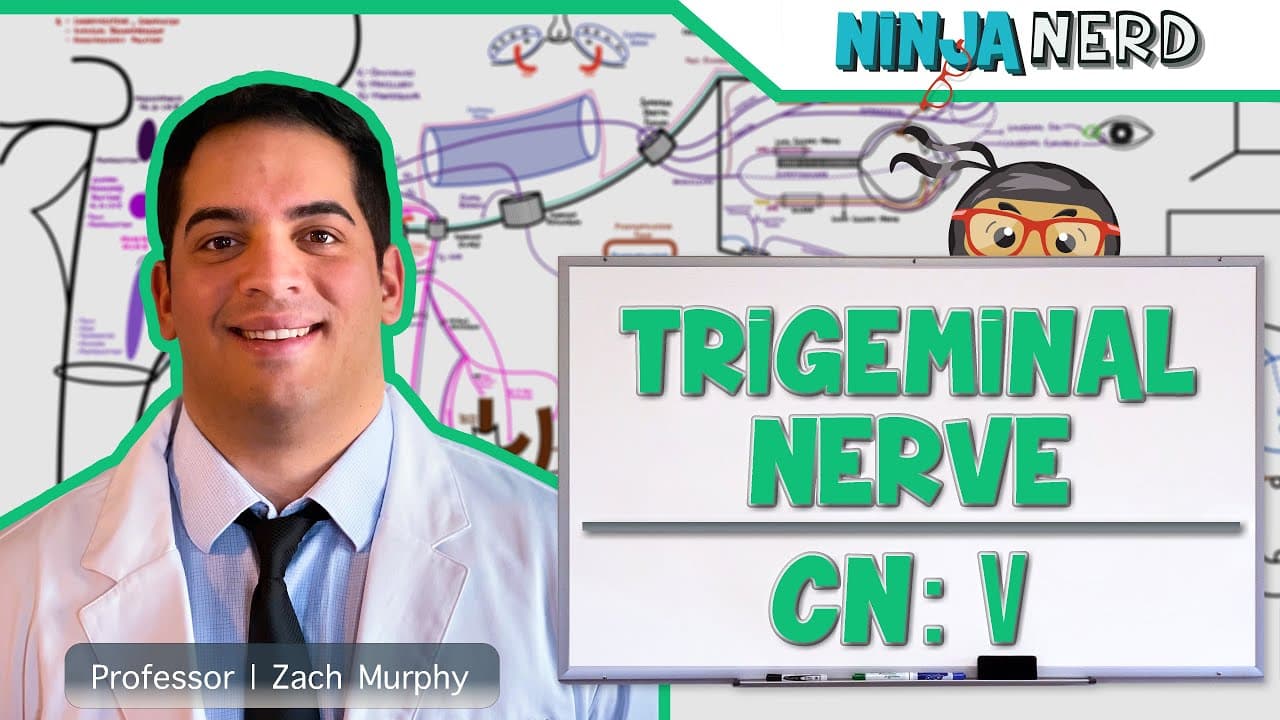
The trigeminal nerve (cranial nerve V) provides facial sensation and helps control the muscles of mastication used for chewing. Its three divisions are ophthalmic (V1), maxillary (V2), and mandibular (V3), while its central processes reach nuclei in the medulla, pons, and midbrain. Each division follows a distinct course through the skull, so read on to understand the nerve’s branches, openings, and sensory roles.
Transcript
all right engineers in this video we're going to talk about the trigeminal nerve or the cranial nerve five this is probably one of the most important cranial nerves when it comes to Sensations like touch pain temperature of the face and a lot of control with the muscles of mastication so for our chewing processes so this nerve we're going to spend ... Read More
Key Insights
- The trigeminal nerve is cranial nerve V and is responsible for sensations of touch, pain, and temperature of the face plus motor control of the muscles of mastication used for chewing.
- The trigeminal ganglion is a group of cell bodies located in the peripheral nervous system that houses the important cell bodies for the peripheral processes forming the nerve's three divisions.
- The three divisions are V1 (ophthalmic), V2 (maxillary), and V3 (mandibular), where V1 is the first division, V2 the second, and V3 the third division of cranial nerve five.
- The spinal nucleus of the trigeminal nerve is located in the medulla and is the most important nucleus because it controls touch, pain, temperature, pressure, and proprioception of the entire face.
- The principal (central) pontine nucleus of CN5 sits in the pons and picks up touch and proprioception mainly from the jaw area, while the mesencephalic nucleus in the midbrain handles proprioception of the face.
- The cavernous sinus is a dural sinus formed between the periosteal layer and the meningeal layer of the dura mater, and both V1 and V2 travel within its lateral wall.
- Each division exits the skull through a distinct opening: V1 through the superior orbital fissure, V2 through the foramen rotundum, and V3 through the foramen ovale.
- The ophthalmic division (V1) branches into three nerves after reaching the superior orbital fissure: the lacrimal branch, the frontal branch, and the nasociliary branch.
Install to Summarize YouTube Videos and Get Transcripts
Explore YouTube Video Summarizer or Get YouTube Transcript Extractor
Questions & Answers
Q: What is the trigeminal nerve, and what does it do?
The trigeminal nerve is cranial nerve V. It carries facial sensations including touch, pain, temperature, pressure, and proprioception, and it helps control the muscles of mastication used for chewing.
Q: What are the three divisions of the trigeminal nerve?
The three divisions are the ophthalmic division (V1), maxillary division (V2), and mandibular division (V3). They arise as peripheral processes associated with the trigeminal ganglion.
Q: What is the trigeminal ganglion?
The trigeminal ganglion is a group of cell bodies located in the peripheral nervous system. It contains cell bodies important to the peripheral processes that form the V1, V2, and V3 divisions of the trigeminal nerve.
Q: Which brainstem nuclei receive central processes from the trigeminal nerve?
The central processes extend to the spinal nucleus in the medulla, the central or principal pontine nucleus in the pons, and the mesencephalic nucleus in the midbrain. The transcript also identifies a trigeminal motor nucleus that supplies the first pharyngeal arch.
Q: What sensory information does the spinal nucleus of cranial nerve V process?
The spinal nucleus processes touch, pain, temperature, pressure, and proprioception from the entire face. It is located in the medulla and is described as especially important because it handles many types of facial sensation.
Q: What do the pontine and mesencephalic trigeminal nuclei process?
The central or principal pontine nucleus processes touch and proprioception, mainly from the jaw area. The mesencephalic nucleus processes proprioception from the face.
Q: Through which skull openings do V1, V2, and V3 pass?
The ophthalmic division (V1) passes through the superior orbital fissure, and the maxillary division (V2) passes through the foramen rotundum. The mandibular division (V3) passes through the foramen ovale.
Q: What are the main branches of the ophthalmic division (V1)?
The ophthalmic division branches into the lacrimal, frontal, and nasociliary nerves as it reaches the superior orbital fissure. These branches continue into the orbit, including distribution around the temporal and nasal sides of the eye.
Summary & Key Takeaways
-
The trigeminal nerve, cranial nerve V, is one of the most important cranial nerves for facial sensations like touch, pain, and temperature, and it also controls the muscles of mastication for chewing. It carries significant clinical relevance, including trigeminal neuralgia.
-
Its origin involves the trigeminal ganglion, a collection of cell bodies in the peripheral nervous system giving rise to three peripheral processes: V1 ophthalmic, V2 maxillary, and V3 mandibular. Central processes extend to three brainstem nuclei across the medulla, pons, and midbrain.
-
The spinal nucleus in the medulla handles touch, pain, temperature, pressure, and proprioception of the whole face. The pontine nucleus handles jaw touch and proprioception, and the mesencephalic nucleus handles facial proprioception. A separate trigeminal motor nucleus supplies the first pharyngeal arch.
Read in Other Languages (beta)
Share This Summary 📚
Summarize YouTube Videos and Get Video Transcripts with 1-Click
Try YouTube Summary with ChatGPT & Claude or YouTube Transcript Generator
Explore More Summaries from Ninja Nerd 📚





Summarize YouTube Videos and Get Video Transcripts with 1-Click
Try YouTube Summary with ChatGPT & Claude or YouTube Transcript Generator