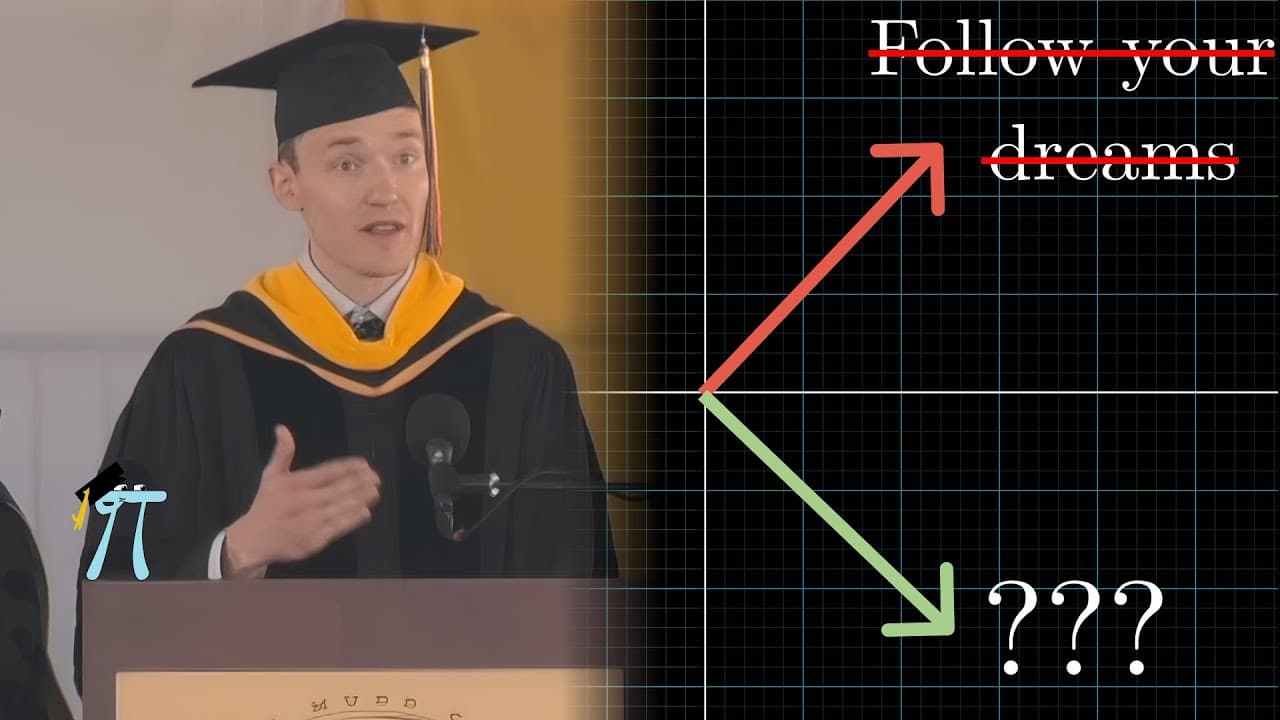
Why Does Following Your Dreams Fall Short?
TL;DR
Career success depends on creating value for others, not simply pursuing what you already enjoy. Passion can develop after action, experience, and useful work, so graduates without a defining dream are not at a disadvantage. Choose opportunities where your skills help people, remain alert to timing and survivorship bias, and let motivation grow through sustained participation.
Transcript
Last year, Grant gave the math department's Michael E. Moody lecture on where math and physics collide. He explored unexpected connections between kinematics, optics, and quantum computing. Our students loved his talk, and the senior class voted overwhelmingly to ask him back as commencement speaker. Grant has said that he seeks to educate and insp... Read More
Key Insights
- Career success is a function of the value a person brings to others. Passion and expertise can support that goal, but enjoying an activity is not enough if the work fails to help, entertain, or otherwise matter to the people it is intended to serve.
- The goal after college shifts from personal growth to adding value for others. Educational institutions support and reward learning, while professional life places greater weight on making colleagues’ lives easier, contributing to a research community, or producing something customers actually want.
- A passion can originate from reinforcement rather than destiny. Sanderson’s love of mathematics partly grew because adults emphasized its importance, told him he was good at it, and encouraged him to spend more time practicing, which created a positive feedback loop of skill and interest.
- Technical excellence is not always the same as public value. Sanderson contrasts a musician pursuing virtuosity with one writing emotionally resonant music, arguing that schools may reward the technically exceptional student while a professional audience may favor the creator who connects with people.
- A defining passion is not required before choosing a career. People can begin by finding opportunities where their existing skills intersect with useful contributions, then allow interest and commitment to develop through experience rather than waiting for a complete dream to appear.
- Action precedes motivation in both daily habits and career development. Getting out of bed can produce wakefulness, exercising can create the drive to exercise, and performing unfamiliar work can cultivate genuine enthusiasm that was absent before the person began.
- Inspirational career stories are vulnerable to survivorship bias. The people who succeed in high-risk paths are the ones most able to give speeches, while those who made similar efforts without reaching the top are less visible in the advice graduates commonly hear.
- Timing can shape career outcomes as strongly as passion. A pursuit may succeed because it matches changes in technology or public behavior, as Sanderson’s mathematics visualizations found an audience through online video platforms and opened an unexpected path into digital education.
Install to Summarize YouTube Videos and Get Transcripts
Explore YouTube Video Summarizer or Get YouTube Transcript Extractor
Questions & Answers
Q: Why is following your dreams incomplete career advice?
Following your dreams is incomplete advice because it focuses on personal enjoyment without requiring a plan for creating value for other people. A sustainable career depends on whether work helps colleagues, contributes to a research community, serves students, entertains an audience, or provides something customers want. Passion matters, but it must connect with usefulness, demand, and the circumstances in which the work is pursued.
Q: How does the goal of life change after college?
During school, the central goal is often to learn, grow, and become more capable, with institutions structured to support and reward that development. After college, success depends more directly on adding value to others. Learning and expertise still matter, but they increasingly operate as means to broader ends, such as improving a workplace, advancing shared research, teaching students, or meeting customers’ needs.
Q: Can passion develop after starting a career?
Passion can develop through action and experience rather than appearing before a career begins. Sanderson had little experience or inclination toward making videos when he finished college, and his initial interest in teaching mainly gave him another way to engage with mathematics. By working in online education and producing visual lessons, he gradually came to love both teaching and video creation.
Q: What does action precedes motivation mean?
Action precedes motivation means that the desire to do something can emerge after a person begins doing it. Sanderson illustrates this with getting out of bed before feeling fully awake and developing a drive to exercise through the habit of exercising. Applied to careers, the principle suggests that useful work and repeated experience can generate enthusiasm, instead of motivation always needing to come first.
Q: What should graduates do if they have no defining dream?
Graduates without a defining passion can seek opportunities where the skills they developed intersect with work that adds value to other people. Sanderson presents this situation as completely acceptable and potentially advantageous because it encourages exploration without attachment to a predetermined identity. Through useful action, experience, and contribution, motivation and passion can follow rather than needing to guide the first decision.
Q: How does survivorship bias distort career advice?
Survivorship bias makes successful people unusually visible while obscuring others who took comparable risks and did not achieve the same outcome. Sanderson uses an XKCD lottery example to show why persistence alone cannot prove that a strategy reliably works. This bias is especially relevant to high-risk careers in professional athletics, the arts, social media entrepreneurship, and other fields where only a few reach prominent positions.
Q: How did personal projects influence Sanderson’s career?
Sanderson created a rudimentary Python library for mathematics visualizations while finishing his undergraduate studies, then used it to make and post several videos about proofs and problems he enjoyed. Although he did not plan for the project to become a career, it led to conversations with Khan Academy and eventually to work creating more online lessons, while his own channel continued growing gradually.
Q: Why does timing matter when choosing a career path?
Timing matters because a person’s interests and skills may align well or poorly with how technology and society develop. Sanderson notes that software enthusiasts in the late 1980s were positioned for the later dot-com boom, while people interested in niche subjects and film production gained opportunities as video-sharing platforms grew. His own mathematics visualizations similarly benefited from the rise of online education and video.
Summary & Key Takeaways
-
Grant Sanderson challenges the advice to follow your dreams because passions often develop while education rewards personal learning and improvement. After college, the central measure of success changes. Expertise remains important, but personal growth becomes a means of helping other people, contributing to communities, solving problems, or creating something they genuinely value.
-
A passion does not need to exist before a career begins. Sanderson argues that action precedes motivation: people feel awake after leaving bed, develop a drive to exercise through exercising, and can learn to love work through doing it. His interests in video production and teaching grew only after he entered online mathematics education.
-
Sanderson’s career combined passion, public value, personal projects, favorable timing, and luck. A Python visualization library and several online mathematics videos led to conversations with Khan Academy, while gradual audience growth encouraged him to continue. His experience also illustrates why successful people should acknowledge survivorship bias instead of presenting persistence as a sufficient explanation.
Read in Other Languages (beta)
Share This Summary 📚
Summarize YouTube Videos and Get Video Transcripts with 1-Click
Try YouTube Summary with ChatGPT & Claude or YouTube Transcript Generator
Explore More Summaries from 3Blue1Brown 📚




Summarize YouTube Videos and Get Video Transcripts with 1-Click
Try YouTube Summary with ChatGPT & Claude or YouTube Transcript Generator