Special Senses: How Do External and Middle Ear Anatomy Support Hearing?
TL;DR
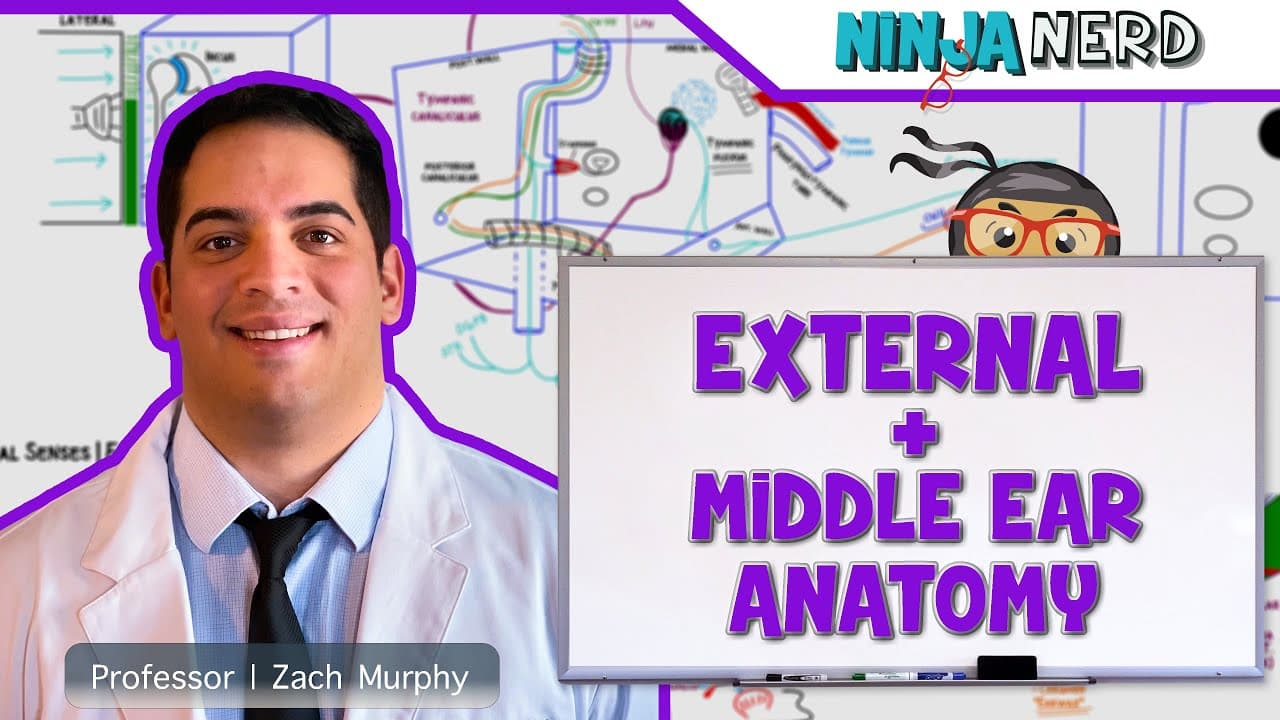
External and middle ear anatomy supports hearing by capturing sound waves, vibrating the tympanic membrane, and transmitting those vibrations through the malleus, incus, and stapes to the inner ear. The auricle and external acoustic meatus direct sound, while the tensor tympani and stapedius limit excessive ossicle movement. Read on to understand how these structures, earwax, pressure equalization, and cranial nerves contribute to hearing and protection.
Transcript
I'm engineers in this video we're going to talk about the external ear in the middle ear the reason why we want to talk about this is before we start going into all the inner ear stuff talking about the cochlea and the vestibule and the semicircular canals and how airwaves or some sorry sound waves can actually get converted into certain electrical... Read More
Key Insights
- The external ear consists of the auricle (pinna) and the external acoustic meatus, which funnel sound waves to the tympanic membrane.
- The auricle is made of elastic cartilage, allowing it to be flexible and return to its original shape after being bent.
- Ceruminous glands in the external ear produce earwax, which helps deter insects and protect the ear canal.
- The tympanic membrane separates the external ear from the middle ear and consists of two parts: pars tensa and pars flaccida.
- The middle ear contains three ossicles: malleus, incus, and stapes, which transmit vibrations to the oval window of the inner ear.
- The tensor tympani and stapedius muscles modulate ossicle movement to protect the inner ear from loud sounds.
- The pharyngotympanic (Eustachian) tube equalizes air pressure between the middle ear and the nasopharynx, preventing pressure-related damage.
- Nerve supply to the ear involves multiple cranial nerves, including the trigeminal, facial, glossopharyngeal, and vagus nerves.
Install to Summarize YouTube Videos and Get Transcripts
Explore YouTube Video Summarizer or Get YouTube Transcript Extractor
Questions & Answers
Q: How do the external and middle ear support hearing?
The auricle and external acoustic meatus capture and direct sound waves toward the tympanic membrane. Its vibrations then pass through the middle-ear ossicles, the malleus, incus, and stapes, to the oval window of the inner ear.
Q: What structures make up the external ear, and what do they do?
The external ear includes the auricle, also called the pinna, and the external acoustic meatus. Together, they collect sound waves and funnel them toward the tympanic membrane.
Q: Why is the auricle flexible?
Beneath its skin, the auricle is primarily made of elastic cartilage. This tissue lets the auricle bend and stretch before recoiling to its normal shape.
Q: What do ceruminous glands and earwax do?
Ceruminous glands in the external acoustic meatus are modified apocrine glands that produce cerumen, commonly called earwax. The cerumen coats part of the ear canal and helps deter insects.
Q: What is the role of the tympanic membrane?
The tympanic membrane separates the external ear from the middle ear and vibrates in response to sound waves. It has two parts, the pars tensa and pars flaccida, and transfers vibrations to the middle-ear ossicles.
Q: What are the three auditory ossicles, and what is their function?
The three middle-ear ossicles are the malleus, incus, and stapes. They transmit and amplify vibrations from the tympanic membrane to the oval window of the inner ear.
Q: How do the tensor tympani and stapedius muscles protect hearing?
The tensor tympani pulls the malleus medially, tensing the tympanic membrane and dampening vibrations. The stapedius stabilizes the stapes, limiting excessive movement and helping protect the inner ear from loud sounds.
Q: What is the function of the pharyngotympanic tube?
The pharyngotympanic, or Eustachian, tube connects the middle ear with the nasopharynx. It equalizes air pressure across the tympanic membrane, helping prevent discomfort and pressure-related damage.
Summary & Key Takeaways
-
The external ear, including the auricle and external acoustic meatus, captures and directs sound waves to the tympanic membrane. The auricle's elastic cartilage allows flexibility, while ceruminous glands produce earwax for protection.
-
In the middle ear, the ossicles—malleus, incus, and stapes—transmit sound vibrations to the inner ear. Muscles like the tensor tympani and stapedius protect the ear from loud noises by modulating ossicle movement.
-
The pharyngotympanic tube plays a vital role in equalizing air pressure between the middle ear and nasopharynx, crucial for preventing conditions like otitis media. The ear's nerve supply involves several cranial nerves, ensuring proper auditory function.
Read in Other Languages (beta)
Share This Summary 📚
Summarize YouTube Videos and Get Video Transcripts with 1-Click
Try YouTube Summary with ChatGPT & Claude or YouTube Transcript Generator
Explore More Summaries from Ninja Nerd 📚


Summarize YouTube Videos and Get Video Transcripts with 1-Click
Try YouTube Summary with ChatGPT & Claude or YouTube Transcript Generator