How to scale value functions with function approximators
TL;DR
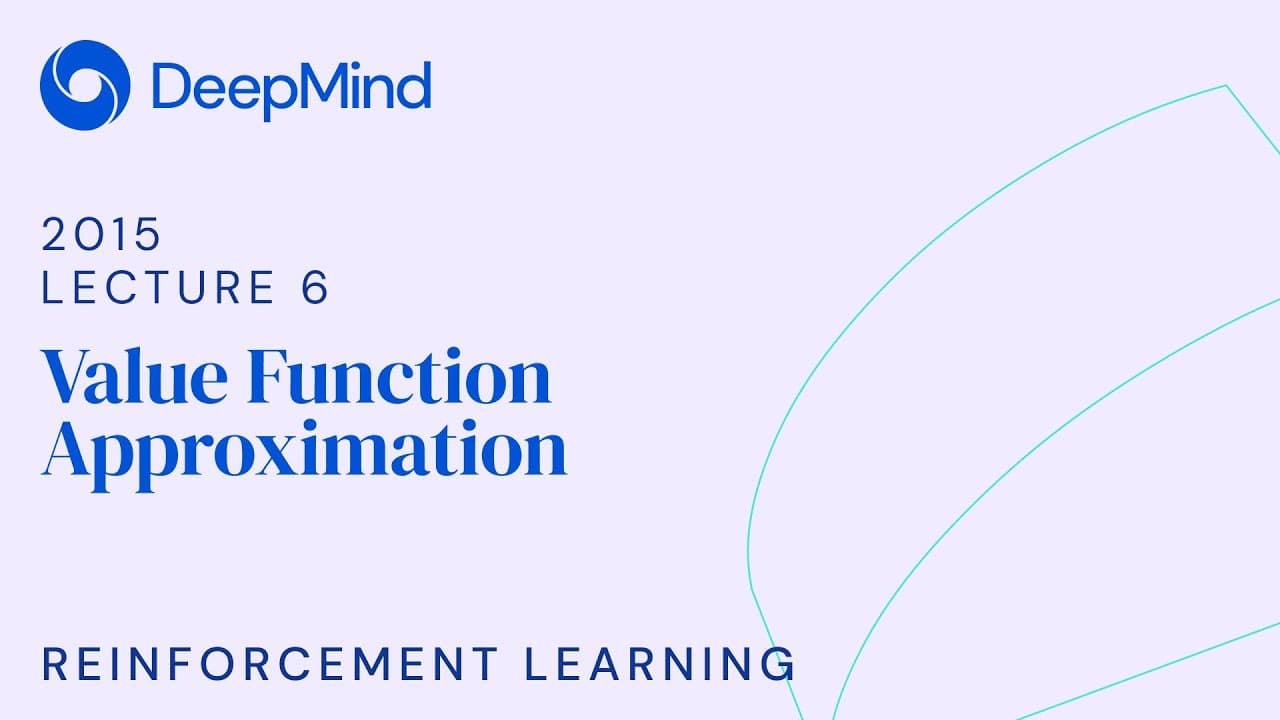
Value function approximation enables scaling up reinforcement learning to large spaces by using parametric representations like neural networks. The talk distinguishes online incremental updates from batch methods and explains how function approximators enable generalization across unseen states, making prediction and control feasible in complex environments.
Transcript
uh so welcome back uh today we're going to start getting serious learn how to scale up reinforcement learning to real practical problems uh by the end of today's class hopefully you'll be able to go off into the world and actually program interesting reinforcement learning agents that can solve uh problems in fact we'll see you know state-of-the-ar... Read More
Key Insights
- Value functions can be approximated by a function with parameter vector W instead of a separate value per state, enabling scalable learning.
- Function approximation generalizes across similar states, reducing memory needs and enabling learning in continuous or large state spaces.
- Two learning paradigms are online incremental updates and batch methods, each with tradeoffs in data efficiency and immediacy.
- The goal is to scale prediction and control by representing V and Q with a compact parameterized function.
- State and action value functions can both be approximated with suitable function estimators to facilitate control.
- World-scale problems require generalization so that learning from visited states helps infer values elsewhere.
- The approach supports using neural networks or other function approximators as black boxes with trainable weights.
- The discussion emphasizes moving beyond tabular representations to practical, scalable reinforcement learning.
- More videos from this channel:
- More from this channel: Google DeepMind
Install to Summarize YouTube Videos and Get Transcripts
Explore YouTube Video Summarizer or Get YouTube Transcript Extractor
Questions & Answers
Q: How does function approximation help scale reinforcement learning to large state spaces
Function approximation helps scale reinforcement learning by replacing a giant tabular representation with a compact parameterized function. This allows the value function V Pi(s) or action value function Q Pi(s,a) to be estimated for unseen states using learned weights W. By generalizing across similar states, the method reduces memory requirements and enables learning in continuous or uncountably large spaces.
Q: What are the two main approaches to learning value functions discussed
The two main approaches are online incremental methods and batch (data efficient) methods. Online incremental methods update the value function immediately with each new piece of data, emphasizing continual adaptation. Batch methods, on the other hand, consider the entire history of observed data to fit the value function more precisely, potentially improving data efficiency at the cost of latency.
Q: Why is generalization important in value function approximation
Generalization is important because the state space can be enormous or continuous, making it impossible to store a separate value for every state. A well-trained function approximator can interpolate or extrapolate values to unseen states, allowing learning to transfer across regions of the state space and enabling effective prediction and control without exhaustive data.
Q: What is the role of the parameter vector W in function approximators
The parameter vector W contains the weights of the function approximator, such as a neural network. It determines how inputs (states or state-action pairs) map to estimated values. Learning updates to W adjust the output of the function to better match targets derived from Monte Carlo or TD methods, thereby improving value estimates across the space.
Q: How are value functions represented in this framework
Value functions are represented as a function approximator that maps from states (or state-action pairs) to real-valued estimates. This function is parameterized by weights W, which can be updated via learning algorithms. The representation replaces a table of values with a compact, generalizable model capable of handling large and continuous spaces.
Q: What challenges arise when using function approximation for reinforcement learning
Challenges include ensuring stability and convergence of learning when updating the function approximator, dealing with function approximation error, and balancing bias and variance in value estimates. Additionally, selecting an appropriate architecture and features or network design is crucial to capture the structure of the value landscape and achieve good generalization.
Q: How does the talk describe moving from tabular to function-based value functions
The talk describes moving from a per-state value table or per state-action table to a parametric function with weights W. This shift enables representing values for many states with a compact model, allowing generalization to unseen states and scalable learning using online or batch updates. The emphasis is on maintaining accurate value estimates while reducing memory and data requirements.
Q: What is the long-term goal of using function approximation in reinforcement learning
The long-term goal is to build scalable reinforcement learning systems that can solve real-world problems by evaluating and improving policies using function approximators. This involves accurate prediction and effective control in large or continuous state spaces, enabling agents to operate and learn in complex environments with practical data efficiency.
Summary & Key Takeaways
-
The lecture explains the need for function approximation to handle large or continuous state spaces where a table is impractical.
-
It contrasts online incremental methods with batch data efficient approaches for learning value functions.
-
The core idea is to represent V and Q with a parametric function and update its weights using established learning algorithms.
Read in Other Languages (beta)
Share This Summary 📚
Summarize YouTube Videos and Get Video Transcripts with 1-Click
Try YouTube Summary with ChatGPT & Claude or YouTube Transcript Generator
Explore More Summaries from Google DeepMind 📚


Summarize YouTube Videos and Get Video Transcripts with 1-Click
Try YouTube Summary with ChatGPT & Claude or YouTube Transcript Generator