How to balance exploration and exploitation in RL
TL;DR
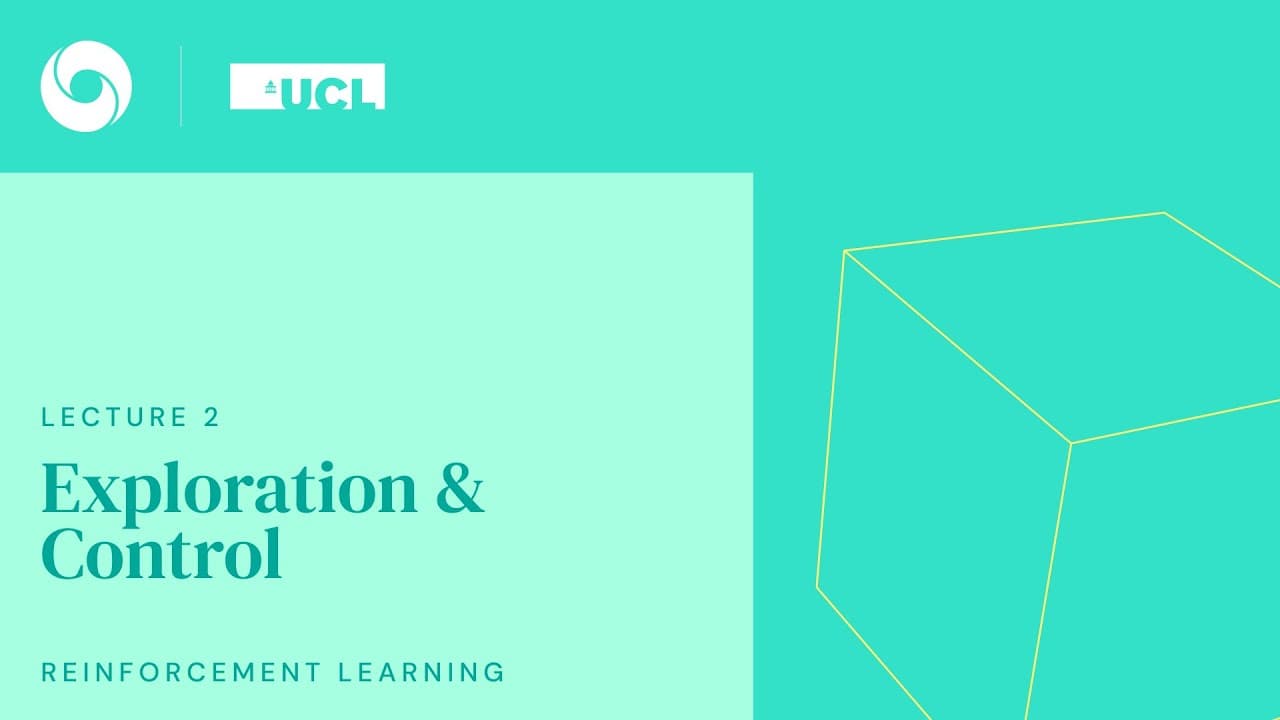
Exploration and exploitation must be balanced because actions influence future data, not just immediate rewards. In a simplified RL setting with a single state, the agent learns to choose actions by comparing immediate rewards and using active information gathering. The lecture discusses how uncertainty and past outcomes guide ongoing action choice.
Transcript
hi and welcome to this second lecture in this course on reinforcement learning my name is adolf and hussels and today i will be talking to you about exploration and exploitation now before i going to tell you what i mean with these terms um i'm quickly going to flash up a slide with some background material i highly recommend you read chapter 2 fro... Read More
Key Insights
- The environment is simplified to a single state, so actions only affect immediate rewards.
- Exploration and exploitation are both necessary because data is outcome dependent, not pre-specified.
- The agent’s data is affected by its own actions, creating an active learning scenario.
- A policy maps internal agent states to actions in the simplified setting.
- Rewards can be seen as the driving signal for learning in this framework.
- The talk references classic RL foundations including the UCB algorithm and bandits literature.
- The presented example uses two actions with binary outcomes to illustrate decision strategies.
- The material connects to broader reinforcement learning topics that extend beyond the single-state simplification.
- More videos from this channel:
- More from this channel: Google DeepMind
Install to Summarize YouTube Videos and Get Transcripts
Explore YouTube Video Summarizer or Get YouTube Transcript Extractor
Questions & Answers
Q: What does it mean to balance exploration and exploitation in reinforcement learning?
Balancing exploration and exploitation means the agent must try different actions to learn about their rewards while also using the information it already has to choose actions that yield high rewards. In this lecture, the environment is simplified to a single state, so the balance centers on maximizing immediate rewards while still gathering information to improve future decisions. The agent faces a trade-off: persisting with a known good action or trying an uncertain option that could yield better rewards, which influences future data and learning progress.
Q: Why is the data in reinforcement learning considered active and influenced by the agent's actions?
Data is active because the agent's actions determine what information is gathered in the environment, unlike static datasets. When the agent takes an action, it experiences a reward and potentially new observations, shaping what it learns next. This creates a feedback loop where improving action choices changes future data availability, guiding ongoing policy updates and learning progress.
Q: What is the role of the policy in the simplified single-state RL setting?
In this simplified setting, the policy is a mapping from the agent’s internal state to actions. It determines which action to take given the current internal configuration, with the goal of selecting actions that maximize cumulative reward. Since observations are not informative about the environment state, the policy focuses on choosing actions based on prior outcomes and current confidence.
Q: How does the lecture illustrate decision making with two actions and binary outcomes?
The lecture presents action A and action B with rewards of either 0 or 1. The agent starts with no information and must decide which action to try, observe the result, and then choose again. Over time, it weighs past successes and failures to decide whether to persist with the better performing action or switch to the other, balancing exploration and exploitation.
Q: What is the significance of using the term bandits in this context?
Bandit terminology is used to describe problems where the agent must choose among several actions with uncertain rewards and learn from outcomes. In this context, the focus is on choosing actions that yield the highest rewards while dealing with uncertainty about payoff distributions, a central theme in exploration and exploitation strategies.
Q: What reference materials are suggested for deeper understanding of RL in this lecture?
The speaker recommends chapter 2 of the Sutton and Barto RL book for background, and further readings on the slide cover topics like bandit algorithms by Latimore and others, as well as the classic Auer, Cesa-Bianchi and Fisher 2002 paper describing the UCB algorithm, which informs later discussions.
Q: What is the relationship between reward signals and the agent’s goals in this talk?
Rewards define the agent’s goal because they quantify success of actions. The agent tries to maximize the received rewards over time, guiding policy and value function development. In the simplified single-state setup, the focus is on immediate rewards, but the same reward-driven principle frames the broader objective of learning an effective decision strategy.
Q: How does this lecture relate exploration to information gathering?
Exploration is presented as a way to actively gather information about action outcomes. Since data depends on chosen actions, the agent must explore to reduce uncertainty about which actions perform best. This information gain informs future decisions, improving the agent’s policy and its ability to achieve higher rewards in subsequent rounds.
Summary & Key Takeaways
-
In this lecture, the setting is simplified to a single state where only rewards matter, and observations can be ignored for learning. The agent must learn a policy mapping internal states to actions, while the data it collects depends on its actions, creating an active learning loop.
-
The talk connects RL to AI goals, introduces the interaction loop of agent, actions, and environment, and emphasizes reward driven optimization and the role of policy and value functions in learning.
-
A practical example compares two actions with binary outcomes, illustrating how to decide when to persist with an option or switch, and introduces long-term implications of exploration in data gathering.
Read in Other Languages (beta)
Share This Summary 📚
Summarize YouTube Videos and Get Video Transcripts with 1-Click
Try YouTube Summary with ChatGPT & Claude or YouTube Transcript Generator
Explore More Summaries from Google DeepMind 📚

Summarize YouTube Videos and Get Video Transcripts with 1-Click
Try YouTube Summary with ChatGPT & Claude or YouTube Transcript Generator