How to predict protein structures with AI
TL;DR
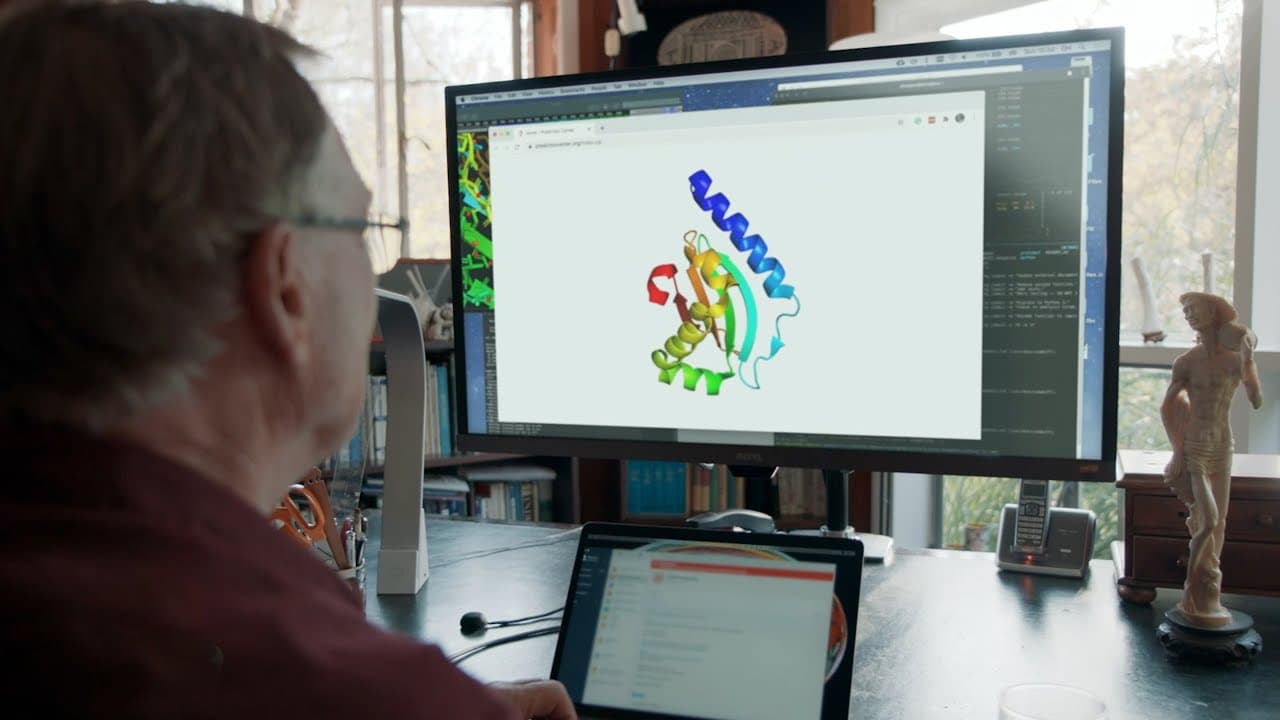
AlphaFold uses AI to predict protein structures quickly, potentially speeding up drug discovery. The project grew through CASP competitions, improving both accuracy and speed, and achieved atomic accuracy in CASP14. The work relies on validation through blind assessments and ongoing innovation to stay ahead of competing groups.
Transcript
We've discovered more about the world than any other civilization before us. But we have been stuck on this one problem. How do proteins fold up? How do proteins go from a string of amino acids to a compact shape that acts as a machine and drives life? When you find out about proteins it is very exciting. You can think of them as little biological ... Read More
Key Insights
- AlphaFold aims to predict protein structures with AI, turning a long standing biology problem into a rapid computational prediction, potentially changing how we study life and disease.
- The team used the CASP competition as an external benchmark to validate progress, treating it as the Olympics of protein folding and applying increasingly ambitious goals.
- CASP14 delivered atomic accuracy predictions, representing a major leap by solving both the right solution search and the verification of its correctness.
- The project progressed from CASP12 where ground truth metrics like GDT were used to evaluate progress, to CASP13 where AI began to show effective early results, and finally to CASP14 with high precision predictions.
- Ground truth comparisons and blind assessments remain critical for confirming that AI predictions reflect real structures rather than overfitting to known data.
- ORF8, a SARS-CoV-2 protein, was a particularly hard target where AlphaFold achieved strong predictive performance, illustrating the method’s potential in real-world viral protein analysis.
- There is an ongoing emphasis on speed and accuracy improvements, with the team aiming to surpass current capabilities and to continuously push the boundaries of what AI can predict in protein folding.
- Skepticism in the biology community is acknowledged as healthy, and the DeepMind team stresses the need for validation and careful interpretation of AI driven predictions.
- More videos from this channel:
- More from this channel: Google DeepMind
Install to Summarize YouTube Videos and Get Transcripts
Explore YouTube Video Summarizer or Get YouTube Transcript Extractor
Questions & Answers
Q: A real search query question about the video (e.g. 'How to...', 'What is...', 'Why does...', 'When should...'). Question 1
How does AlphaFold use AI to predict protein structures and why is this important for biology and medicine. The answer describes predicting the three dimensional shapes of proteins from amino acid sequences, enabling faster and potentially more affordable discovery of drugs and better understanding of diseases. This approach aims to replace or supplement traditional experimental methods by providing reliable structural models.
Q: Question 2
What is CASP and why is it described as the Olympics of protein folding. The response explains that CASP is a competition where groups submit predicted structures for a set of proteins and receive ground truth comparisons. It serves as an external benchmark to validate progress, pushing teams to improve accuracy and speed in their computational methods.
Q: Question 3
What happened in CASP14 that marked a turning point for AlphaFold. The explanation notes that CASP14 produced atomic accuracy predictions, addressing both finding the right solution and recognizing a correct solution. This milestone represents a significant leap from earlier CASP results and demonstrates AI capabilities in precise structural biology.
Q: Question 4
How did CASP13 differ from CASP14 in terms of AI capabilities. The answer highlights that CASP13 showed the first effective application of artificial intelligence, improving state of the art but still lacking full atom level details. The progress from CASP13 to CASP14 illustrates rapid advancement and the maturation of AI methods in this field.
Q: Question 5
What is the role of ground truth and blind assessments in AlphaFold's validation. The response emphasizes that blind assessments are crucial to verify that predictions are real and not artifacts. Ground truth data from experiments is used to measure accuracy, and ongoing validation helps manage risk of overfitting and ensures reliability across targets.
Q: Question 6
How did AlphaFold perform on the SARS CoV 2 ORF8 protein during CASP. The answer notes that ORF8 was one of the hardest targets and AlphaFold achieved strong predictive performance, showing the method’s applicability to real viral proteins and its potential utility in understanding coronavirus biology.
Q: Question 7
What is the expected impact of AlphaFold on drug discovery and disease understanding. The explanation discusses the potential to accelerate drug discovery and improve disease understanding by providing reliable structural information that informs how proteins function and interact, potentially speeding up the development of therapies.
Q: Question 8
Why is the team optimistic about future improvements and CASP challenges. The response cites ongoing work, the complexity of protein folding, and the possibility of other groups making breakthroughs. It emphasizes the need to continue refining models and staying vigilant about accuracy and generalization across diverse proteins.
Summary & Key Takeaways
-
AlphaFold is described as a simple system whose predictions can outpace traditional experiments, aiming to speed up structure prediction and enable quicker biological insights.
-
The CASP framework is highlighted as a benchmark to measure progress, with CASP14 showing atomic accuracy and transforming expectations for AI in biology.
-
The story emphasizes collaboration, healthy skepticism, and the importance of continual iteration to solve the protein folding problem.
Read in Other Languages (beta)
Share This Summary 📚
Summarize YouTube Videos and Get Video Transcripts with 1-Click
Try YouTube Summary with ChatGPT & Claude or YouTube Transcript Generator
Explore More Summaries from Google DeepMind 📚

Summarize YouTube Videos and Get Video Transcripts with 1-Click
Try YouTube Summary with ChatGPT & Claude or YouTube Transcript Generator