What Are Model-Free Control Techniques in Reinforcement Learning?
TL;DR
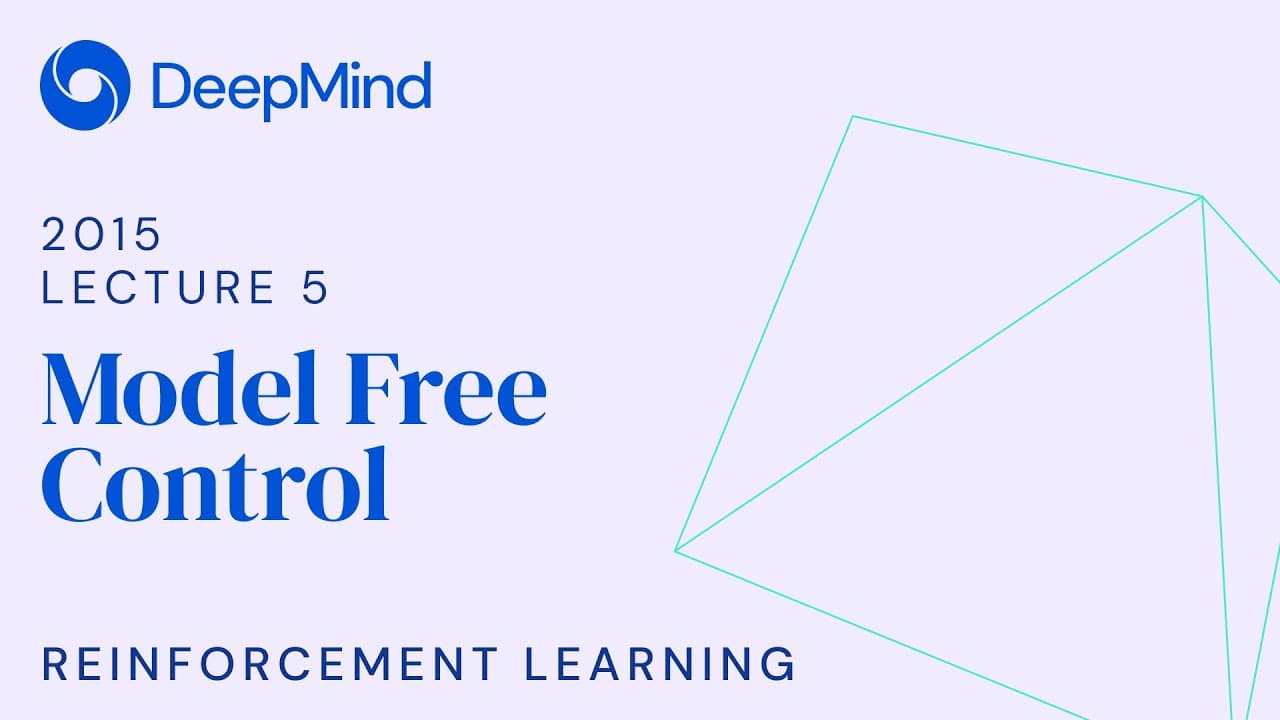
Model-free control techniques allow agents to learn optimal behaviors in unknown environments without prior knowledge of the dynamics. These methods bifurcate into on-policy learning, where agents learn from their actions, and off-policy learning, which utilizes information from other agents. Effective exploration strategies, such as epsilon-greedy methods, are essential to ensure all actions are experienced and to overcome local optima.
Transcript
in some sense you know everything in the course up to this point has been leading to this lecture okay we're going to finally find out how if you drop your robot or agent into some unknown environment and you don't tell it anything about how that environment Works how can it figure out the right thing to do how can it maximize its reward in that en... Read More
Key Insights
- 🥶 Model-free control allows agents to learn optimal behaviors without a predefined understanding of the environment's dynamics.
- ❓ On-policy learning requires agents to learn from the actions they take, while off-policy learning can utilize observations from other agents or policies.
- ❓ Effective exploration strategies are essential for overcoming local optima and ensuring that all relevant actions are experienced by the agent.
- 🇶🇦 Q-learning is a prominent off-policy approach that updates action values using maximum Q-values from alternative actions for improved learning efficiency.
- ❓ Temporal difference learning incorporates both bootstrapping and the concept of delayed rewards, enabling agents to learn continuously from their experiences.
- ⚖️ The epsilon-greedy method remains a straightforward yet powerful technique for balancing exploration and exploitation during policy learning.
- 🦮 Generalized policy iteration serves as a foundational approach, guiding the systematic improvement of policies through iterative evaluations.
Install to Summarize YouTube Videos and Get Transcripts
Explore YouTube Video Summarizer or Get YouTube Transcript Extractor
Questions & Answers
Q: What is the primary goal of model-free control in reinforcement learning?
The primary goal of model-free control is to maximize the long-term reward in an unknown environment by allowing an agent to learn the optimal policies through exploration and experience, rather than relying on a predefined model of the environment.
Q: How does on-policy learning differ from off-policy learning?
On-policy learning involves learning from the actions the agent takes itself while following a specific policy, meaning the agent evaluates and improves the same policy it's currently executing. Off-policy learning, in contrast, enables learning from actions taken by another policy, which can include observing another agent's behavior or historical actions from a previous policy.
Q: Why is exploration important in reinforcement learning, and how is it typically achieved?
Exploration is crucial because it ensures that the agent experiences various states and actions, which is necessary to learn effective policies. It can be achieved using strategies like epsilon-greedy, where the agent occasionally selects random actions with a probability of epsilon, ensuring ongoing exploration while also exploiting known rewarding actions.
Q: What are Q-values, and how do they facilitate learning in reinforcement learning?
Q-values, or action-value functions, represent the expected future rewards for taking a specific action in a given state. They facilitate learning by enabling agents to update their understanding of the value of actions based on experience, leading to improved decision-making and the ability to derive optimal policies.
Q: Can you explain the concept of off-policy learning with an example?
Off-policy learning allows an agent to learn about different policies while following a separate behavior policy. For instance, if an agent watches another agent play a game, it can analyze those actions and learn about how to behave optimally in similar situations, even though it’s not actually performing those actions itself.
Q: What role does temporal difference (TD) learning play in reinforcement learning?
Temporal difference learning allows agents to update their value estimates based on the difference between predicted rewards and actual rewards observed after taking actions. It combines ideas from Monte Carlo methods and dynamic programming to provide efficient learning through bootstrapping, enabling updates after each step rather than waiting for an entire episode.
Q: How does the epsilon-greedy strategy work, and why is it effective?
The epsilon-greedy strategy works by allowing an agent to choose the best-known action most of the time while occasionally selecting a random action with probability epsilon. This balances exploitation of known rewards with exploration of potentially better actions, thus facilitating better learning over time.
Q: What is the significance of the generalized policy iteration framework?
The generalized policy iteration framework is significant because it provides a structured approach to alternating between policy evaluation and policy improvement. By evaluating the current policy to obtain value estimates and then improving the policy based on those estimates, agents can iteratively converge to optimal policies in reinforcement learning.
Summary & Key Takeaways
-
The lecture introduces model-free control techniques for reinforcement learning, focusing on how agents can learn optimal policies in unknown environments without prior knowledge.
-
It distinguishes between on-policy and off-policy learning, explaining how on-policy methods learn from actions taken by the agent itself while off-policy methods can learn from other agents’ actions or policies.
-
The importance of exploration versus exploitation is emphasized, with methods like epsilon-greedy strategies used to ensure that agents adequately explore the state space while still learning effective policies.
Read in Other Languages (beta)
Share This Summary 📚
Summarize YouTube Videos and Get Video Transcripts with 1-Click
Try YouTube Summary with ChatGPT & Claude or YouTube Transcript Generator
Explore More Summaries from Google DeepMind 📚

Summarize YouTube Videos and Get Video Transcripts with 1-Click
Try YouTube Summary with ChatGPT & Claude or YouTube Transcript Generator