How Can AI Design Drugs with AlphaFold 3?
TL;DR
AI can design drug molecules by predicting how proteins and small molecules fit, using AlphaFold 3 to map structures. The approach opens a practical path toward solving diseases by modeling biology numerically, enabling rapid exploration of targets and molecules. Experts emphasize collaboration between biology and AI, with future work extending to clinical design and toxicity insights.
Transcript
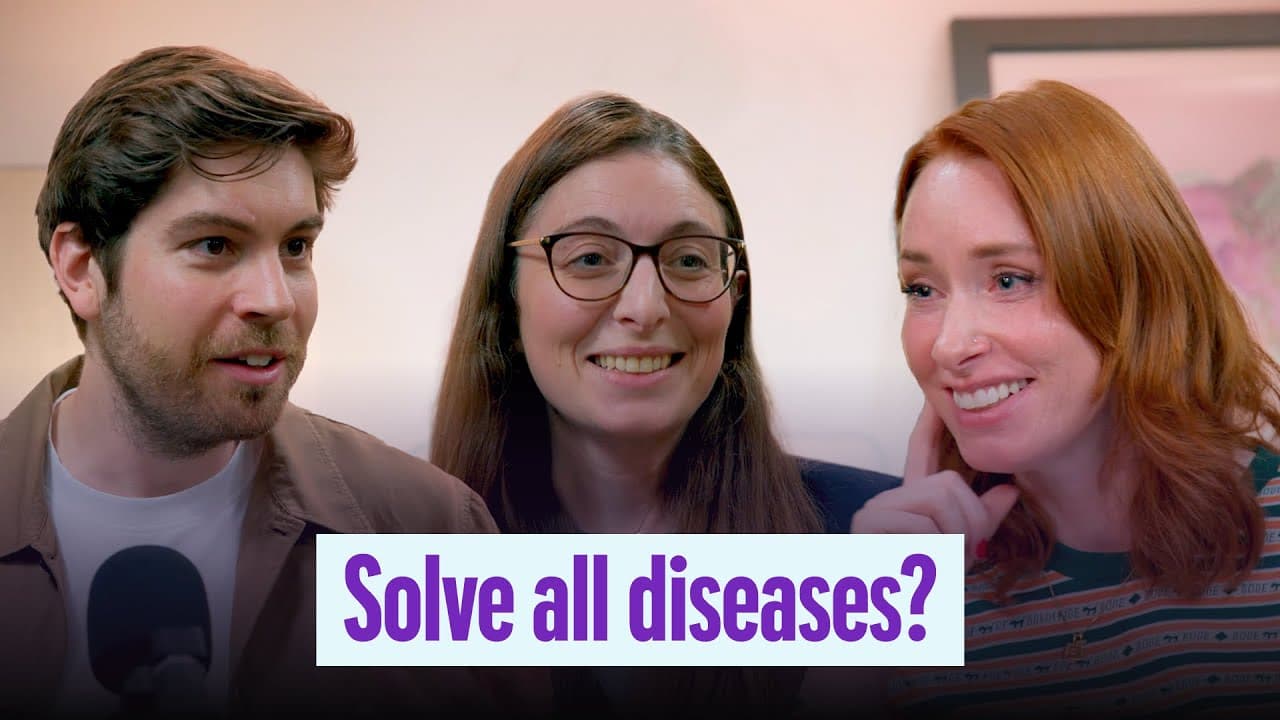
HANNAH FRY: So, I mean, you literally say, make me a drug for X disease, off it goes, says, here's the molecule you need. MAX JADERBERG: Yeah, yeah. HANNAH FRY: Do you think that's possible? MAX JADERBERG: It's possible. I think, it's possible. I think everything is pointing in that direction. REBECCA HALL: Well, I've seen first hand is what can co... Read More
Key Insights
- AlphaFold 3 enables prediction of structures for proteins and small molecules, expanding the space of druggable targets.
- Drug design relies on molecules fitting into protein pockets, like a wrench fitting a gear, to modulate function and alter disease states.
- AI is suited for this domain because structural prediction provides clear, quantitative targets for supervised learning and diffusion modeling.
- The field aims to create an AI driven drug design engine that can handle many diseases and targets without pre existing drugs.
- Clinical development remains slower and regulatory heavy, but improved design could streamline future trials and safety assessments.
- Isomorphic Labs views the immediate goal as validating design principles and speeding up early drug discovery steps.
- A multi disciplinary collaboration between biologists and AI researchers is essential to translate models into real molecules.
- The progress mirrors the broader trajectory of AI in science where computing and data drive new hypotheses and faster iteration.
- More videos from this channel:
- More from this channel: Google DeepMind
Install to Summarize YouTube Videos and Get Transcripts
Explore YouTube Video Summarizer or Get YouTube Transcript Extractor
Questions & Answers
Q: A real search query question about the video (e.g. 'How to...', 'What is...', 'Why does...', 'When should...'). Question 1
What is AlphaFold 3 and how does it change drug design? AlphaFold 3 extends structure prediction to include small molecules and proteins, creating a more complete map of how potential drugs can interact with targets. This expanded capability enables researchers to design molecules that fit active sites with precision, reducing guesswork and enabling more rapid iteration in the early stages of drug discovery.
Q: What is the core ambition of Isomorphic Labs in drug discovery?
Isomorphic Labs aims to move toward a solvable disease space by building an AI driven drug design engine that can take any disease and target and generate molecules that modulate the protein’s function. The goal is to create drug candidates quickly, enabling faster progression from target to hopeful therapeutic agents while rethinking traditional design and testing workflows.
Q: How does AI help with understanding disease biology according to the podcast?
AI helps by providing models that understand the biochemical world in new ways, enabling exploration of disease space previously considered intractable. By predicting how molecules interact with proteins and cells, AI can reveal mechanisms driving disease and identify how to intervene, which was harder with earlier methods that relied more on trial and error.
Q: Why are some cancers harder to cure with drugs, as discussed in the interview?
Some cancers continually evolve, meaning they adapt to escape a single drug, unlike cancers that are driven by a single stable mutation. This ongoing evolution requires designing drugs that can keep up with changes, a task that benefits from rapid AI guided design to propose new molecular strategies repeatedly.
Q: What is the role of protein pockets in drug design?
Protein pockets or crevices are the sites where small molecules must fit to block or modulate function. Designing a molecule that perfectly fits these pockets is akin to inserting a precise wrench into gears, which can stop the protein’s detrimental activity and alter disease progression.
Q: What future aspects beyond drug design are envisioned for AI in this field?
Beyond initial design, AI could influence clinical development and trial design by better predicting how molecules behave in the body, potential toxicity, and efficacy, enabling smarter, more targeted clinical studies and possibly altering traditional regulatory approaches as understanding improves.
Q: What makes this domain particularly suitable for AI modeling?
The domain offers a clear success metric: accurate prediction of 3D coordinates and molecular interactions. This provides a concrete target for supervised learning and diffusion models, creating a measurable path to validate AI driven designs and accelerate the generation of viable drug candidates.
Q: What is the practical timeline suggested by the speakers for AI driven drug discovery?
The speakers acknowledge the timeline is gradual and not instantaneous, emphasizing progress toward a practical path where AI models understand biology and chemistry well enough to enable meaningful design iterations. They stress the current focus on drug design and anticipate broader changes in related processes over time.
Summary & Key Takeaways
-
We discuss the fusion of biology and AI to accelerate drug discovery, highlighting AlphaFold 3 as a pivotal tool for predicting molecular structures and guiding molecule design.
-
The conversation explains target selection, molecular docking as a blocking mechanism, and the concept of replacing traditional trial and error with AI driven design and evaluation.
-
The speakers outline a staged ambition from design to potential clinical development while noting current focus on drug design and future implications for trials and regulatory considerations.
Read in Other Languages (beta)
Share This Summary 📚
Summarize YouTube Videos and Get Video Transcripts with 1-Click
Try YouTube Summary with ChatGPT & Claude or YouTube Transcript Generator
Explore More Summaries from Google DeepMind 📚

Summarize YouTube Videos and Get Video Transcripts with 1-Click
Try YouTube Summary with ChatGPT & Claude or YouTube Transcript Generator