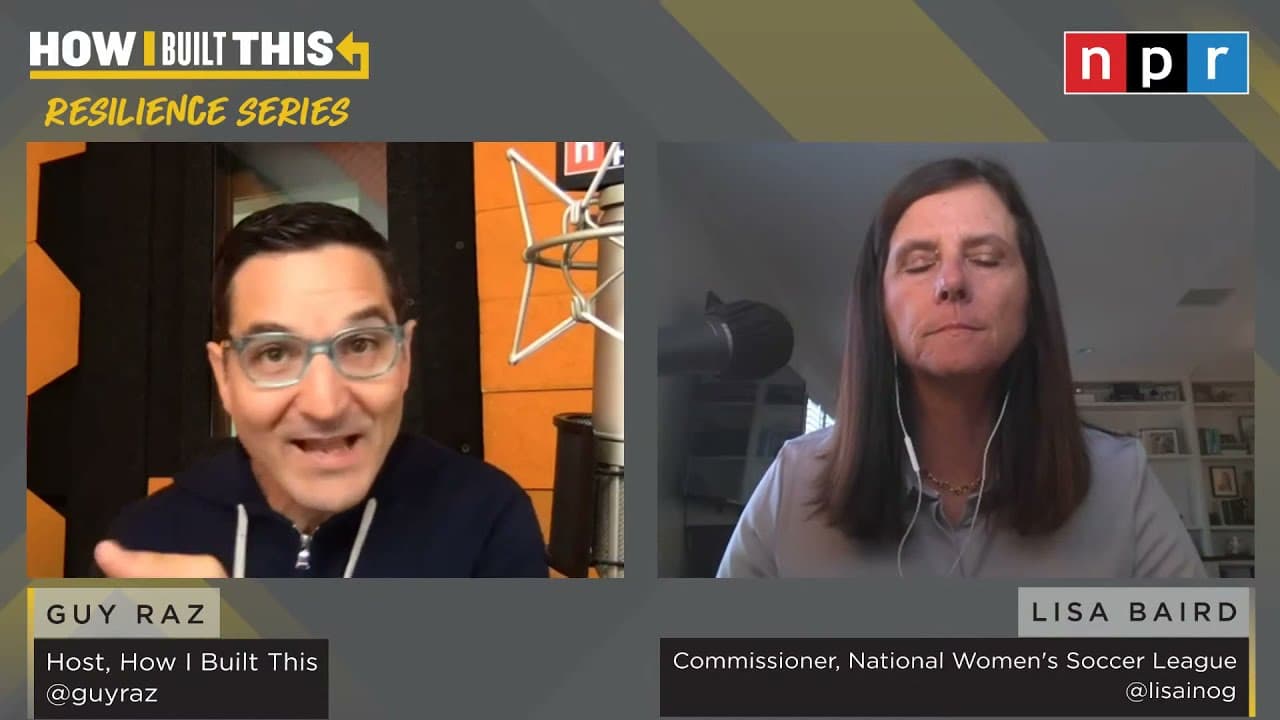
The Strength of Women's Soccer in 2021 | How I Built This with Guy Raz | NPR
TL;DR
The NWSL protected players by suspending operations, forming a medical task force, developing safety protocols, preserving player pay, and redesigning its competition. Commissioner Lisa Baird secured federal small-business support and coordinated doctors, owners, teams, and league staff, helping the league become one of the first to resume live matches without recording a positive COVID test.
Transcript
hello and welcome to how i built this resilience edition from npr i'm guy roz it is um hard to believe but uh a year ago this week so many things around the united states around the world shut down including major sports leagues i was just looking at my iphone and and you know how it shows you the on this day a year ago it was a photo of me at a fa... Read More
Key Insights
- Lisa Baird suspended NWSL operations two days after becoming commissioner because soccer is a contact team sport, and the league could not responsibly expose athletes while the health risks of COVID-19 remained unclear.
- The sports industry shut down worldwide within roughly 24 hours, leaving the NWSL without an existing model for handling the crisis. Baird contacted larger sports organizations and Olympic contacts, but discovered that no established return-to-play playbook existed.
- The NWSL created a medical task force of 15 doctors to determine how operations could resume safely. Their work produced protocols governing every aspect of the league's activities, including the eventual process for returning players to training.
- Player protection included financial security as well as medical safeguards. The commissioner and team owners treated continued compensation as a critical principle, including payment for players who chose to opt out after competition resumed.
- The league's crisis response was divided into connected work streams covering medical protocols, short-term and long-term financing, safe training, and competition design. Baird participated in every group because choices in one area could affect all the others.
- The NWSL's financial vulnerability came from its dependence on ordinary revenue sources such as tickets and sponsorships. When those sources disappeared, the league needed outside resources to continue paying its players and preserve operations.
- Federal small-business assistance provided the NWSL with a temporary financial lifeline. Baird researched the emerging program, found knowledgeable support through the league's banking partner, and personally uploaded about a thousand pages of documents for the application.
- The NWSL became one of the first leagues to return to live matches and did so without a single positive COVID test. Its return began with the Challenge Cup in Utah, following weeks of work on health protocols, training, financing, and competition planning.
Install to Summarize YouTube Videos and Get Transcripts
Explore YouTube Video Summarizer or Get YouTube Transcript Extractor
Questions & Answers
Q: Why did the NWSL suspend operations during COVID-19?
The NWSL suspended operations because soccer is a contact team sport, and continuing preseason activity could have placed athletes at risk before the league understood COVID-19. Lisa Baird made the decision two days after becoming commissioner. She described player health and wellness as the principle that made the immediate choice clear, even though the consequences for players, owners, and fans were serious.
Q: How did Lisa Baird create an NWSL return-to-play plan?
Lisa Baird began by identifying the separate but connected problems the league needed to solve. She established groups focused on medical protocols, financial resources, safe training, and the format of a future competition. Because the league office had only 17 employees, she remained involved in every group and coordinated decisions whose effects crossed from one work stream into another.
Q: What role did the NWSL medical task force play?
The NWSL convened a medical task force consisting of 15 doctors. Although not all were infectious-disease specialists, they had access to relevant resources and worked to understand what the league needed for a safe return. Their efforts produced medical protocols that governed every aspect of league activity and supported the process of bringing players back to training over a period of weeks.
Q: How did the NWSL continue paying players during the shutdown?
The commissioner and NWSL owners decided that continuing player compensation was a critical part of their response, alongside medical safety. With ticket and sponsorship revenue unavailable, Lisa Baird investigated federal assistance offered through the Small Business Administration. The resulting funds gave the league time and resources to keep paying players while it planned safe training and a redesigned competition.
Q: Were NWSL players paid if they opted out of playing?
NWSL players continued to be paid even if they chose not to participate after play resumed. Lisa Baird presented this policy as part of the league's broader commitment to safeguarding players. Protection therefore included both health protocols and financial resources, allowing players to make decisions about participation without losing the compensation that the commissioner and owners had identified as a critical principle.
Q: How did Lisa Baird secure small-business funding for the NWSL?
Lisa Baird researched the developing federal small-business program when little information was initially available online. She contacted the league's banking partner and located someone who could help her understand the process. With the finance director on maternity leave, Baird personally spent six hours uploading about a thousand pages of supporting documents. The league received the requested resources seven days later.
Q: Why was the NWSL financially vulnerable during the shutdown?
The NWSL was a small, thinly resourced league that depended on revenue from tickets and sponsorships. Suspending operations removed those ordinary sources while the organization still wanted to compensate its players. This created an urgent need for both short-term and long-term financial planning, including outside assistance that could preserve payroll while the league developed safety protocols and a new competition structure.
Q: How successful was the NWSL's return to live matches?
The NWSL became one of the first professional leagues to return to live competition. It resumed with the Challenge Cup in Utah after developing medical protocols, arranging safe training, securing financial support, and determining a new competition format. According to the description, the return produced no positive COVID tests and attracted a major increase in television viewership.
Summary
In this episode of "How I Built This: Resilience Edition," Lisa Baird, the commissioner of the National Women's Soccer League (NWSL), talks about the challenges and successes the league faced during the COVID-19 pandemic. She discusses the decision to shut down the league, the creation of a bubble-like environment for the teams, and the remarkable increase in TV viewership for the league. Baird also addresses questions about the future of the NWSL, including its potential for growth and media attention, and the impact of the recent lawsuit on pay disparity in women's soccer.
Questions & Answers
Q: Can you tell us a little bit about the National Women's Soccer League (NWSL)?
The NWSL was started nine years ago by U.S. Soccer with the intention of creating a professional league for the U.S. women's national team to continue playing and improving their skills between major competitions like the World Cup and the Olympics. The league currently has ten teams, with two more teams set to join in California. The NWSL is focused on creating a strong foundation of support for women's soccer at the professional level.
Q: How did the decision to shut down the league due to the pandemic unfold?
As the newly appointed commissioner, I had to make the difficult decision to shut down the NWSL just two days into my job. It was a moment of clarity, knowing that the safety and well-being of our players, staff, and fans were at stake. The entire sports industry worldwide shut down within 24 hours, and it became evident that we needed to take immediate action to safeguard everyone involved.
Q: What was the process of bringing women's soccer back, specifically the Challenge Cup tournament?
After developing medical protocols and determining the necessary resources, we decided to create a bubble-like environment for the teams. We selected Utah as the host city due to low COVID-19 incidents in that region. We worked closely with the governor and Real Salt Lake to secure suitable facilities and coordinated schedules to ensure the teams could safely train and compete. It required meticulous planning, testing, and a high level of discipline from everyone involved.
Q: Did the increase in TV viewership during the Challenge Cup have a financial impact on the league?
While the pandemic presented financial challenges, the increased TV viewership and strong engagement from fans were significant. We were able to sign three national sponsors (Procter & Gamble, Verizon, and Google) and deliver strong ratings for advertisers. This response gives us hope that the attention and support for women's soccer will continue to grow, which will ultimately lead to greater financial stability for the league.
Q: Do you think women's soccer will reach the same level of media attention as men's soccer within the next ten years?
Yes, I believe that women's soccer has the potential to receive equal media attention in the future, despite currently only accounting for four percent of all sports media coverage. The key is to continue building exposure and engagement with the audience. By showcasing the talent of our athletes, expanding coverage, and securing more endorsement deals, women's soccer can become a self-sustaining sports league that garners the attention and resources it deserves.
Q: What have you learned from this past year that will shape your leadership going forward?
This past year has taught me the importance of resilience and adaptability in the face of adversity. Despite the challenges, I realize the privilege of leading a growing sport and the responsibility to use my platform to make a positive impact. I aim to continue fostering a strong sense of unity and believe in finding innovative solutions to overcome obstacles. The lessons learned during this time will stay with me as I continue to lead the NWSL.
Takeaways
The COVID-19 pandemic presented significant challenges for the National Women's Soccer League, but it also created opportunities for growth and adaptation. The decision to shut down the league and create a bubble-like environment for the teams was a difficult but necessary step to protect the health and safety of everyone involved. The increased TV viewership and strong engagement from fans during the Challenge Cup highlighted the potential of women's soccer to capture a broader audience. By continuing to build exposure, secure sponsors, and address media disparities, there is a real chance for women's soccer to achieve equal recognition and financial stability in the future. The lessons of resilience, adaptability, and collaboration learned during this challenging time will shape the league's leadership moving forward.
Summary & Key Takeaways
-
Lisa Baird became NWSL commissioner just as COVID-19 brought worldwide sports operations to a halt. Two days into the job, she suspended league activity because a contact team sport could expose athletes to an unknown health threat. Protecting player health and wellness supplied a clear principle for that difficult decision.
-
With no established plan for restarting professional sports, Baird divided the crisis into connected work streams. A task force of 15 doctors developed medical protocols, while the league addressed finances, player compensation, safe training, and competition design. Baird remained involved across groups because the central league office employed only 17 people.
-
The NWSL depended on ticket revenue and sponsorship, yet its owners and commissioner committed to paying players, including those who opted out. Baird pursued federal small-business assistance, personally submitted extensive supporting documentation, and obtained funding seven days later. The resulting resources bought time for the league to maintain player compensation and prepare its return.
Read in Other Languages (beta)
Share This Summary 📚
Summarize YouTube Videos and Get Video Transcripts with 1-Click
Try YouTube Summary with ChatGPT & Claude or YouTube Transcript Generator
Explore More Summaries from NPR 📚





Summarize YouTube Videos and Get Video Transcripts with 1-Click
Try YouTube Summary with ChatGPT & Claude or YouTube Transcript Generator