Bill Creelman on Spindrift and Moments of Joy with Guy Raz | How I Built This | NPR
TL;DR
Spindrift kept its grocery field team working through the early lockdowns, with gloves, masks and six feet of distance, because stores were flooded and asked for support. Take-home sales rose two to four hundred percent while food service partners collapsed, so the company helped those partners resell or return product and shifted toward e-commerce channels like target.com, Costco and Instacart.
Transcript
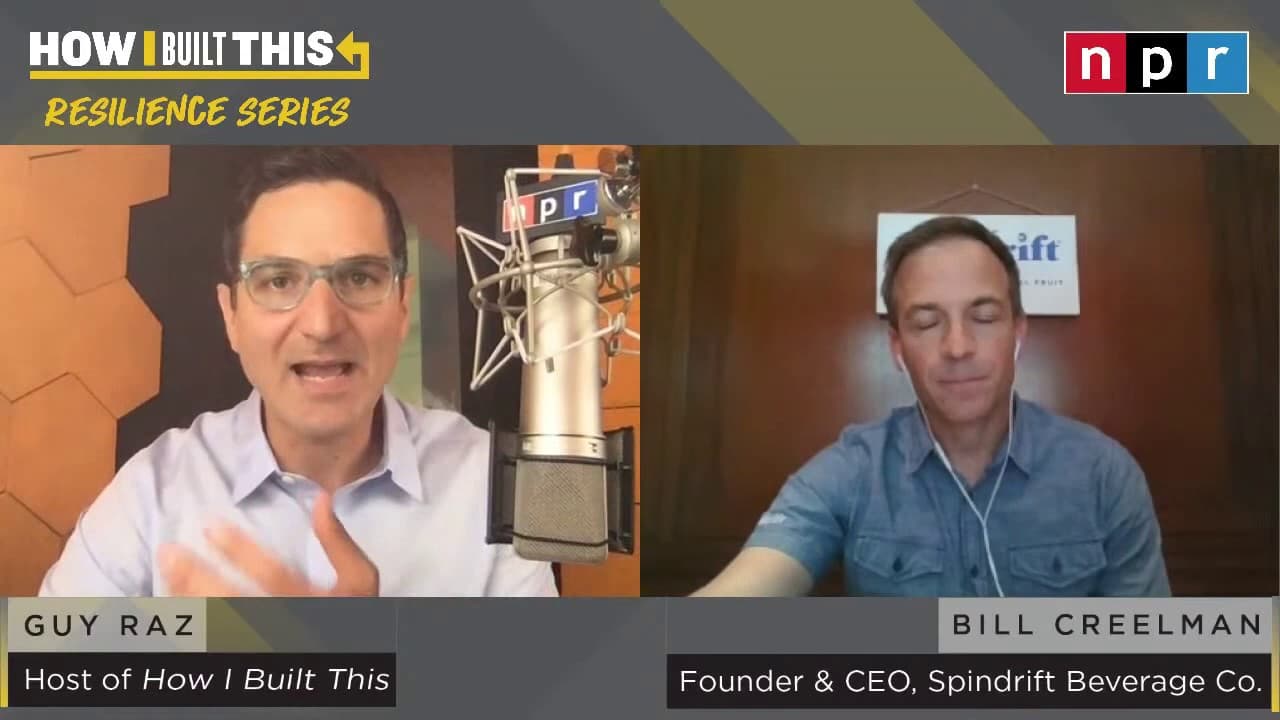
hello everyone and welcome to how I built this resilience edition this is where we're hearing from founders about how they're navigating the economic crisis how is everyone doing today I am so excited to have Bill Creelman the founder and CEO of spindrift sparkling water with me is right there next to me and we are taking your questions right now f... Read More
Key Insights
- The first major pandemic decision for Spindrift was skipping its largest trade show, scheduled at the start of the outbreak, as people began talking about the virus arriving on the West Coast while the company is based in Massachusetts.
- Keeping the field team in grocery stores was one of the hardest decisions Spindrift made, because it involved employees' health and their families' health, and leadership had to decide on imperfect information.
- Spindrift decided its field team could keep working if they had gloves and masks and could maintain six feet of distance, and Bill Creelman says this commitment was a difference maker over three or four months.
- The initial pandemic buying surge gave Spindrift roughly a two to four hundred percent lift in the take-home trade, with shelves emptied and trucks pulled forward to restock stores.
- Food service partners such as Starbucks, Sweetgreen and Panera faced the opposite pressure, losing business while grocery boomed, and Spindrift treated them as partners who helped bring the brand forward rather than only as customers.
- Spindrift's supply chain was affected all the way to the farms growing its fruit, whose restaurant business slowed, which left more fruit volume available to Spindrift while the farmers' livelihoods were in question.
- Spindrift developed a remote production strategy, adding new technology in its plants and having staff wait in parking lots to test product, while also launching a new pineapple flavor during this period.
- Spindrift saw sales move between channels rather than simply fall, leaving food service and convenience and moving into e-commerce grocery such as target.com, Costco and Instacart, helped by an early decision to enter e-commerce.
Install to Summarize YouTube Videos and Get Transcripts
Explore YouTube Video Summarizer or Get YouTube Transcript Extractor
Questions & Answers
Q: How did Spindrift handle its grocery field team during COVID-19?
Spindrift chose to keep its field team working in grocery stores during the first week of lockdowns, because stores were flooded and asked for support. Bill Creelman and his head of sales decided the team could work safely with gloves and masks while keeping six feet of distance. He called it one of the hardest decisions the team made, since the information was imperfect and people's health was involved.
Q: How much did Spindrift sales rise at the start of the pandemic?
During the initial pandemic buying push, Spindrift saw roughly a two to four hundred percent lift in the take-home trade, meaning products people buy to drink at home. Shelves were emptied and the company pushed to pull trucks forward to restock. Its food service business moved the other way at the same time, because restaurant and cafe partners suddenly had no customers to serve.
Q: Why did Spindrift skip its biggest trade show in 2020?
Spindrift's largest trade show was scheduled for the very beginning of the outbreak, just as people started talking about the virus arriving in the United States, especially on the West Coast. Since the company is based in Massachusetts and would have had to travel, it chose not to attend. Bill Creelman describes this as the first big pandemic decision the company had to make.
Q: How did Spindrift support food service partners during the lockdowns?
Spindrift had five people on its food service team, and Bill Creelman says they simply asked partners how they could help. Many stores were left holding Spindrift with nowhere to sell it, so the team worked with distributors and stores to find places to resell the product or take it back when necessary. Creelman expected food service to come roaring back and wanted to stay a good partner.
Q: Who are Spindrift's food service partners?
Bill Creelman names smaller fast casual restaurants along with larger chains such as Starbucks, Sweetgreen and Panera. He sees them as more than customers: they helped bring Spindrift to the forefront, and their food and values match the brand's, which played a big part in its growth. That relationship is why Spindrift felt compelled to help them during the pandemic.
Q: How did the pandemic affect Spindrift's supply chain?
The disruption ran through the whole chain, starting with the farmers who grow Spindrift's fruit. Their restaurant business slowed, which left more fruit for Spindrift but put the farmers' livelihoods at risk, and Spindrift wanted to support them. In its plants around the country, the company used a remote production strategy with new technology, while staff waited in parking lots to test product coming off the line.
Q: Did Spindrift sales drop as shoppers spent less time in grocery stores?
Bill Creelman describes the change as people moving between channels rather than an overall drop. Sales fell in food service and convenience, which were hit hardest, and moved into e-commerce versions of grocery such as target.com, Costco and Instacart. An early decision to enter e-commerce and a social community of about 50,000 people helped, and he says the company kept pushing toward its plan for the year.
Q: What new product did Spindrift launch during the pandemic?
Spindrift was launching a new pineapple flavor just as the pandemic hit. Bill Creelman says it was a complicated new liquid, and the team had to work out what it would taste like and make sure production went well under remote conditions. He calls those months a period of real improvisation, with new technology going into the plants to keep production running.
Summary
In this video, Bill Creelman, the founder and CEO of Spindrift Sparkling Water, discusses how his company has been navigating the economic crisis caused by the pandemic. He talks about the challenges they have faced, such as deciding whether to keep their field team in grocery stores, the impact on their supply chain, and the shift in consumer purchasing behavior. He also discusses the potential opportunities for innovation and growth during this time. Finally, he touches on the importance of diversity and inclusion in business and his commitment to taking action.
Questions & Answers
Q: How has the pandemic affected Spindrift's business so far?
The pandemic has posed significant challenges for Spindrift. They had to make tough decisions, such as whether to keep their field team in grocery stores and how to navigate their supply chain. However, they have also seen a surge in sales in certain channels, such as e-commerce, and have been able to maintain their long-term growth projections.
Q: Did Spindrift experience a spike or drop in purchases when the lockdowns began?
Spindrift initially saw a spike in purchases as people stocked up on essential goods, including their sparkling water. However, they also experienced a drop in sales in channels such as food service and convenience stores, which were heavily impacted by the lockdowns.
Q: How did Spindrift handle the challenges in their supply chain?
Spindrift faced challenges in their supply chain, particularly in sourcing fresh juice, which is a key ingredient in their product. They had to work closely with farmers and navigate the changing landscape of the food and beverage industry. They implemented new strategies and technology in their production facilities and had to make quick decisions to ensure continuity in their operations.
Q: Have Spindrift's sales been affected by the decrease in foot traffic and the shift in consumer behavior?
Spindrift has seen a shift in consumer behavior, with people moving to different channels, such as e-commerce, to purchase their products. While foot traffic in grocery stores has decreased, they have seen an increase in sales through online platforms and delivery services. They have adapted their strategy to reach consumers in these new channels.
Q: How has Spindrift supported its food service partners during this challenging time?
Spindrift recognizes the impact of the pandemic on their food service partners and has worked closely with them to find solutions. They have helped their partners resell products, taken back inventory if needed, and offered support and assistance throughout the crisis. Spindrift aims to be a supportive partner and build stronger relationships with all their stakeholders.
Q: Did Spindrift face layoffs or did they manage to avoid them?
Spindrift managed to avoid layoffs by making difficult decisions and supporting their field team and employees. They chose to continue supporting grocery stores and found ways for their team to work safely while maintaining social distancing rules. This commitment to their employees' health and well-being has helped them avoid layoffs thus far.
Q: How does Spindrift compete against larger brands with more market share and brand awareness?
Spindrift differentiates itself through its focus on real ingredients and flavor. They rely on sampling and getting people to try their product and recognize its unique qualities. While they may not be able to compete on price or advertising budgets, they believe that their commitment to quality and innovation sets them apart.
Q: How does Spindrift see the crisis impacting its business model and future plans?
Spindrift is evaluating different aspects of its business model, including distribution channels and e-commerce, to adapt to the changing landscape. They are exploring opportunities to leverage their brand's uniqueness and engage consumers in more meaningful ways. The crisis is prompting them to think creatively and find innovative solutions for the future.
Q: How does Spindrift plan to address diversity and inclusion within the company?
Spindrift believes in being a values-driven business and is committed to diversity and inclusion. They have already taken immediate action, such as making donations, supporting employee activism, and funding education. Moving forward, they plan to include diversity and inclusion as part of their long-term planning process and hold themselves accountable for progress in this area.
Q: What does Bill Creelman hope to take away from this moment in history in five years' time?
Bill Creelman sees this moment as a time for self-reflection, growth, and positive change. He hopes that the lessons learned during this crisis will lead to greater equality and progress in society, education, and business. He believes that this challenging period can be a catalyst for positive transformation and is inspired by the opportunities for improvement and innovation that may arise.
Takeaways
During the economic crisis caused by the pandemic, Spindrift Sparkling Water has faced challenges, such as navigating the supply chain and adapting to changes in consumer behavior. However, they have also seen opportunities for innovation and growth, particularly in e-commerce. The company remains committed to its values, including diversity and inclusion, and plans to hold themselves accountable for progress in these areas. In the future, they aim to build a better future for their business and the communities they serve. Overall, this period of uncertainty has prompted Spindrift and other businesses to reassess their strategies and find ways to thrive in the changing landscape.
Summary & Key Takeaways
-
Bill Creelman, founder and CEO of Spindrift, a sparkling water brand made with a squeeze of fresh juice, joined Guy Raz on How I Built This Resilience Edition. He described a year that looked like a record before the lockdowns, and talked about working from home while homeschooling his children.
-
Spindrift skipped its largest trade show and decided to keep its grocery field team working with gloves, masks and six feet of distance. Take-home sales jumped two to four hundred percent while food service partners such as Starbucks, Sweetgreen and Panera lost business, so Spindrift worked closely with them.
-
The pandemic disrupted Spindrift's whole supply chain, from fruit farms to production plants. The company built a remote production strategy, launched a new pineapple flavor, and saw demand shift into e-commerce channels like target.com, Costco and Instacart. It also helped food service stores resell or return unsold inventory.
Read in Other Languages (beta)
Share This Summary 📚
Summarize YouTube Videos and Get Video Transcripts with 1-Click
Try YouTube Summary with ChatGPT & Claude or YouTube Transcript Generator
Explore More Summaries from NPR 📚




Summarize YouTube Videos and Get Video Transcripts with 1-Click
Try YouTube Summary with ChatGPT & Claude or YouTube Transcript Generator