How to Lead with Empathy featuring the CEOs of Boxed, Dallas Mavericks, and barre3 | NPR
TL;DR
Empathetic leadership starts with listening to employees, learning from their experiences, and treating them as people rather than merely as workers. Leaders build trust through small acts of care, honest self-awareness, collaboration, and a willingness to take thoughtful risks. As organizations grow, leaders must also leave frontline tasks behind and focus on responsibilities only they can perform.
Transcript
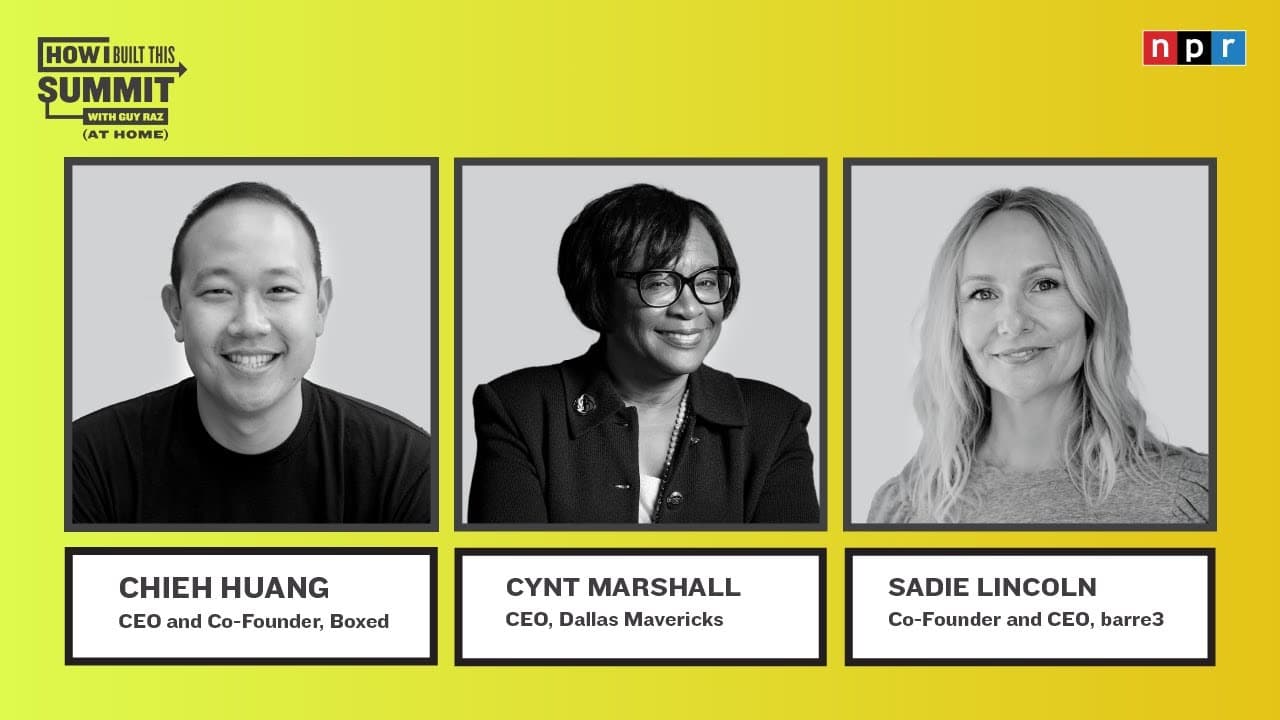
uh we are gonna dive right into our panel conversation and discussion on leadership and i am so excited to be joined by these three incredible people um friends of the show and and even though i've only met sadie in person i consider che and instant friends and good friends and it's so wonderful to have all of you here so please join me in welcomin... Read More
Key Insights
- Empathetic leadership is grounded in listening to employees, learning from their perspectives, and caring about them as people. Marshall's early policy change succeeded because she first understood what evening operators needed, then accepted the risk of advocating for a different approach.
- Small acts of care can shape a person's lasting understanding of leadership. Huang remembered a senior law firm partner checking on exhausted junior employees and personally bringing them breakfast after an all-night transaction, demonstrating that empathy can be expressed through simple, practical attention.
- Leadership is a practice rather than a destination. Lincoln says she continues learning every day, using greater self-knowledge to recognize her inherent strengths and surrounding herself with people who respect those strengths while contributing capabilities she does not possess.
- A founder's responsibilities must change as the organization grows. Huang learned that continuing to pack boxes was no longer the best use of his time because hundreds of employees needed him to handle strategy, fundraising, marketing, and other work they could not perform themselves.
- Frontline participation is not always the same as effective service. Although Huang viewed warehouse work as staying close to the troops, an investor helped him see that performing an employee's task could prevent him from fulfilling the leadership duties that most benefited the company.
- Collaborative questioning can create ownership without requiring the founder to possess every answer. Lincoln asked prospective Barre3 owners what they saw in the company and how its model could work in communities such as Bend, Seattle, or Manila, helping establish a participatory culture.
- Culture transformation becomes more achievable when employees already want change. Marshall entered the Dallas Mavericks during a highly public crisis, but she found supportive people inside the organization and established a vision of setting a global standard for diversity and inclusion by year's end.
- Self-awareness helps leaders build complementary teams. Lincoln's approach is to identify where her natural strength lies, stand up for it, and work with people who can contribute where she falls short while still respecting the abilities she brings to the organization.
Install to Summarize YouTube Videos and Get Transcripts
Explore YouTube Video Summarizer or Get YouTube Transcript Extractor
Questions & Answers
Q: How can leaders build trust through empathy?
Leaders can build trust by listening carefully to employees, learning from their experiences, and showing that they value them as people. Marshall demonstrated this by understanding the concerns of evening operators before proposing changes to restrictive break policies. Huang's former law firm partner demonstrated it through a small act of care, personally checking on exhausted junior employees and bringing them breakfast.
Q: What are Cynt Marshall's three principles of leadership?
Cynt Marshall summarizes her leadership role with three actions: listen to the people, learn from the people, and love the people. She developed this philosophy while supervising ten evening operators at age 21. By hearing their concerns, understanding the work process, and advocating for changed policies, she helped the group move its results from the bottom of the state to the top.
Q: Why should founders stop doing frontline work as their companies grow?
Founders may need to stop frontline work because organizational growth creates responsibilities that employees cannot perform on the founder's behalf. An investor told Huang that every moment spent packing boxes prevented him from leading hundreds of people effectively. His higher-value responsibilities had become setting strategy, raising money, working on marketing, and guiding the company rather than continuing warehouse tasks he once enjoyed.
Q: How can a small act demonstrate empathetic leadership?
A small act demonstrates empathetic leadership when it recognizes another person's condition and responds with practical care. After junior law firm employees had worked through the night, their lead partner came to their area, asked how they were holding up, took their coffee, hot chocolate, and breakfast orders, and brought the items back. Huang remembered that gesture as a defining leadership lesson.
Q: Why does Sadie Lincoln describe leadership as a practice?
Lincoln describes leadership as a practice because she believes leaders continue learning rather than arriving at a final state of mastery. Her development depends on learning more about herself, identifying her inherent strengths, and supporting those strengths. She also surrounds herself with people who fill areas where she is weaker while respecting the capabilities she contributes, making leadership an ongoing process of reflection and collaboration.
Q: How did Barre3 create collaboration among studio owners?
Barre3 created collaboration by inviting prospective owners to interpret and adapt the concept rather than simply receiving fixed instructions. Lincoln asked what they saw in Barre3, how they believed it could grow, and what it might look like in their own communities and lives. Those questions reduced the pressure on her to supply every answer and encouraged both literal ownership and a broader culture of participation.
Q: How can a leader begin changing a troubled workplace culture?
A leader can begin culture change by acknowledging the crisis, identifying people inside the organization who also want improvement, and setting a clear vision. Marshall entered the Dallas Mavericks during a public cultural crisis and knew changes would be necessary. She found that some employees supported transformation, then articulated a goal of setting a global standard for diversity and inclusion by the end of that year.
Q: How does self-awareness improve leadership?
Self-awareness improves leadership by helping a person distinguish between natural strengths and areas where support is needed. Lincoln says learning more about herself allowed her to stand up for her inherent strengths and support them effectively. She then built relationships with people who could fill the places where she was less strong while still recognizing and respecting what she contributed, creating a complementary leadership environment.
Summary
This panel discussion on leadership features Che Huang, the founder and CEO of Boxed, Sin Marshall, the CEO of the Dallas Mavericks, and Sadie Lincoln, the founder of Barre3. They discuss their experiences and insights on leadership, including moments that shaped their understanding of leadership, the transition from worker to leader, the importance of vulnerability and authenticity, the challenges of micromanaging, creating a culture of trust, and the difficulty of letting go of underperforming team members.
Questions & Answers
Q: Can you share a moment early in your career when you started forming your understanding of leadership?
Sin recalls a moment early in her career when she had to listen to and empathize with her team, which led to successful results. She learned the importance of listening, learning, and loving her team, and still applies those principles in her leadership today.
Q: How did you begin to understand what it means to be a leader?
Che shares a moment when he was a first-year lawyer and his lead partner showed empathy by bringing food and drinks for the team after an all-nighter. This small act made a big impression on Che and taught him the value of empathy as a leader.
Q: How do you define leadership and what has helped you become a leader?
Sadie believes leadership is a practice rather than a destination. She emphasizes the importance of self-awareness and surrounding herself with people who complement her strengths and fill her gaps. Building a collaborative and ownership-driven culture has been key to her leadership journey.
Q: How did you transition from being a worker to being a leader?
Sin shares her experience of starting as a hands-on worker in her company, but realizing that as the company grew, she needed to focus on leading instead of physically doing the work. An investor helped her understand the importance of stepping back to focus on strategies and leadership rather than day-to-day tasks.
Q: How did you move from being a follower to understanding leadership?
Che recalls a moment when his lead partner showed empathy towards the team and realized the impact such a small act had on him. This experience shifted his understanding of leadership and made him recognize the power of showing empathy as a leader.
Q: How did you become a leader in your own organization?
Sadie explains that she attracted people who shared her vision and values, and she created a culture of collaboration and ownership. She believes in learning from her team and empowering them to contribute their ideas, which has contributed to the success of her organization.
Q: How did you transition from being hands-on in your company to managing others?
Sin admits that it was difficult for her to let go of physically doing the work even after the company grew. An investor made her realize that she needed to focus on tasks that only she could do as a leader, such as setting strategies and working on marketing, while leaving the physical work to the team members.
Q: How did you let go of micromanaging and start trusting your team?
Che acknowledges the instinct to micromanage as a founder and leader, but he learned that micromanaging is counterproductive and hinders employee growth. He advises shifting focus to trust and providing a foundation of trust through open communication and constructive feedback.
Q: How do you create a culture where everyone's voice is heard and respected?
Sin emphasizes the importance of trust and creating an environment where everyone feels comfortable to speak up. She initiates one-on-one conversations, small circles, and organization-wide meetings to encourage open dialogue and shows appreciation for those who challenge and bring different perspectives.
Q: How do you create a safe space for vulnerability and authenticity in a work environment?
Sadie talks about the power of holding regular leadership circles where vulnerability is encouraged. By sharing her own fears and concerns and creating a culture of collaboration and trust, she creates an environment where people can bring their true selves and contribute authentically.
Q: How do you handle situations where you need to let someone go?
Che admits that it is a difficult task but recognizes the importance of recognizing when someone is not the right fit for the organization. It is crucial to have open and honest conversations and not keep someone too long in a role that is not suitable for them. It is essential to prioritize what is best for the company as well as the individual's growth and well-being.
Takeaways
Leadership is about listening, learning, and loving your team. It is important to understand and empathize with others, and build a culture of collaboration and trust. Transitioning from being a worker to a leader requires letting go of control and focusing on higher-level tasks. Vulnerability and authenticity are key to creating a safe and inclusive work environment. Micromanaging hinders employee growth and should be replaced with trust and open communication. Providing open channels for feedback and encouraging dialogue ensures that everyone's voice is heard and respected. Letting go of underperforming team members is difficult but necessary, and it is important to prioritize the best interests of both the company and the individual.
Summary & Key Takeaways
-
Cynt Marshall traces her leadership philosophy to supervising evening operators at age 21. After listening to their concerns about restrictive break policies, she proposed a new approach despite her boss's initial hesitation. The change succeeded, and her team's results moved from the bottom of the state to the top.
-
Chieh Huang learned the value of empathy while working as a first-year law firm employee after an all-night transaction. A lead partner personally checked on the exhausted junior staff and brought them breakfast. Huang later had to apply another leadership lesson by leaving warehouse packing to focus on strategy, fundraising, and marketing.
-
Sadie Lincoln describes leadership as a continuing practice rather than a completed achievement. Her approach centers on understanding her strengths, surrounding herself with people who complement them, and asking collaborators how Barre3 could serve their communities. Cynt Marshall similarly used an inclusive vision to begin changing the Dallas Mavericks' troubled organizational culture.
Read in Other Languages (beta)
Share This Summary 📚
Summarize YouTube Videos and Get Video Transcripts with 1-Click
Try YouTube Summary with ChatGPT & Claude or YouTube Transcript Generator
Explore More Summaries from NPR 📚


Summarize YouTube Videos and Get Video Transcripts with 1-Click
Try YouTube Summary with ChatGPT & Claude or YouTube Transcript Generator