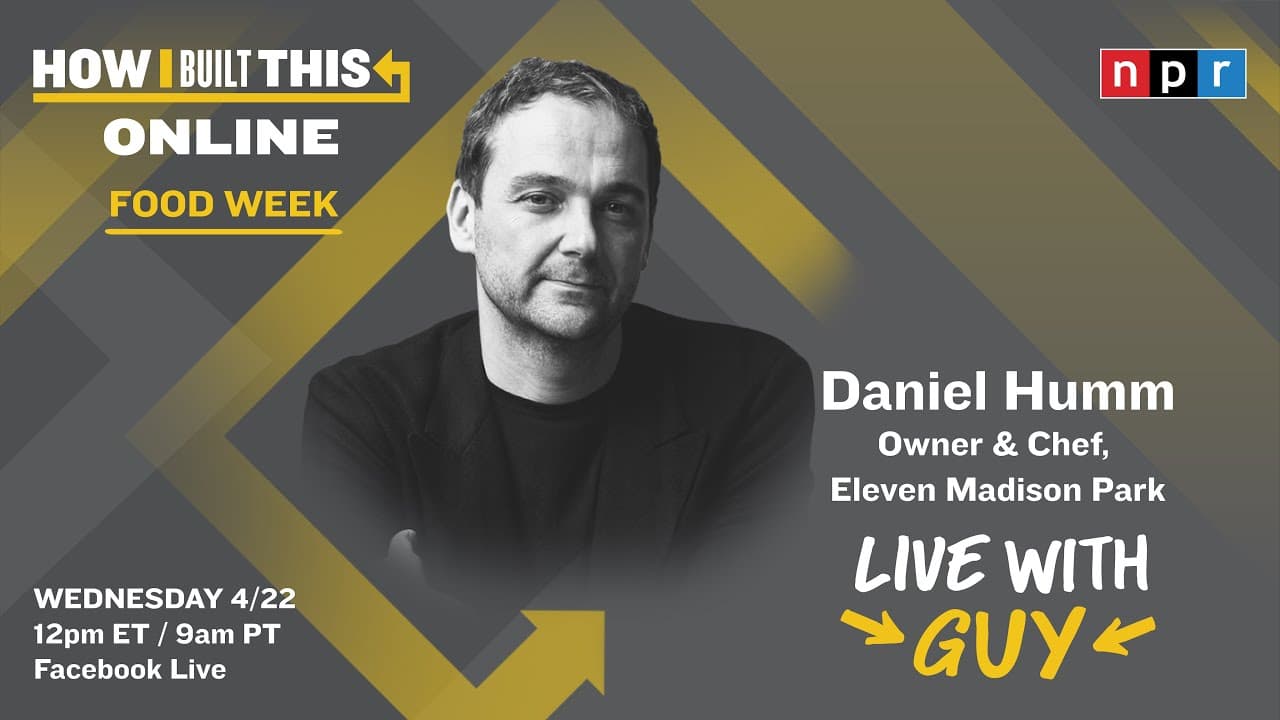
Daniel Humm Converted His Three-Star Michelin Restaurant To A Soup Kitchen
TL;DR
Daniel Humm converted Eleven Madison Park into an emergency kitchen by combining its cooking facilities, supplier relationships, fundraising potential, and partnership with Rethink Food. After studying soup kitchens and establishing safety procedures, his teams began producing 5,000 free meals daily for hospital workers, senior homes, homeless shelters, and other New Yorkers needing food during the COVID-19 shutdown.
Transcript
hello everyone and welcome to how I built this video edition how are you all doing today I hope you're well hope you're healthy safe and hopefully indoors mainly indoors we are here to talk about how business and businesses are building resilience right now and we're taking your questions right now on Facebook on Twitter and on YouTube um this week... Read More
Key Insights
- Eleven Madison Park closed on March 16 after operating a full restaurant the previous Sunday, forcing Daniel Humm to confront an abrupt shutdown, furlough 300 employees, and watch a long-established team disperse as some international staff returned to their home countries.
- A restaurant's greatest value is its team, according to Humm, because guests can recognize an exceptional establishment through the staff's shared energy before receiving food or service. The shutdown therefore damaged more than revenue, it disrupted the human foundation of the restaurant.
- The takeout option felt inappropriate to Humm because New York was experiencing a severe crisis while ambulances filled the city's soundscape. He concluded that delivering elaborate dishes such as honey-lavender roasted duck in fancy packaging did not match what people urgently needed.
- The emergency kitchen became possible through existing resources: Humm had relationships with farmers and producers, access to a professional kitchen, the ability to cook, potential team members, fundraising capacity, and a board position with the nonprofit organization Rethink Food.
- Soup-kitchen research was essential because Humm initially did not know the appropriate meal format, portion size, packaging method, cost per meal, or safe kitchen procedures. Visiting operations around New York helped him design a practical emergency food program quickly.
- Kitchen safety depended on smaller working groups, temperature checks when people entered, social distancing considerations, and operational planning. Humm specifically wanted to avoid a situation in which one sick person could force the entire meal-production effort to shut down.
- The two activated kitchens produced 5,000 meals daily, with Eleven Madison Park making 3,000 and Humm's fast-casual restaurant making another 2,000. Rethink Food handled distribution to hospitals, senior homes, homeless shelters, frontline workers, and others needing meals.
- Purpose became a central question after Eleven Madison Park was named the world's best restaurant in 2017. Humm had pursued that goal for 10 years, but achieving it removed the motivating target and left him searching for a new direction that included giving back and sustainability.
Install to Summarize YouTube Videos and Get Transcripts
Explore YouTube Video Summarizer or Get YouTube Transcript Extractor
Questions & Answers
Q: How did Daniel Humm turn Eleven Madison Park into an emergency kitchen?
Daniel Humm identified the resources already available to him: a professional kitchen, relationships with farmers and producers, cooking expertise, potential staff, fundraising capacity, and a connection to Rethink Food, where he served on the board. He then studied New York soup kitchens, recruited a small team, established safety procedures, and organized meal production and distribution through the nonprofit partnership.
Q: Why did Daniel Humm reject a takeout model during the COVID-19 shutdown?
Humm explored operating some form of takeout business after the restaurant closed, but the idea felt wrong to him during New York's crisis. While the city was shut down and ambulances were constantly audible, he did not believe people needed elaborate dishes such as honey-lavender roasted duck delivered in fancy packaging. He chose to direct the restaurant's capabilities toward free emergency meals instead.
Q: How many meals did Daniel Humm's emergency kitchens produce each day?
The emergency operation produced 5,000 meals per day across two kitchens. Eleven Madison Park prepared 3,000 daily meals, and a second kitchen at Humm's fast-casual restaurant added another 2,000. Although Humm acknowledged that this sounded substantial, he also described it as only a drop in the bucket compared with the scale of food need across New York.
Q: Who received meals from Eleven Madison Park's emergency kitchen?
Rethink Food distributed the prepared meals to senior homes, hospitals, homeless shelters, frontline workers, and other people who needed food. Hospital workers had difficulty finding time or access to meals, while many soup kitchens had closed because they depended on volunteers, including elderly volunteers concerned about their health. These conditions expanded the number of New Yorkers requiring reliable meal support.
Q: What did Daniel Humm learn by visiting soup kitchens in New York?
Humm visited soup kitchens because running an emergency meal operation required knowledge that differed from managing a three-star Michelin restaurant. He needed to understand what each meal should contain, how large portions should be, how food should be packaged, what each meal should cost, and how teams could work safely. Those visits informed the structure of the new kitchen operation.
Q: How did the emergency kitchen protect workers during meal production?
Safety measures included dividing workers into smaller groups and taking each person's temperature when they entered the kitchen. Humm also considered social distancing and designed the workflow to reduce the chance that one illness would shut down the entire operation. These precautions were especially important because employees faced personal health concerns, family responsibilities, and uncertainty about returning to work.
Q: How did Eleven Madison Park's shutdown affect Daniel Humm's staff?
Humm furloughed 300 people after realizing the shutdown would last longer than initially expected. About 30 percent of the staff came from elsewhere, and some returned to their home countries. When he sought volunteers for the emergency kitchen, only 10 people responded. He found that difficult, but recognized that employees were following stay-at-home guidance and protecting themselves, elderly relatives, and their families.
Q: Why did Daniel Humm consider teamwork more valuable than restaurant amenities?
Humm believed the team was the restaurant's most valuable asset because its shared experience created an energy guests could recognize within two or three minutes of entering. Beautiful rooms, china, and food were not sufficient by themselves. In his view, a long-standing team made exceptional service possible, so seeing that group disperse during the shutdown was personally and professionally heartbreaking.
Summary
In this video edition of "How I Built This," Chef Daniel Humm discusses how he transformed his world-renowned Michelin-star restaurant, Eleven Madison Park, into an emergency kitchen during the COVID-19 crisis. He shares his journey of adapting to the new circumstances, finding a new purpose, and reimagining the future of fine dining.
Questions & Answers
Q: How did Chef Daniel Humm transform Eleven Madison Park into an emergency kitchen?
Chef Humm explains that when the COVID-19 crisis hit, he realized the need to adapt and help the community. He went on bike rides to clear his mind, explored different ideas, and eventually came up with the concept of turning his restaurant into an emergency kitchen. He leveraged his contacts, kitchen facilities, and experience to set up the operation quickly.
Q: What inspired Chef Humm to dive into this new direction?
Chef Humm shares that he always had a deep connection with food and understood its power to bring people together. In this crisis, with his restaurant closing and having to lay off many staff members, he saw an opportunity to use food to make a positive impact and help those in need. He found a renewed love for food and a new purpose that aligned with his values.
Q: How many meals is Eleven Madison Park currently producing every day?
Chef Humm mentions that they are currently producing 3,000 meals per day at Eleven Madison Park. Additionally, they activated the second kitchen of their fast-casual restaurant, making an additional 2,000 meals per day. In total, they are producing 5,000 meals per day to support hospital workers, homeless shelters, and other individuals in need.
Q: Where are the meals being distributed?
Chef Humm partnered with organizations like Rethink Food and Frontline Foods to distribute the meals. The meals are delivered to hospitals, senior homes, front-line workers, and communities impacted by the crisis. The goal is to ensure that everyone who needs a meal can have access to one.
Q: How is Eleven Madison Park funding these efforts?
Chef Humm mentions that they initially received funding from their corporate partner, American Express, who acted quickly to support their initiative. They also raised funds through creative means, such as hosting auctions where people could bid on private dinners and other experiences. The money raised supports the staff and the operation of the emergency kitchen.
Q: What changes does Chef Humm envision for the future of fine dining?
Chef Humm believes that there will always be a place for high-quality, artistic fine dining experiences. However, he also sees the need for restaurants to adapt and evolve, focusing on timeliness, sustainability, and inclusivity. He envisions a future where fine dining establishments prioritize serving everyone and sharing the experience of food with a broader audience.
Q: How has this crisis impacted Chef Humm personally and professionally?
Chef Humm explains that this crisis has had a profound impact on him. It has made him reevaluate his purpose and find a new sense of meaning in his work. It has inspired him to create a restaurant that can serve both the privileged and the underprivileged, breaking down barriers and making food accessible to all. He believes that this experience will inform the rest of his career.
Q: How can individuals help in supporting initiatives like Chef Humm's emergency kitchen?
Chef Humm suggests donating to organizations like Frontline Foods, Rethink Food, and World Central Kitchen, which are working tirelessly to provide meals to those in need. Additionally, if someone has excess food that they don't know what to do with, they can reach out to these organizations to see how they can contribute.
Q: Is Chef Humm working harder than ever before during this crisis?
Chef Humm shares that the initial days of setting up the emergency kitchen were challenging, as he had to convince staff members to come back and work under the new circumstances. However, once things started to fall into place, he found the work to be incredibly gratifying. Although it is demanding and he is working long hours, he is driven by the impact he is making and the sense of purpose it gives him.
Q: How has the crisis changed the way Chef Humm views his work?
Chef Humm expresses that this crisis has brought clarity and a new perspective to his work. It has made him realize that his true goal is to create a restaurant that can feed everyone, where no one is excluded. He wants to share his experience and the power of food with a wider, more diverse audience, and make a lasting difference in the world.
Takeaways
Chef Daniel Humm's journey of transforming Eleven Madison Park into an emergency kitchen showcases the resilience and adaptability of businesses during the COVID-19 crisis. He demonstrates the power of food to unite people and make a tangible difference in the community. This crisis has pushed him to reimagine the future of fine dining, with a focus on inclusivity and sustainability. It is a reminder that even in challenging times, there is an opportunity to rethink and create meaningful change.
Summary & Key Takeaways
-
After Eleven Madison Park closed on March 16, Daniel Humm furloughed 300 employees and considered operating a takeout service. He rejected that direction because delivering elaborate restaurant dishes felt inappropriate during New York's crisis. Instead, he examined the resources still available, including a professional kitchen, producer relationships, culinary expertise, fundraising capacity, and nonprofit connections.
-
Humm visited soup kitchens across New York to understand meal portions, packaging, cost, workflow, and safety. Only 10 people from his 300-person staff initially responded to help, which he understood amid health concerns and social distancing. The emergency operation used smaller teams, temperature checks, and procedures intended to prevent one illness from closing the entire kitchen.
-
Eleven Madison Park began producing 3,000 meals each day, while an activated second kitchen at Humm's fast-casual restaurant added 2,000 more. Rethink Food distributed the meals to hospitals, senior homes, homeless shelters, frontline workers, and other people in need. Humm viewed 5,000 daily meals as meaningful but small compared with New York's broader need.
Read in Other Languages (beta)
Share This Summary 📚
Summarize YouTube Videos and Get Video Transcripts with 1-Click
Try YouTube Summary with ChatGPT & Claude or YouTube Transcript Generator
Explore More Summaries from NPR 📚




Summarize YouTube Videos and Get Video Transcripts with 1-Click
Try YouTube Summary with ChatGPT & Claude or YouTube Transcript Generator