Sharon Chuter on Inclusive Beauty & Holding Brands Accountable with Guy Raz | How I Built This | NPR
TL;DR
Inclusive beauty requires more than adding shades, it requires products designed around different skin needs and workplaces that disclose who holds power. Sharon Chuter built Uoma Beauty around customized skin families, self-expression, and broad representation, then launched Pull Up For Change to press companies supporting the Black community to reveal their numbers of Black employees and executives.
Transcript
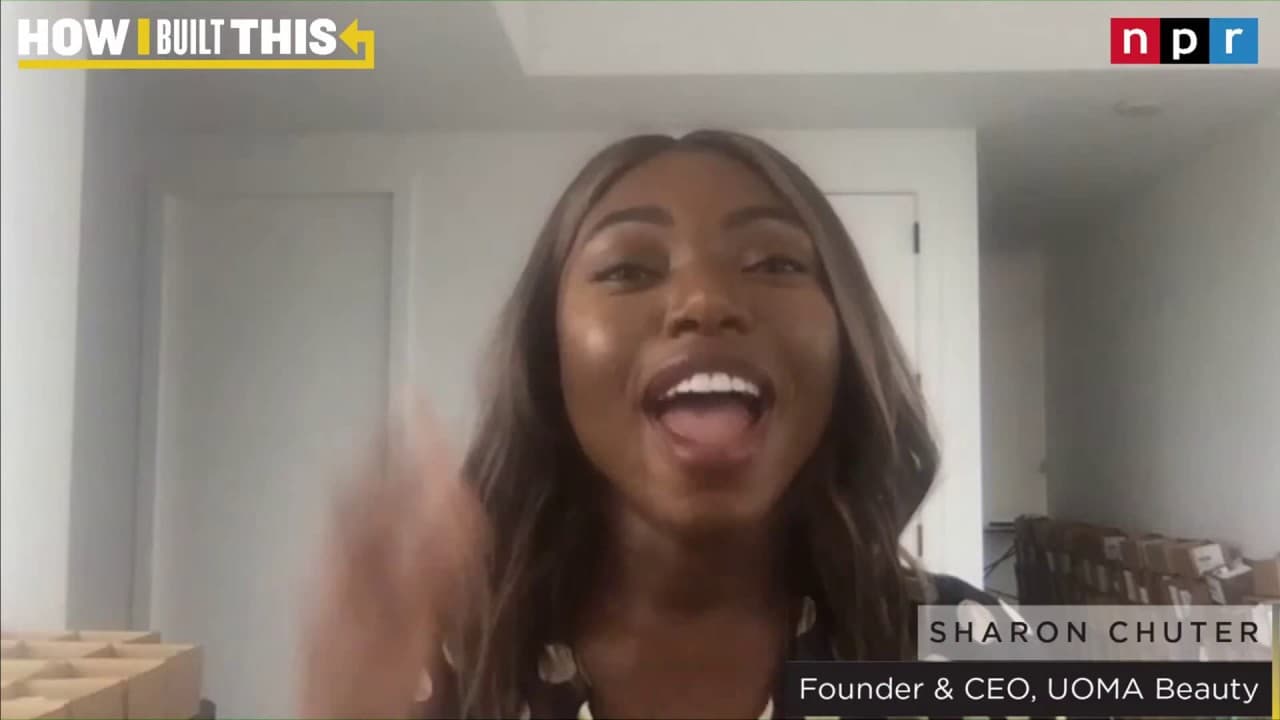
Hello and welcome to How I Built This Resilience Edition. This is a place where we talk with entrepreneurs and other interesting people about how they're working through this challenging moment in history. Um, inbox next to me is Sharon Chu Chuta. Um, she's the founder of Uma Beauty. It's a cosmetics brand designed for people with all different ski... Read More
Key Insights
- Inclusive beauty is a product-development principle, not simply a marketing claim. Chuter argues that people have different skin needs, structures, and common concerns, so brands should design formulas around those differences instead of offering one supposedly universal product to every customer.
- Uoma Beauty is built around inclusion, self-love, self-expression, and authenticity. Chuter describes its cosmetics as tools that help people show up as their best selves while feeling welcomed, represented, and free to play with makeup on their own terms.
- The foundation range contains 51 shades organized into six skin families. Each family has a customized formula intended to address its distinctive skin needs, demonstrating how seriously treating diversity can influence both the breadth of shades and the substance of the products.
- The website simplifies foundation selection by guiding shoppers through skin family and undertone. After identifying those characteristics, a customer can narrow an initially daunting 51-shade assortment to a much smaller group and ultimately choose among three products.
- Makeup is for everybody, according to Chuter, because it can conceal imperfections, reduce the appearance of dark circles, mattify skin, or support personal expression. Men already use cosmetics privately and on television, even when social expectations discourage them from acknowledging it.
- Uoma Beauty emerged from Chuter's frustration with exclusion she observed while working inside the cosmetics industry. She believed practices behind the scenes shaped what customers saw, so changing products required taking representation and inclusion seriously throughout the business.
- Entrepreneurial resilience is the practice of continually confronting obstacles without treating retreat as the only option. Chuter's response to the uncertainty of 2020 was to sense conditions, judge them, act, show up each day, and keep moving forward.
- Pull Up For Change is an accountability initiative asking companies that expressed support for the Black community to disclose their numbers of Black employees and executives. Its goal is to make companies examine themselves differently and begin creating meaningful organizational change.
Install to Summarize YouTube Videos and Get Transcripts
Explore YouTube Video Summarizer or Get YouTube Transcript Extractor
Questions & Answers
Q: Why did Sharon Chuter create Uoma Beauty?
Sharon Chuter created Uoma Beauty because her experience inside the cosmetics industry left her frustrated by its lack of inclusion. She believed internal company practices were producing an external marketplace that served one particular audience while overlooking many others. Her response was to build a brand where more people could see themselves, access products made for their needs, and experience makeup through self-love, authenticity, and expression.
Q: How does Uoma Beauty make foundation more inclusive?
Uoma Beauty makes foundation more inclusive by recognizing that different complexions can have different needs, structures, and common concerns. Its range includes 51 shades divided into six skin families, and the formulas are customized between those families. This approach treats inclusion as more than expanding shade labels because it also changes how the underlying products are developed for the people expected to use them.
Q: How can shoppers choose among Uoma Beauty's 51 foundation shades?
Shoppers begin by identifying their skin family through the Uoma Beauty website. They then narrow the selection within that family and determine their undertone, which Chuter describes as relating to the shade of the skin. This guided process reduces the complexity of browsing 51 shades. By the end, the shopper has only three products to consider, making selection easier and more intuitive.
Q: What values define the Uoma Beauty brand?
Uoma Beauty is founded on inclusion, self-love, self-expression, and authenticity. Chuter wants people to feel welcomed by the brand and empowered to present themselves as their best selves. The products serve as tangible expressions of that broader experience. The company combines advocacy and outspoken challenges to industry practices with the enjoyment, experimentation, and play that people seek from color cosmetics.
Q: Why does Sharon Chuter say makeup is for everyone?
Chuter says makeup is for everyone because cosmetics have practical and expressive uses that are not limited by gender. People can use concealer for dark circles or imperfections, mattifying products for the skin, and other cosmetics to accentuate features for a camera. She also rejects the idea that women use makeup only to appear pretty, emphasizing that makeup can instead be a form of personal expression.
Q: What is Pull Up For Change asking companies to disclose?
Pull Up For Change asks companies that publicly expressed support for the Black community to disclose the numbers of Black people among their employees and executives. The initiative seeks measurable information rather than relying only on statements of solidarity. Its stated goal is to force companies to examine themselves in a new way and create a starting point for meaningful change within their organizations.
Q: How did Sharon Chuter enter the beauty industry?
Chuter entered the beauty industry after questioning why good color cosmetics were not available in Nigeria. She contacted multiple brands, and Revlon was the only company that responded positively. Revlon had tried to enter the country for 15 years without succeeding. Chuter says her youthful refusal to accept no helped the company finally enter Nigeria, beginning her career in the beauty sector.
Q: How does Sharon Chuter approach entrepreneurial resilience?
Chuter approaches entrepreneurial resilience by expecting obstacles and continuing to act despite them. She compares entrepreneurship to facing a brick wall every day and finding a way through because there is no other option. During the pandemic, her method was to sense, judge, and act, then take each day as it came by waking up, showing up, and moving forward.
Summary
In this video, Sharon Chuter, the founder of UOMA Beauty, discusses her journey in the cosmetics industry and the challenges she faced as a black woman. She also addresses the impact of the pandemic on her business and her recent call to action for corporations to disclose their diversity and inclusion data. She emphasizes the importance of transparency and accountability in creating real change.
Questions & Answers
Q: Where is Sharon Chuter based right now?
Sharon Chuter is based in Los Angeles.
Q: How has Sharon been dealing with the last few months of the pandemic?
Sharon describes the last few months as intense, but she approaches each day as an opportunity. She sees this year as an opportunity for growth and evolution in every aspect of life.
Q: What prompted Sharon to start UOMA Beauty?
Sharon was frustrated with the lack of inclusivity in the beauty industry. She wanted to create a brand where everyone can find themselves, offering high-quality products that set a new standard for the industry.
Q: Can you explain the concept of UOMA Beauty's foundation range?
UOMA Beauty offers six different skin families with customized formulas to target the unique needs of each skin type. The website is structured to help customers find their skin family and select the best shades and undertones for their complexion.
Q: Are UOMA Beauty products available in other languages?
Yes, UOMA Beauty products have instructions in English, Spanish, and French. The brand plans to expand translations to include more languages as they expand into Europe and the Middle East.
Q: Are UOMA Beauty products SPF rated and waterproof?
UOMA Beauty products are waterproof, but they do not contain SPF. Sharon explains that SPF can affect the performance of the product, especially for darker skin tones. She believes it is more effective for consumers to use separate SPF products based on their specific needs.
Q: What inspired Sharon to start the #PullUpOrShutUp campaign?
Sharon was frustrated with performative activism from companies following the Black Lives Matter movement. She wanted to hold corporations accountable for their lack of diversity and inclusion. The campaign calls for companies to publicly disclose the percentage of black employees, executives, and board members.
Q: Is Sharon encouraged or skeptical about the possibility of real change in corporate America?
Sharon is encouraged because consumers have the power to affect change. She believes that if people continue to demand transparency and accountability, companies will be forced to make real change within a few years.
Q: How has the #PullUpOrShutUp campaign impacted companies' responses?
Companies are facing pressure and realizing the need for change. Many are reaching out for guidance and solutions, acknowledging that the entire corporate ecosystem needs reform, including rewriting HR models that discriminate against black hairstyles and addressing unconscious bias.
Q: How has Sharon's personal experiences influenced her perspective on racial justice?
Sharon shares her personal experiences with racial bias in the workplace, such as being told not to wear braids and facing microaggressions. She believes that holding uncomfortable conversations and conscious counteraction are crucial in breaking the cycle of unconscious bias.
Q: How does Sharon respond to critics who view the campaign as divisive?
Sharon emphasizes that the campaign is not about dividing people but about addressing a human rights issue. She highlights the need for change and the unconscious bias that permeates society, often leading to discrimination against black individuals.
Summary & Key Takeaways
-
Sharon Chuter founded Uoma Beauty after years inside major cosmetics companies left her frustrated by the industry's limited approach to inclusion. She wanted to create a movement where everyone could recognize themselves, access strong products, and use makeup for self-love, authenticity, and expression instead of conforming to a narrow beauty standard.
-
Uoma Beauty organizes its foundation range into six skin families, with formulas customized for the needs, structures, and common concerns associated with each family. Its website guides shoppers from skin family to undertone and then narrows the available choices, making a collection of 51 shades easier and more intuitive to navigate.
-
Chuter connects entrepreneurship with persistence, describing each day as another brick wall that founders must overcome. During the pandemic and social movements of 2020, she focused on sensing conditions, judging them, acting, and continuing forward. Her Pull Up For Change initiative similarly channels disruption into demands for measurable corporate accountability and meaningful change.
Read in Other Languages (beta)
Share This Summary 📚
Summarize YouTube Videos and Get Video Transcripts with 1-Click
Try YouTube Summary with ChatGPT & Claude or YouTube Transcript Generator
Explore More Summaries from NPR 📚






Summarize YouTube Videos and Get Video Transcripts with 1-Click
Try YouTube Summary with ChatGPT & Claude or YouTube Transcript Generator