Sadie Lincoln on barre3's Post-COVID Future with Guy Raz | How I Built This | NPR
TL;DR
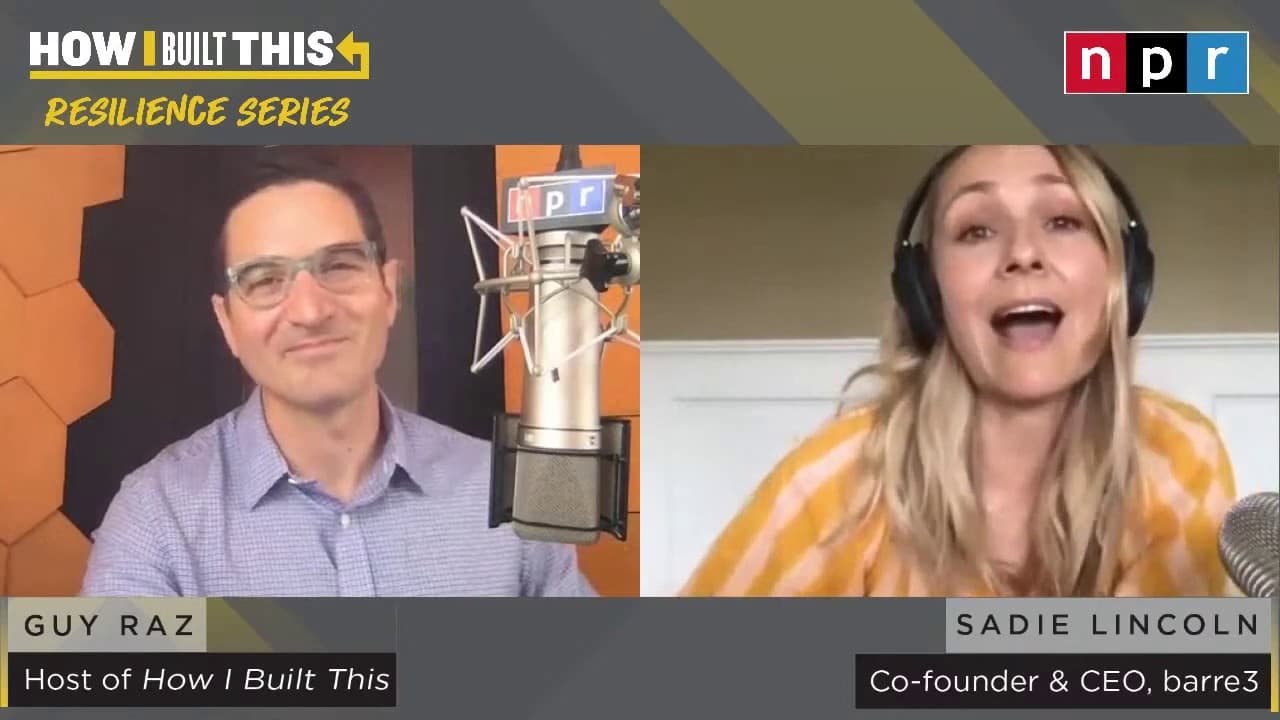
barre3 responded to COVID-19 closures by launching livestream classes from instructors’ homes within 24 hours, prioritizing community connection over polished production. Although only 30 percent of its studios had begun reopening and studio revenue was around 55 percent of its pre-COVID level, strong local relationships and growing online subscriptions helped sustain the company.
Transcript
hmm sorry about that hello welcome to how I built this resilience Edition I was just doing the most NPR thing which is eating my homemade yogurt with puffed quinoa this fellas men you've been talking to founders and entrepreneurs about Heather coping with these uncertain economic times in the box next to me is our friend Sadie Lincoln she's the fou... Read More
Key Insights
- barre3 converted closures into virtual operations within 24 hours by having instructors livestream from their homes. The rapid transition required the company to accept household interruptions and inconsistent production while concentrating on maintaining exercise routines and relationships with local communities.
- barre3’s studio business was operating at around 55 percent of its pre-COVID revenue level during the interview. Results varied substantially, with some individual studios preserving approximately 90 percent of their earlier revenue because loyal clients continued supporting owners they knew personally.
- The franchise model gives each barre3 owner legal authority to decide whether to reopen when local rules permit. Owners also meet regularly to share current information and practices from different geographic areas, helping the broader network consider safety while adapting services.
- barre3’s premium digital workouts previously relied on a dedicated Portland production set and instructors trained for years to perform on camera. Pandemic restrictions forced the company to abandon that polished format temporarily and give instructors permission to experiment, make mistakes, and teach from ordinary living spaces.
- Local studio customers prefer virtual classes led by instructors and owners they already know, even when those classes look less polished. Lincoln says emotional familiarity matters more to these clients than access to the company’s professionally produced streaming workouts, creating unexpected intimacy during isolation.
- barre3’s established online service attracted significantly more subscriptions when quarantine increased interest in exercising at home. The service already had subscribers in 98 countries, and its growth helped the company remain financially stronger while also giving customers a way to move during closures.
- The barre3 network was 100 percent female-led at the time of the conversation. Lincoln describes this structure as an empowered model in which each owner runs her own business, responds to local circumstances, and benefits from the collective knowledge of other owners.
- In-person fitness remains valuable because people have a basic need for connection and shared experiences. Lincoln believes gathering for exercise, music, coordinated movement, and physical empowerment can counter loneliness, so she does not expect physical studios to disappear as digital fitness expands.
Install to Summarize YouTube Videos and Get Transcripts
Explore YouTube Video Summarizer or Get YouTube Transcript Extractor
Questions & Answers
Q: How did barre3 respond when COVID-19 closed its studios?
barre3 responded by opening virtual studios within 24 hours of the closures. Instructors began livestreaming classes from their living rooms, sometimes alongside babies, pets, household noise, and other interruptions. Leadership accepted that the classes would not match the company’s usual premium production standards because preserving movement, personal relationships, and community support was more important than maintaining a perfectly polished presentation.
Q: How much of barre3’s studio business remained after the closures?
barre3’s overall studio business was around 55 percent of its pre-COVID revenue level at the time of the interview. Performance differed among locations. Some studios retained approximately 90 percent of their pre-COVID revenue because clients felt loyal to their local communities, knew the owners personally, and continued providing financial support while physical locations were closed or operating under restrictions.
Q: Why did barre3 launch livestream classes so quickly?
barre3 launched livestream classes quickly because its leaders decided that studio closures did not have to end the company’s relationship with customers. After an emotional call involving the franchise advisory board and leadership team, they reframed the situation as opening virtual studios. Acting within 24 hours allowed owners and instructors to keep their communities connected despite uncertainty about how long closures would continue.
Q: What did barre3 learn about customers’ virtual fitness preferences?
barre3 learned that studio customers often wanted virtual instruction from the local people they already knew, rather than only using the company’s professionally produced streaming service. Clients valued their emotional connection with a familiar instructor or franchise owner and accepted informal home settings, including visible pet hair or household disruptions. Personal trust proved more important to them than flawless production.
Q: How does barre3’s franchise model support local owners?
barre3’s franchise model treats each location as the owner’s business and gives that owner legal authority to decide whether to reopen when local conditions allow. At the same time, owners collaborate regularly and share practices, recent information, and lessons from their different geographic areas. This combines local autonomy with collective knowledge about safety, customer needs, and new ways to deliver workouts.
Q: Why was teaching virtual barre3 classes challenging?
Teaching virtual classes was challenging because performing for a camera requires different skills from leading people in a physical room. barre3’s established streaming instructors had trained for years and worked on a dedicated production set in Portland. During the closures, many local instructors had to manage camera-related fear, appear authentic without that preparation, and teach effectively from imperfect home environments.
Q: How did online subscriptions help barre3 during quarantine?
Online subscriptions helped barre3 by providing a service customers could use while exercising at home and by supporting the company during widespread studio closures. The established streaming platform already served subscribers in 98 countries, and demand increased significantly during quarantine. Lincoln said that this growth helped barre3 remain strong while also helping customers continue moving and caring for themselves at home.
Q: Will virtual workouts replace in-person fitness studios?
Lincoln does not expect virtual workouts to eliminate in-person fitness because people crave connection and gathering with others. She argues that group exercise combines music, coordinated movement, and an empowering physical experience in a way that can fight loneliness. Digital services gained importance during quarantine, but the human need for community supports a future in which physical experiences continue alongside online options.
Summary
In this video, Sadie Lincoln, the founder of barre3, a fitness company with over 150 studios, discusses how her company is coping with the uncertain economic times caused by COVID-19. She talks about the challenges faced by the fitness industry and how they pivoted to a virtual model. She also touches upon the impact of the Black Lives Matter movement on her leadership and the importance of holding space for difficult conversations. Lincoln reflects on the lessons learned during this time and expresses optimism for the future.
Questions & Answers
Q: How has barre3 coped with the economic impact of COVID-19?
Barre3 faced significant challenges when their studios had to close due to the pandemic. However, within 24 hours, they decided to open a virtual studio and began offering livestream classes from their instructors' homes. This decision allowed them to stay connected with their community and maintain 90% of their pre-COVID revenue in some studios.
Q: Are all barre3 locations open?
No, currently only about 30% of barre3 studios are open. The remaining 70% are still closed due to the pandemic. The decision to reopen is made by each franchise owner, based on the restrictions in their respective states.
Q: How did barre3 transition to a virtual model?
Barre3 had to make adjustments to their premium brand and let go of the beautiful production value they were known for. Instructors now teach classes via Zoom or Instagram Live from their homes, creating a more intimate and authentic experience. They discovered that their community valued the connection with their instructor more than the production quality.
Q: Has barre3 seen an increase in sign-ups for their virtual classes?
Yes, barre3 experienced a spike in sign-ups for their virtual classes. The shift towards at-home workouts during the quarantine period and the recognition of the importance of self-care led to increased subscriptions to their online streaming service.
Q: Do you think the future of fitness will be virtual or a hybrid of virtual and in-person?
Sadie Lincoln believes that humans crave connection and being together. While virtual workouts have proven to be convenient and accessible, the in-person experience offers an empowering physical and social experience that fights loneliness. Hence, she sees a future that includes both virtual and in-person fitness experiences.
Q: How has Sadie Lincoln grown as a leader during this time?
Sadie Lincoln acknowledges that leadership requires continuous learning and being a student. She emphasizes the importance of being open to new knowledge and perspectives, especially during this time of social uprising. She has been actively engaging with her team and community, participating in circle leadership conversations to create a safe space for open and honest discussions.
Q: How has barre3 addressed racial justice within their organization?
Barre3 has been prioritizing diversity, equity, and inclusion. They have implemented circle leadership practices to facilitate open conversations around race. They have also started a voluntary book club focused on discussions related to race. Additionally, they are examining how to lower the cost of building out their studios to support broader access to their services.
Q: In the face of the multiple crises happening, what lessons does Sadie Lincoln hope to take away from this moment?
Sadie Lincoln hopes to remember that "we can do hard things" and that this challenging period can lead to greatness and positive change. She sees this moment as an opportunity for growth, learning, and building a sustainable future. She wants to create a stronger value system for her own company, barre3, and hopes to contribute to a better future for her children, employees, and community.
Takeaways
This video highlighted the resilience of barre3 in adapting to the challenges brought on by COVID-19. It showcased their quick pivot to a virtual model and the success they achieved in staying connected with their community. It also emphasized the importance of holding difficult conversations around racial justice and the need for continuous learning and growth as a leader. The key takeaway is to embrace change and challenges as opportunities for growth and innovation.
Summary & Key Takeaways
-
COVID-19 forced nearly every barre3 studio to close, creating an immediate crisis for the fitness company and its franchise owners. Within 24 hours, its leaders decided they were not simply closed. They launched virtual studios, allowing instructors to teach livestream classes from their homes despite uncertain conditions and imperfect production quality.
-
barre3 discovered that local studio clients valued familiar instructors and owners more than polished digital production. Some studios retained approximately 90 percent of their pre-COVID revenue because their communities felt personally connected to the owners. The company’s female-led franchise structure allowed local decisions while encouraging owners to exchange safety practices and operational knowledge.
-
The pandemic increased demand for barre3’s established online subscription service, which already served subscribers in 98 countries. Lincoln expects fitness to develop as a hybrid of digital convenience and physical community. She argues that in-person exercise remains important because people crave connection, shared music, coordinated movement, and empowering experiences with others.
Read in Other Languages (beta)
Share This Summary 📚
Summarize YouTube Videos and Get Video Transcripts with 1-Click
Try YouTube Summary with ChatGPT & Claude or YouTube Transcript Generator
Explore More Summaries from NPR 📚




Summarize YouTube Videos and Get Video Transcripts with 1-Click
Try YouTube Summary with ChatGPT & Claude or YouTube Transcript Generator