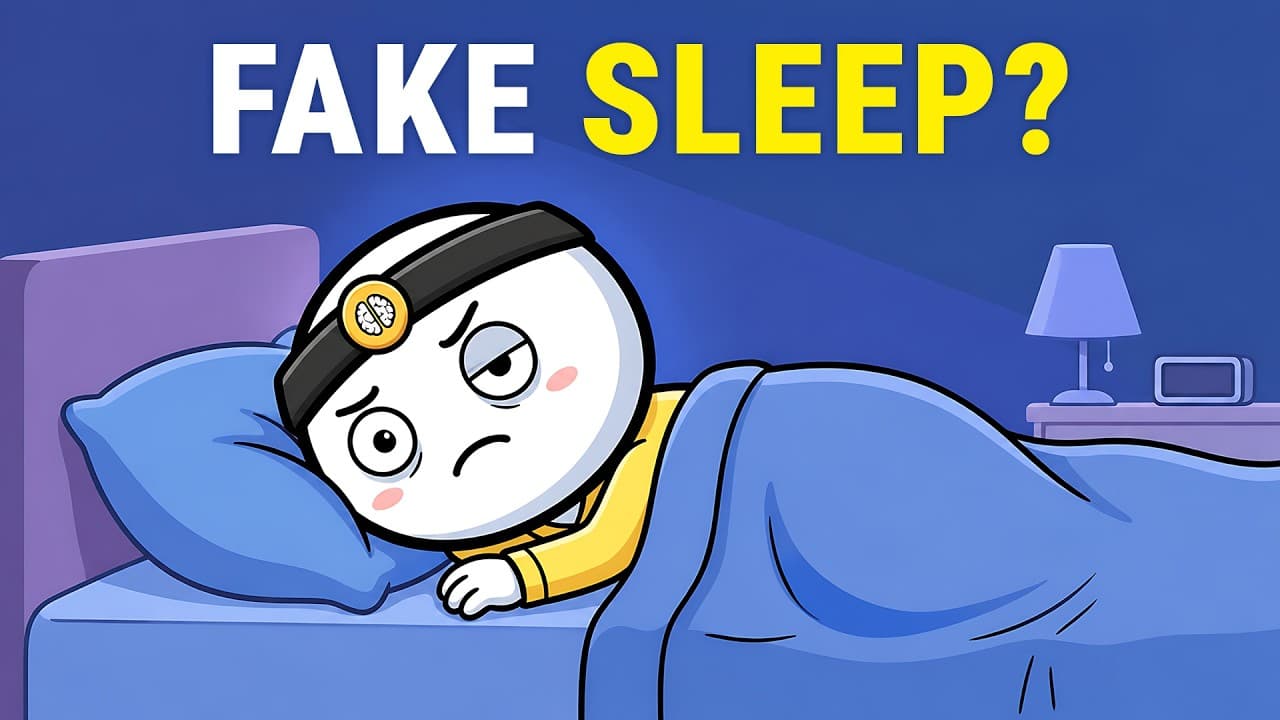
How does pretending to sleep help you fall asleep?
TL;DR
Lying down and closing your eyes signals safety to the brain, allowing the sleep system to take over gradually. Adenosine builds sleep pressure while slow breathing and vagus nerve activation shift the autonomic nervous system toward rest. This bottom up process helps move from wakefulness to sleep, not with a single instant switch.
Transcript
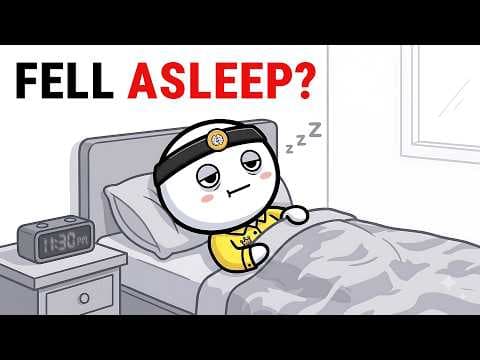
Every night we all do something super weird that hardly anyone notices. We have to pretend to be asleep. You lie down in bed, pull up the covers, close your eyes. You try to stay totally still as if you are already fast asleep. But the funny part is you are still awake. Your body is playing the part of someone deeply asleep. While inside your head ... Read More
Key Insights
- The flip flop model describes a tug of war between wake promoting and sleep promoting brain systems.
- The VLPO sleep promoting system gradually overpowers the wake system when sleep pressure and safety signals align.
- Lying down and closing eyes sends signals of safety that allow the sleep system to win the tug of war.
- Adenosine builds sleep pressure as we stay awake, but needs additional cues to trigger sleep.
- Slow breathing during pretend sleep triggers the vagus nerve and releases acetylcholine to lower heart rate and blood pressure, aiding sleep onset.
- The reticular activating system slows when there is less light and movement, putting the cortex into standby mode.
- Sleep state misperception occurs when subjective sleep differs from objective sleep measured by EEG.
- Hypnagogia and hypnic jerks occur during the transition from wakefulness to sleep, reflecting the transitional state.
Install to Summarize YouTube Videos and Get Transcripts
Explore YouTube Video Summarizer or Get YouTube Transcript Extractor
Questions & Answers
Q: What is the flip flop model of sleep and wakefulness?
The flip flop model describes two opposing brain systems that regulate sleep and wakefulness. The wake promoting system in the midbrain and brainstem constantly pushes for alertness, while the sleep promoting system in the VLPO pushes for rest. They cannot win at the same time, so sleep begins when the sleep system overpowers the wake system, and wake dominates when the wake system is stronger. This tug of war creates a boundary region where neither fully controls, allowing a safe transition rather than a sudden switch.
Q: Why do we pretend to sleep before actually falling asleep?
Pretending to sleep signals safety to the brain, indicating that threats are absent and rest can begin. Lying down signals reduced sensory input, closing eyes reduces visual information, and relaxing muscles demonstrates there is no need to defend. Together these actions allow the brain to shift from a state of readiness to a resting state, enabling the sleep promoting system to slowly take over without risking immediate vulnerability.
Q: What role does adenosine play in sleep onset?
Adenosine accumulates as we stay awake, creating sleep pressure that weighs on the nervous system. This chemical build up makes the brain more inclined toward sleep, but on its own it is not enough to trigger sleep. The brain requires safety cues and environmental signals to complete the transition, making adenosine one part of a multi factor process that leads to sleep.
Q: How do slow breathing and the vagus nerve influence sleep?
Slow, deep breaths mimic sleeping patterns and physically influence the autonomic nervous system. This breathing pattern stimulates the vagus nerve, which then releases acetylcholine to slow heart rate and lower blood pressure. The result is a bottom up shift toward rest, where the body signals the brain that it is safe to enter a resting state and begin sleep.
Q: What is sleep state misperception and how does it affect our view of sleep?
Sleep state misperception describes the mismatch between how asleep a person feels and what EEG tests show about their brain state. A person may feel awake or lightly asleep while the brain has already entered a light sleep stage. This phenomenon highlights the complex relationship between subjective experience and objective sleep measurements during the transition to sleep.
Q: What is hypnagogia and what experiences accompany it?
Hypnagogia is the transitional state between wakefulness and sleep. During this period, people may hear vague sounds, see random images, or have illogical thoughts that do not make sense. It marks the drift from consciousness to sleep and is a common phenomenon that occurs as the brain moves toward rest, often accompanied by vivid, dream like experiences.
Q: Why are hypnic jerks triggered when pretending to sleep?
Hypnic jerks are thought to be a leftover evolutionary response when relaxing muscles too quickly could signal danger. As the brain lags behind in the transition to sleep, it might misinterpret a fall or loss of balance as a threat to safety, triggering a sudden muscle jerk to grab onto safety and reestablish readiness.
Q: How does the SCN influence when we start pretending to sleep?
The suprachiasmatic nucleus monitors light information from the eyes to align the body with day and night. When night falls, the SCN signals melatonin production to guide the body into rest mode. This circadian cue helps determine when to begin the sleep onset process, coordinating internal timing with environmental light cues.
Summary & Key Takeaways
-
In this video, the brain uses a flip flop between wake and sleep states, and lying still with closed eyes provides safety signals that help switch to sleep.
-
Adenosine creates sleep pressure over the day, but the brain needs additional environmental and behavioral cues to commit to sleep.
-
The brain uses breathing, the vagus nerve, and slow, deep breaths to ease the transition from wakefulness to sleep, illustrating a bottom up mechanism.
Read in Other Languages (beta)
Share This Summary 📚
Summarize YouTube Videos and Get Video Transcripts with 1-Click
Try YouTube Summary with ChatGPT & Claude or YouTube Transcript Generator
Explore More Summaries from Apex Psychology 📚
Summarize YouTube Videos and Get Video Transcripts with 1-Click
Try YouTube Summary with ChatGPT & Claude or YouTube Transcript Generator