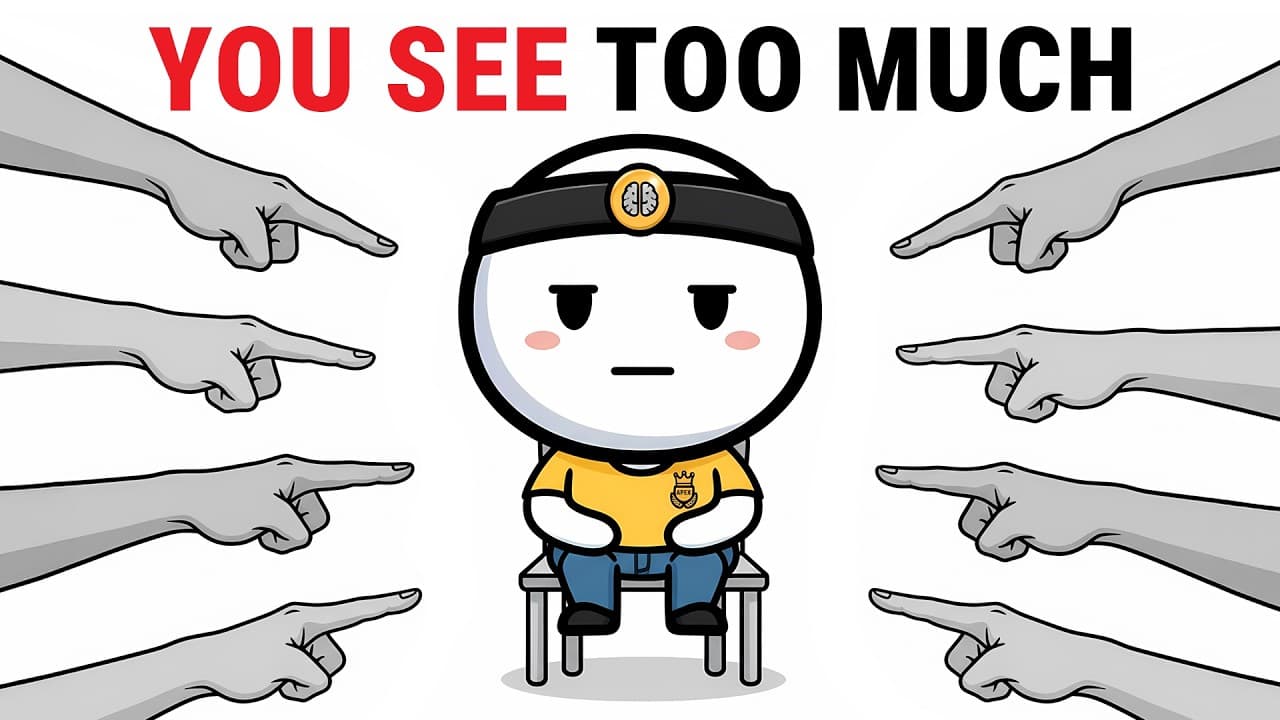
What causes people to see what others miss?
TL;DR
Some people process social cues extremely fast, catching microexpressions and incongruences that others miss. This exposes them to uncomfortable truths, social friction, and emotional exhaustion. They rely on nonverbal signals and pattern recognition, but the heightened awareness can lead to isolation and a need to guard their minds.
Transcript
There's a type of person who always sees what others miss. These are people who can catch the tiniest facial expressions, read emotions others try to hide, and notice psychological patterns no one else sees. They can easily see through social masks, spotlight right away, and feel the unspoken tension in any room. Most people call it sharp intuition... Read More
Key Insights
- Thin slicing is a fast data processing mechanism that helps some people detect hidden cues in social interactions.
- Nonverbal signals, especially microexpressions, often reveal true emotions even when words lie.
- Theory of mind allows perceivers to infer others internal states from behavior and expressions.
- The ability to see through masks can lead to social advantage but also to social backlash and isolation.
- Perceptive people may become accidental villains when they expose truths others prefer hidden.
- The detective trap is a habit of over analyzing everything, leading to chronic vigilance and bias.
- Emotional dumping becomes a risk when highly perceptive individuals absorb others pain without boundaries.
- Balancing insight with restraint is essential to avoid burnout and maintain healthy relationships.
Install to Summarize YouTube Videos and Get Transcripts
Explore YouTube Video Summarizer or Get YouTube Transcript Extractor
Questions & Answers
Q: What is thin slicing in psychology and how does it help see what others miss?
Thin slicing is a rapid information processing process that allows people to form judgments from very small samples of behavior. In the video, it is described as the brain constantly collecting data and noticing incongruences quickly, which helps perceptive individuals detect hidden emotions and unreliable cues. This capability can improve social understanding but also increase sensitivity to flaws and deception.
Q: How do microexpressions influence our understanding of honesty in interactions?
Microexpressions are tiny facial movements that reveal authentic emotions in fractions of a second. The video explains that perceptive people notice mismatches between what is said and how the face moves, such as a smile that does not reach the eyes. Recognizing these cues can signal deception or hidden feelings, guiding how someone responds in conversations.
Q: What role does theory of mind play in reading others according to the video?
Theory of mind refers to the ability to infer others mental states from their behavior. The video notes that when pattern recognition combines with theory of mind, a person can see underlying insecurities and fears in others. This helps explain why some people seem to understand what others are truly feeling behind their outward actions.
Q: Why can highly perceptive people feel like they see through social masks too often?
The video explains that social life relies on masks and polite lies to function smoothly. People with sharp perception frequently encounter this, as their ability to uncover truth makes them aware of hidden motives. This leads to fatigue, as they carry unspoken truths that others prefer to keep hidden, causing a sense of isolation.
Q: What are the three traps faced by people who see through others, as described in the video?
The first trap is becoming the accidental villain, where honesty breaks social harmony and others fear confrontation. The second is the detective trap, where constant analysis leads to overthinking and distrust. The third is becoming an emotional dumping ground, which drains energy as they absorb others pain without being able to respond. Each trap reduces relationship ease.
Q: How does the video describe the Accidental Villain trap and its social consequences?
In the Accidental Villain trap, the perceptive person exposes truths that others do not want to hear. They may be labeled as cold, judgmental, or lacking empathy because people prefer comforting stories over uncomfortable reality. This dynamic can push the perceptive individual into conflict and social exile, even though their intentions are protective.
Q: What coping strategies are suggested for balancing insight and personal well being?
To cope, the video suggests setting boundaries and choosing when to speak or stay silent. Managing overanalysis by recognizing when to trust appearances and when to question them helps prevent burnout. Practicing restraint and focusing on compassionate engagement can preserve relationships while preserving personal mental energy.
Q: Why is it important for perceptive individuals to avoid overthinking and projection?
Overthinking leads to confirmation bias, where the mind only accepts information that supports a chosen belief. Projection can distort others intentions and create unnecessary conflict. The video emphasizes that staying open to new information, validating interpretations with context, and maintaining emotional boundaries help perceptive individuals engage more healthily with others.
Summary & Key Takeaways
-
Perception specialists use thin slicing and microexpression detection to read hidden emotions, which can reveal truths others miss.
-
This heightened awareness creates psychological burdens such as isolation, constant vigilance, and emotional exhaustion in daily life.
-
Managing these insights involves setting boundaries, avoiding overinterpretation, and recognizing when to stay silent for self care.
Read in Other Languages (beta)
Share This Summary 📚
Summarize YouTube Videos and Get Video Transcripts with 1-Click
Try YouTube Summary with ChatGPT & Claude or YouTube Transcript Generator
Explore More Summaries from Apex Psychology 📚



Summarize YouTube Videos and Get Video Transcripts with 1-Click
Try YouTube Summary with ChatGPT & Claude or YouTube Transcript Generator