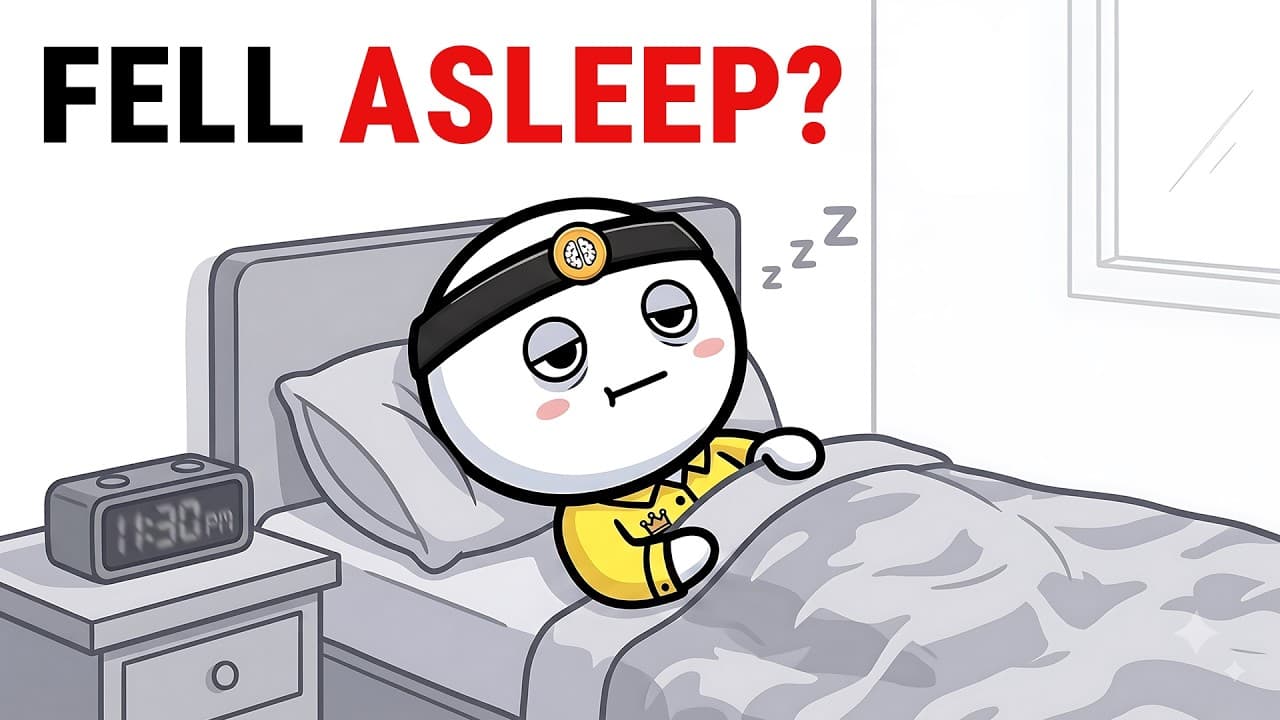
How can you remember the moment you fall asleep
TL;DR
A reminder that the moment you fall asleep is not recorded by the brain. Adenosine builds up with wakefulness, then the thalamus gates sensory input while the hippocampus stops taking in new data. Hypnagogia creates brief, fragmentary experiences before REM dreams later in the night. Our memory system paints nothing final at sleep onset.
Transcript
What if you could actually remember the exact moment you fell asleep? Try rewinding last night. You got into bed, turned off the lights, closed your eyes. Instead of a clean cut to black, you could actually feel your muscles letting go, your thoughts slowing down. You witnessed the very moment your mind officially disconnected from the real world. ... Read More
Key Insights
- Adenosine acts as an electric bill for brain activity, stacking up during wakefulness until sleep begins.
- The thalamus functions as a gatekeeper, blocking sensory input from reaching the cortex during sleep onset.
- Hypnagogia is a transient twilight state where the cortex generates random imagery and sounds.
- The hippocampus stops taking in new data during the early sleep transition to protect memory integrity.
- Local sleep means different brain regions shut down at different times rather than a single global switch.
- The prefrontal cortex powers down first, reducing self awareness and planning during sleep onset.
- Ears hold on to sound the longest, which is why an alarm or name call can be perceived briefly.
- Hypnic jerks are reflexive contractions that may reset the brain to record momentary events before sleep fully ensues.
Install to Summarize YouTube Videos and Get Transcripts
Explore YouTube Video Summarizer or Get YouTube Transcript Extractor
Questions & Answers
Q: How does adenosine influence the moment you fall asleep?
Adenosine builds up in the brain with wakefulness acting like an electric bill that must be paid before sleep can progress. As adenosine increases, it drags down one system after another that keeps you awake, guiding the brain toward the sleep state and reducing the likelihood of recording the exact moment of falling asleep.
Q: What role does the thalamus play at sleep onset?
The thalamus acts as a gatekeeper, deciding what sensory information can reach the cortex as you fall asleep. When sleepiness hits, its signals are reduced, gradually cutting off external input and contributing to the fading of conscious experience, which helps explain why you do not remember the moment you drift off.
Q: What is hypnagogia and why does it matter for memory of falling asleep?
Hypnagogia is the twilight state between waking and sleeping where the cortex still receives some input but lacks a cohesive signal. It can produce vivid, fragmented experiences that are quickly forgotten because the recording system is already shutting down. This helps explain why these early experiences do not form lasting memories.
Q: Why does the hippocampus stop encoding new memories at sleep onset?
The hippocampus halts new memory encoding as the brain redirects energy toward processing the day’s memories and preparing for sleep. With the influx of information reduced and the cortex receiving less input, the moment of falling asleep is not captured as a stable memory trace.
Q: What is local sleep and how does it relate to waking experiences during sleep onset?
Local sleep describes how different brain regions can be in different states of consciousness simultaneously. While some areas shut down, others may remain active, allowing actions like sleepwalking. This mosaic of asleep and awake regions explains why transitions into sleep are gradual rather than a single moment.
Q: Which brain region goes to sleep first and how does that affect our sense of self?
The prefrontal cortex, which governs planning and self awareness, packs up first during sleep onset. Its early sleep reduces conscious control and self recognition, contributing to the difficulty in remembering the exact moment of falling asleep because the brain’s narrative center is already dimming.
Q: Why can you still hear alarm sounds during transition into sleep?
Hearing is the most stubborn sense during the transition, so even when other senses are shutting down, the auditory system can briefly transmit signals. This explains why an alarm or a name call can sometimes be perceived just as you are slipping into hypnagogia, before the rest of consciousness fades.
Q: What is the relationship between hypnic jerks and memory of falling asleep?
Hypnic jerks occur as a partial brain reset when muscles relax at sleep onset. They are tied to the adenosine cycle and stress or caffeine effects, and they provide a moment where the brain can briefly re-engage after a near-sleep event. This can be remembered because the sudden jolt disrupts the fading recording process.
Summary & Key Takeaways
-
The video explains that memory formation during sleep onset is limited by the brain turning off input rather than a single switch. Adenosine buildup promotes sleep pressure, while the thalamus blocks signals to the cortex as wakefulness ends. The hippocampus stops encoding new data early in the process.
-
Hypnagogia is described as a transitional, dreamlike state with vivid but fleeting hallucinations that do not become memories because the recording system shuts down before events are integrated.
-
Local sleep shows that different brain regions enter sleep at different times, enabling wakeful actions like sleepwalking. The prefrontal cortex, key for self awareness and planning, goes to sleep first, shaping how we experience the onset of sleep.
Read in Other Languages (beta)
Share This Summary 📚
Summarize YouTube Videos and Get Video Transcripts with 1-Click
Try YouTube Summary with ChatGPT & Claude or YouTube Transcript Generator
Explore More Summaries from Apex Psychology 📚




Summarize YouTube Videos and Get Video Transcripts with 1-Click
Try YouTube Summary with ChatGPT & Claude or YouTube Transcript Generator