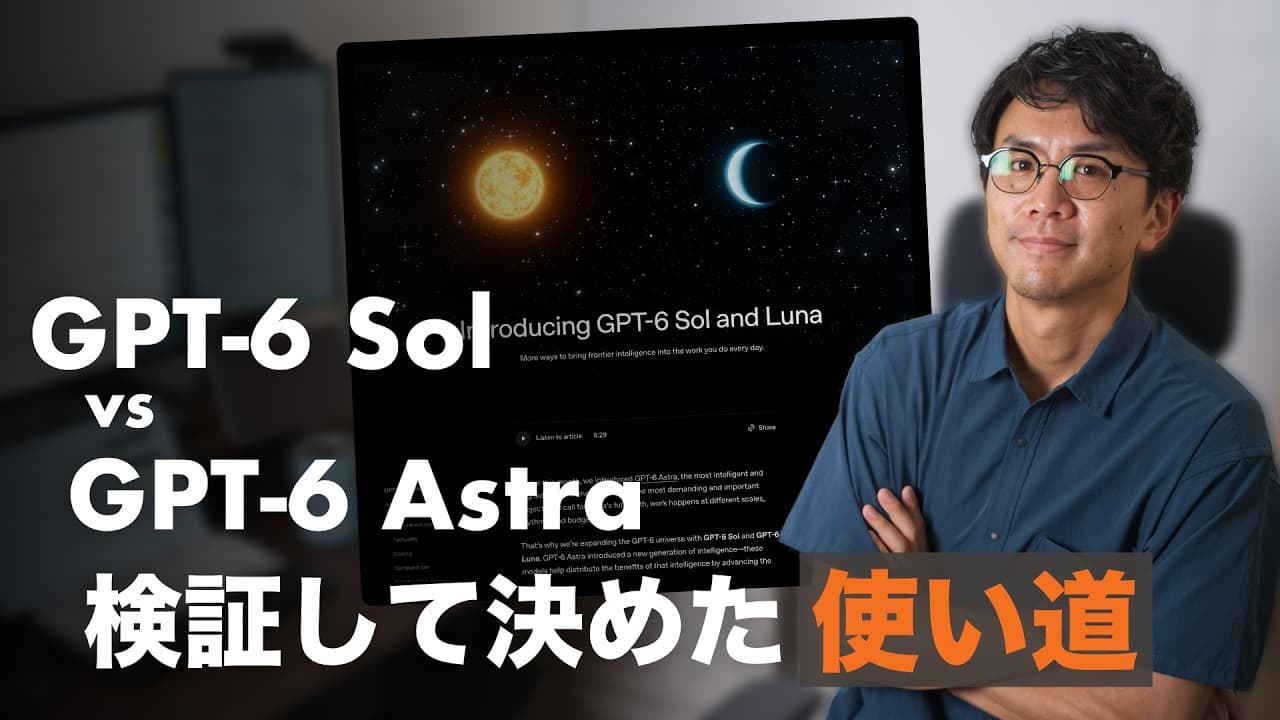
How does GPT-6 Sol compare to Astra for travel planning?
TL;DR
GPT-6 Sol completes the travel planning task much faster and at lower quota cost than Astra, delivering a usable itinerary. It finished the same task in 19 minutes 50 seconds using about 3 percent of the weekly quota, versus Astra taking 45 minutes and about 15 percent. Sol showed strong practicality but still had some minor limitations in video editing tasks.
Transcript
OpenAI has released a new model, GPT-6 Sol. In a recent video, I had GPT-6 Astra plan a day trip for my wife and me. I had it find three places reachable by car from Shinagawa, choose Katsunuma from them, and finally create a travel itinerary. It took 45 minutes to finish this. Using my ChatGPT Pro 5x plan, it consumed 15%of my weekly usage limit. ... Read More
Key Insights
- GPT-6 Sol finishes the same travel planning task in 19 minutes 50 seconds and uses 3 percent of the weekly quota
- Sol is cheaper than Astra for the API and plan-based usage, offering substantial cost savings
- Sol provides more concise and readable itineraries compared with Astra
- Sol’s map outputs are split into destination, outbound, and return views for easier distance checking
- Sol corrected its schedule when calculating the route, showing self-correcting capability
- Astra previously used a service area rest stop, while Sol selected different rest stops, showing flexible planning
- Sol writes a complete travel itinerary in Craft including reservations and rain plans
- Astra had more text volume and detail in some aspects, but Sol emphasizes concise communication and clarity
Install to Summarize YouTube Videos and Get Transcripts
Explore YouTube Video Summarizer or Get YouTube Transcript Extractor
Questions & Answers
Q: What is the primary claim about GPT-6 Sol compared to Astra for travel planning?
The primary claim is that GPT-6 Sol completes the travel planning task faster and with lower usage of the weekly quota than Astra, delivering a usable itinerary. It finished the same task in 19 minutes 50 seconds using only 3 percent of the quota, versus Astra taking 45 minutes and about 15 percent. This suggests Sol can handle Astra-like tasks more efficiently for daily use.
Q: How did the tester measure performance between Sol and Astra?
The tester used a three-step process: generate three day-trip plans, visualize routes on Google Maps to verify distances and feasibility, and produce a final travel itinerary in Craft with reservations, costs, packing lists, and rain plans. Time and quota usage were tracked for each model, allowing direct speed and cost comparisons.
Q: What were the three day-trip plan options Sol offered, and which one was chosen?
Sol offered three plans including spider lilies in Hidaka, Saitama; Shine Muscat grape harvest in Katsunuma, Yamanashi; and freshly dug peanuts in Sakura, Chiba. The tester chose the Katsunuma plan for further testing, noting differences in on-site activities compared with Astra and improvements in route planning.
Q: How did Sol handle map visualization differently from Astra?
Sol divided the map into three parts: travel to the destination, the trip there, and the trip back, which made distance checking easier at the destination. In contrast, Astra connected the entire itinerary into a single map. The tester found Sol’s approach easier to use for verifying distances.
Q: What were the observed strengths of Sol in itinerary creation?
Sol produced a concise, readable itinerary with reservations, cost estimates, packing lists, and rain plans. It also included notes on what to confirm by phone and offered a clear, practical workflow. The tester highlighted Sol’s concise writing style and its ability to finalize the itinerary effectively.
Q: What weaknesses or limits did the tester note for Sol?
One noted limit was that Sol could not avoid minor mistakes in video editing tasks, such as typographical edits, which Astra did not exhibit. In planning tasks, Sol sometimes required a small correction for time feasibility, though it generally corrected itself during map creation.
Q: How did Sol perform in terms of cost savings and efficiency compared to Astra?
Sol used about 3 percent of the weekly quota for the full three-step test and cost roughly 190 yen, compared to Astra which consumed 5 to 15 percent depending on the test and cost a bit over 500 yen. This demonstrates substantial savings in both time and cost while maintaining a high-quality output.
Q: What future usage strategy does the narrator suggest for Sol vs Astra?
The narrator suggests using Sol for fast, routine planning tasks given its speed and cost advantages, while leveraging Astra when deeper detail or volume is required. The goal is to combine both tools to optimize different parts of the workflow, especially for non-engineers relying on AI-driven planning.
Summary & Key Takeaways
-
GPT-6 Sol delivers a travel itinerary with reservations, cost estimates, packing lists, and rain plans, more concisely than Astra while maintaining quality.
-
Sol is faster and cheaper, reducing time and quota usage significantly, while producing readable, actionable outputs.
-
Astra offers more text volume and deeper detail in some cases, but Sol overall provides a concise, practical workflow with strong edits and map handling
Read in Other Languages (beta)
Share This Summary 📚
Summarize YouTube Videos and Get Video Transcripts with 1-Click
Try YouTube Summary with ChatGPT & Claude or YouTube Transcript Generator
Explore More Summaries from Leo Tohyama / AIコーチ 📚






Summarize YouTube Videos and Get Video Transcripts with 1-Click
Try YouTube Summary with ChatGPT & Claude or YouTube Transcript Generator