How to Automate Five Finance Workflows with Claude
TL;DR
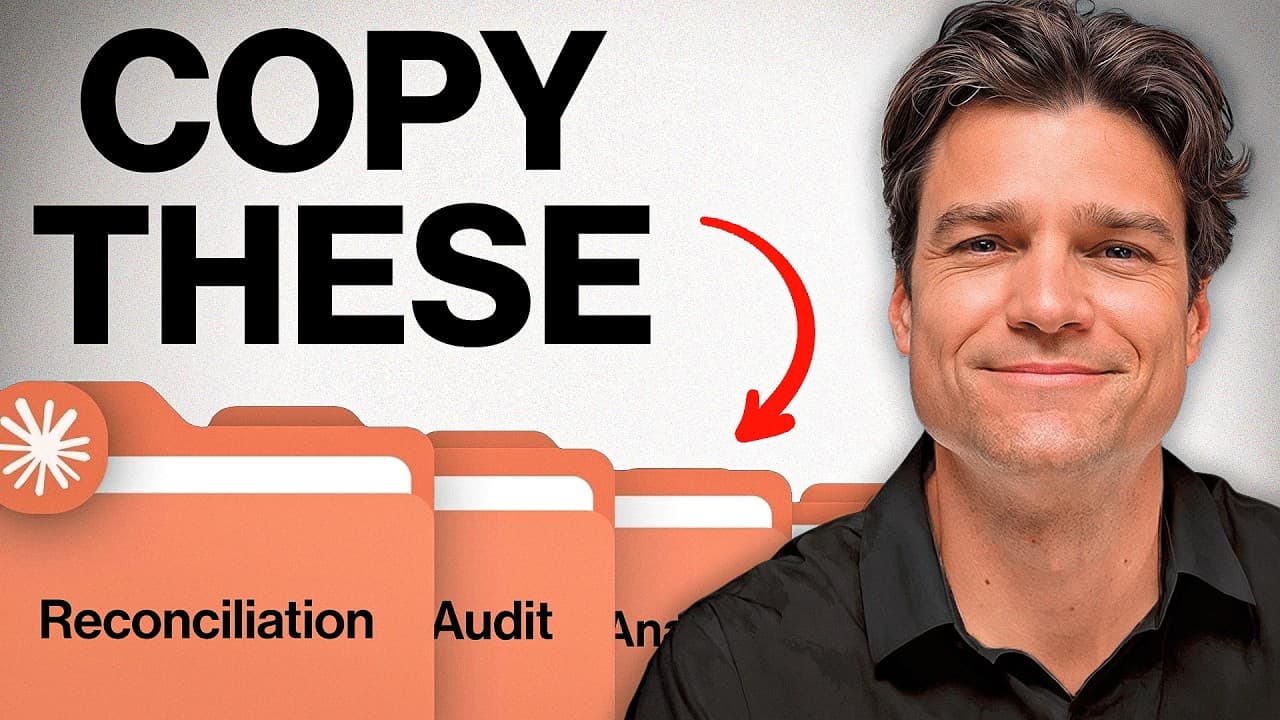
Claude skills turn recurring finance tasks into reusable workflows that automatically apply predefined instructions, scripts, and reference materials. Five demonstrated uses cover financial modeling, reconciliation, audit support, interactive dashboards, and board presentations, helping teams produce consistent, review-ready outputs without manually rebuilding each process through prompts every month or quarter.
Transcript
There are five claw skills that every finance professional needs if they want AI outputs that are actually usable in real finance work. Now, most finance professionals are still using claw like a chatbot instead of a system. Statements come in, you build the model. Numbers do not tie in. So, you reconcile them. Controls need testing and then you ha... Read More
Key Insights
- A Claude skill is a reusable workflow containing an instruction file that defines when it should activate and how it should handle a task. More complex skills can also include scripts and reference materials, allowing Claude to execute established steps after receiving a short outcome-focused instruction.
- The financial modeling skill converts raw financial statement PDFs into a structured model. In the demonstration, it processes 12 quarters from 2022 through 2024, creates more than 500 formulas, completes statement and cash flow checks, and corrects a forecast tax calculation error before finalizing the workbook.
- The modeling output is organized for analysis and review. It includes separate sheets for extracted data, standardized data, historical results, forecast scenarios, and a dashboard, along with an audit report and standardized financials CSV, giving users both the working model and its supporting documentation.
- The reconciliation skill compares balances across the general ledger, subledger, and bank statement. It identifies and categorizes differences as timing items, required adjustments, or matters needing investigation, while tracking their age and escalating unresolved items that have remained outstanding for more than 100 days.
- The June 2024 reconciliation reduces a starting variance of 3,287 to zero after identifying bank charges, a missing settlement entry, posting variances, and a refund absent from the ledger. It also flags cash-basis revenue recording that creates a large variance against the sales subledger.
- The audit support skill connects identified problems to assertions such as existence, completeness, and accuracy, then evaluates whether controls address those risks. It classifies findings by severity and considers their combined effect because several individually smaller issues can collectively indicate a broader control weakness.
- The audit demonstration produces 10 findings: three material weaknesses, four significant deficiencies, and three standard deficiencies. The memo also identifies recurring themes involving spreadsheet reliance, missing escalation for unresolved matters, and inconsistent data structures, then provides quantified impacts, root causes, and remediation steps.
- The dashboard skill creates a self-contained HTML file with KPIs, charts, and a sortable detail table. Embedded data eliminates external connections, filters update every metric and visual dynamically, and year-over-year comparisons are calculated against prior-period benchmarks within the file itself.
- More videos from this channel:
- More from this channel: Luke Finance
Install to Summarize YouTube Videos and Get Transcripts
Explore YouTube Video Summarizer or Get YouTube Transcript Extractor
Questions & Answers
Q: What is a Claude skill for finance workflows?
A Claude skill is a reusable way of working rather than a single improved prompt. Its instruction file defines when the skill should activate and how Claude should perform the task. It can also contain supporting scripts and reference materials. After installation, Claude detects the relevant context, applies the established structure, and executes the workflow from a concise instruction describing the desired outcome.
Q: How can Claude turn financial statements into a model?
The financial statements skill extracts information from raw PDFs, organizes the data, maps line items into a consistent structure, and builds calculations on top. In the demonstration, it processes 12 quarters covering 2022 through 2024 and produces an Excel model with more than 500 formulas. It also verifies income statement consistency, balance sheet balance, and cash flow reconciliation before delivering the finished files.
Q: What files does the financial modeling skill produce?
The financial modeling skill produces an Excel workbook with separate sheets for raw extracted data, standardized data, the historical model, forecast scenarios, and a dashboard. It also creates a supporting audit report and a standardized financials CSV. In the demonstration, every model check passes with zero recalculation errors, and the skill detects and corrects a tax calculation problem in the forecast logic before completion.
Q: How does the reconciliation skill identify financial differences?
The reconciliation skill pulls balances from the general ledger, subledger, and bank statement, compares those sources, and identifies every difference. It categorizes items according to whether they result from timing, require an adjustment for a missing entry or posting variance, or need further investigation. It also tracks how long items remain unresolved and flags those outstanding for more than 100 days for escalation.
Q: What did the June 2024 reconciliation find?
The June 2024 reconciliation began with a variance of 3,287, with the general ledger overstated, and ended with the adjusted bank and general ledger balances matching exactly. The skill identified unrecorded bank charges, a missing settlement entry, posting variances, and a refund shown by the bank but absent from the ledger. It also flagged cash-basis revenue recording that caused a large sales-subledger variance requiring management review.
Q: How does the audit support skill evaluate control issues?
The audit support skill reviews a financial data set for inconsistencies, control problems, and risks. It links each identified matter to relevant assertions, including existence, completeness, and accuracy, and evaluates whether established controls address those risks. Findings are separated into material weaknesses, significant deficiencies, and standard deficiencies. The workflow also considers the combined effect of issues that may appear less serious when reviewed individually.
Q: What findings did the audit support workflow produce?
The audit workflow produced 10 findings grouped by severity. Three were material weaknesses involving an overridden expense total, negative interest expense causing a large misstatement, and a formula error overstating deposits. Four were significant deficiencies, while three were standard deficiencies. The final memo included an executive summary, quantified impact, root cause analysis, and remediation steps formatted for management or an audit committee.
Q: How does the dashboard skill make financial reporting shareable?
The dashboard skill turns a clean data set into one self-contained HTML file that opens in a browser without a server or external data connection. It places KPIs at the top, charts in the middle, and a sortable detail table below. Filters dynamically update all metrics and visuals, while year-over-year comparisons are calculated against prior-period benchmarks directly inside the embedded file.
Summary & Key Takeaways
-
Claude skills are reusable ways of working, not merely improved prompts. Each skill contains instructions that tell Claude when to activate and how to perform a task, plus any required scripts or reference materials. Once installed, a skill detects the relevant context and executes its predefined workflow from a short user instruction.
-
The demonstrated finance workflows address five recurring needs: converting statements into models, reconciling financial sources, testing controls and documenting audit findings, creating interactive dashboards, and producing board-ready presentations. Their shared purpose is to automate repetitive execution while preserving structured outputs that finance professionals can inspect, review, and distribute to other stakeholders.
-
The examples show skills processing raw PDFs, checking hundreds of model formulas, categorizing reconciliation differences, aging unresolved items, classifying control deficiencies, and generating self-contained HTML dashboards. The resulting deliverables include Excel workpapers, audit reports, standardized CSV files, management-ready findings memos, dynamic visual reports, and presentations based directly on financial analysis.
Read in Other Languages (beta)
Share This Summary 📚
Summarize YouTube Videos and Get Video Transcripts with 1-Click
Try YouTube Summary with ChatGPT & Claude or YouTube Transcript Generator
Explore More Summaries from Luke Finance 📚

Summarize YouTube Videos and Get Video Transcripts with 1-Click
Try YouTube Summary with ChatGPT & Claude or YouTube Transcript Generator