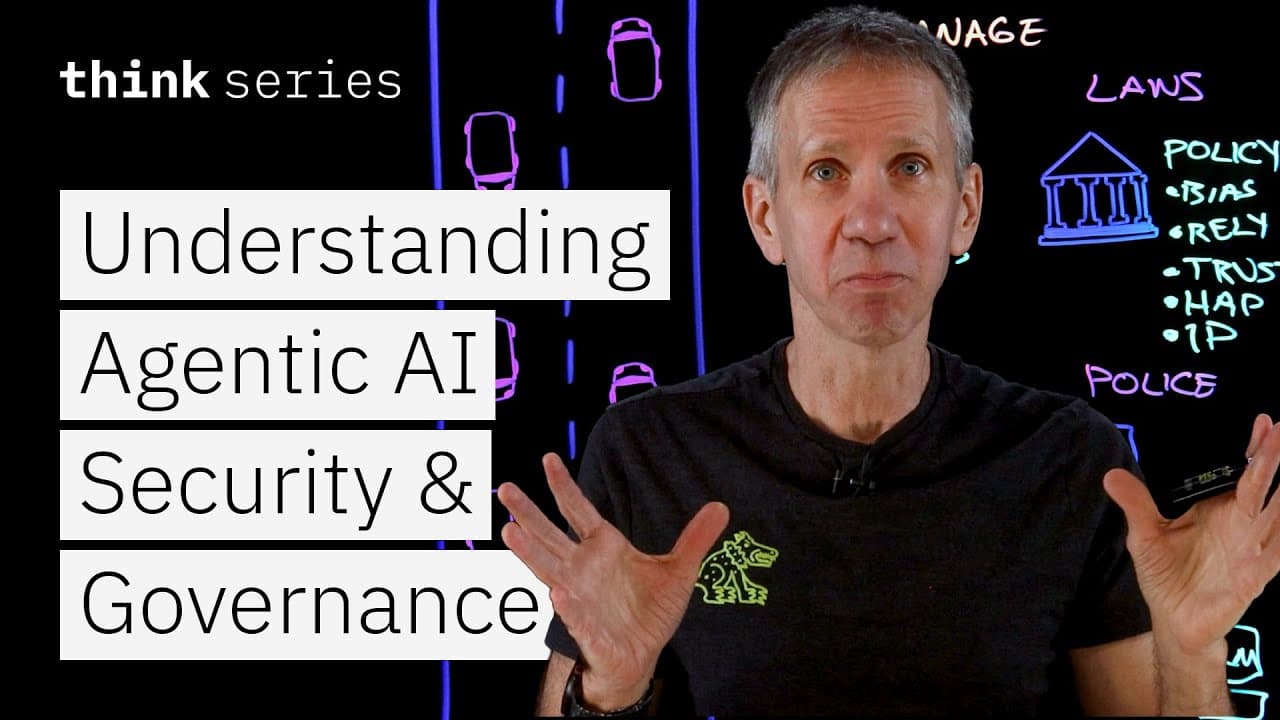
How to govern AI agents with policies and credentials
TL;DR
An AI governance system uses credentials for nonhuman identities, a secure vault for keys, and enforced policies to keep agents in check. It emphasizes authorization, monitoring for bias and drift, reliability of results, and a trusted, enforceable framework to prevent harmful or unintended agent behavior.
Transcript
I remember when I first took the test to get a driver's license, approximately a thousand years ago. The handbook said driving a car is a privilege, not a right. As a society, we've developed an infrastructure to govern and secure the way that we exercise that privilege in order to keep us all safe. AI agents need something similar if we're going t... Read More
Key Insights
- AI governing systems rely on authenticating agents before they can operate, ensuring only authorized actions occur.
- A secure vault for credentials is essential to manage and protect keys used by many agents across the environment.
- Policies define what agents can and cannot do, creating a safety boundary and reducing misuse and bias.
- Regular monitoring for drift helps ensure that agents continue to operate within approved parameters over time.
- Reliability is crucial when agents use LLMs, requiring checks that results are explainable and trustworthy.
- Enforcement layers act as gatekeepers between agents and resources, preventing unauthorized access or harmful actions.
- Nonhuman identities (NHIs) must be managed at scale, given the number of agents and the potential for autonomous operation.
- Guardrails against hate, abuse and profanity protect customer experience and business interests.
Install to Summarize YouTube Videos and Get Transcripts
Explore YouTube Video Summarizer or Get YouTube Transcript Extractor
Questions & Answers
Q: How to start governing AI agents with credentials and policies
To begin governing AI agents, you authenticate each agent to confirm it is allowed to operate, then issue credentials that verify its authorization level for specific tasks. You store and manage these credentials in a secure vault, reducing the risk of credential leakage. Pair this with clearly defined policies that specify permissible actions and consequences for violations, creating an enforceable framework.
Q: What is the role of NHIs in AI governance
Nonhuman identities, or NHIs, populate the agent ecosystem to represent each autonomous actor. They require a system that issues and manages credentials, authenticates access, and tracks permissions. By organizing NHIs, you can control which agents can access which resources, monitor activity, and enforce rules consistently across a large number of agents.
Q: Why is a secure vault important for AI agents
A secure vault centralizes storage for credentials and keys used by agents, enabling controlled check out and return of sensitive access information. This reduces exposure to theft or misuse, provides a single point for policy enforcement, and supports auditing to ensure that only authorized agents perform permitted operations.
Q: How do policies help manage AI agents
Policies specify what agents are allowed to do and define boundaries to prevent unsafe or undesired actions. They help detect and prevent bias, guide behavior, and provide a reference for enforcement. Clear policies ensure that agents operate within safe, predictable limits and that deviations can be identified and corrected.
Q: What is the purpose of an enforcement layer
The enforcement layer acts as a checkpoint between agents and resources. It verifies permissions before an action is taken and rechecks results after the action completes. This reduces the chances of unauthorized access, incorrect results, or harmful outcomes, effectively keeping agents aligned with intended goals.
Q: How is drift and bias addressed in AI governance
Drift is monitored to ensure that agents stay aligned with original goals and constraints over time. Bias is checked by analyzing outcomes for unfair tendencies and adjusting policies or models accordingly. Regular evaluation helps maintain reliability and fairness in agent decisions and actions.
Q: What makes AI agents trustworthy
Trustworthy AI agents are those whose behavior is reliable, explainable, and bounded by enforceable rules. They operate under authenticated identities, use vetted data, reveal explanations for decisions, and have protections against harmful outputs. Trust grows when governance mechanisms demonstrate consistent safety, transparency, and accountability.
Q: How does enforcement prevent unsafe AI behavior
Enforcement uses a gatekeeping step to ensure that only permitted actions proceed and that results are validated before being returned. If an action is disallowed or the result is questionable, the system blocks the operation and can trigger corrective workflows. This proactive approach helps keep agents on the intended path and prevents incidents.
Summary & Key Takeaways
-
A governance framework parallels driving laws with authenticated nonhuman identities, secure key management, and policy enforcement to control AI agents.
-
The system emphasizes detection of bias and drift, reliability of outputs, and the need for trustworthy, enforceable rules around agent actions.
-
The enforcement layer includes access control checkpoints and validation of results before delivering outcomes to users or other systems.
Read in Other Languages (beta)
Share This Summary 📚
Summarize YouTube Videos and Get Video Transcripts with 1-Click
Try YouTube Summary with ChatGPT & Claude or YouTube Transcript Generator
Explore More Summaries from IBM Technology 📚



Summarize YouTube Videos and Get Video Transcripts with 1-Click
Try YouTube Summary with ChatGPT & Claude or YouTube Transcript Generator