How Do Human Hormone Receptor Pathways Work?
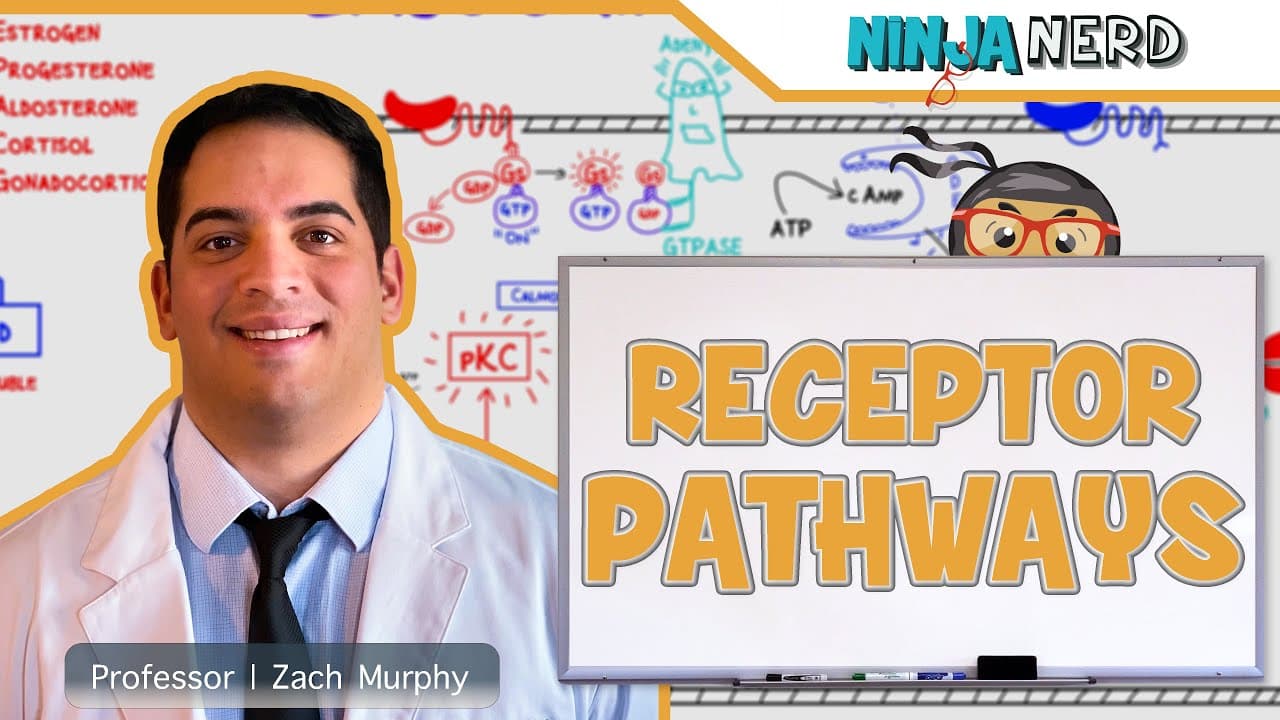
TL;DR
Water-soluble peptide hormones bind membrane receptors and activate intracellular second-messenger systems because they cannot cross the phospholipid bilayer. Lipid-soluble steroid hormones pass through the membrane, bind intracellular receptors, and influence gene transcription. Major peptide-hormone pathways include Gs, Gi, and Gq signaling, which regulate cAMP, IP3, DAG, calcium, protein kinases, enzymes, and membrane channels.
Transcript
all engine n what we're going to do in this video is we're going to talk about the various different types of receptor Pathways now to go over every single type of receptor for every single hormone it's just it's impossible to do all of that in this video so what we're going to do is we're going to focus on the most important receptor Pathways okay... Read More
Key Insights
- Peptide hormones are water-soluble molecules whose charged and relatively large structures prevent them from passing freely through the phospholipid bilayer. They therefore require membrane-bound receptors that translate an extracellular hormone signal into intracellular activity through second-messenger systems.
- Steroid hormones are lipid-soluble molecules derived from cholesterol, which allows them to cross the lipid bilayer and bind receptors inside the cell. Their intracellular receptor pathway can affect gene transcription instead of relying exclusively on a membrane-bound second-messenger cascade.
- G protein-coupled receptors are seven-pass transmembrane proteins, also called serpentine receptors. Hormone binding alters the receptor's three-dimensional structure, enabling the receptor to activate an associated G protein on the intracellular side of the membrane.
- GTP binding is the activating switch for the stimulatory G protein, while GDP binding represents its inactive condition. Receptor activation displaces GDP and permits GTP to bind, allowing the activated G protein to move along the membrane and interact with an effector enzyme.
- Adenylate cyclase is the membrane-associated effector enzyme stimulated by activated Gs. Its activation leads to the conversion of ATP into cyclic AMP, creating an intracellular second messenger that can distribute and amplify the original signal initiated by hormone binding.
- Cyclic AMP is a second messenger that activates protein kinase A. Activated protein kinase A phosphorylates proteins and enzymes, producing cellular effects that can include opening membrane channels, changing ion permeability, and regulating enzymes involved in metabolic processes.
- Protein phosphorylation is a mechanism for changing the behavior of cellular proteins. A phosphorylated channel may open and permit ions such as calcium or sodium to move, while phosphorylation of metabolic enzymes can modify reactions such as the conversion of glucose into pyruvate.
- Gs, Gi, and Gq are major G protein pathways involved in peptide-hormone signaling. The lecture description identifies cAMP, IP3, DAG, and calcium as important intracellular messengers, and clarifies that phospholipase C cleaves PIP2 into IP3 and DAG.
Install to Summarize YouTube Videos and Get Transcripts
Explore YouTube Video Summarizer or Get YouTube Transcript Extractor
Questions & Answers
Q: Why do peptide hormones need membrane receptors?
Peptide hormones need membrane receptors because they are water-soluble, may carry charges, and are relatively large. These properties prevent them from moving through the phospholipid bilayer, which has a lipid-based interior. A membrane receptor therefore binds the hormone outside the cell and transfers its message inward through intracellular second messengers that produce the required cellular response.
Q: How do steroid hormones signal inside a cell?
Steroid hormones are lipid-soluble because they are derived from cholesterol. This property allows them to pass through the cell's phospholipid bilayer and bind receptors located inside the cell. The intracellular hormone-receptor pathway can then influence gene transcription. Examples presented include testosterone, estrogen, progesterone, aldosterone, cortisol, gonadocorticoids, vitamin D, and thyroxine.
Q: What is a G protein-coupled receptor?
A G protein-coupled receptor is a membrane receptor associated with a G protein on the intracellular side of the cell membrane. It passes through the membrane seven times, which is why it is also described as a seven-pass transmembrane or serpentine receptor. Hormone binding changes its three-dimensional structure and activates the associated G protein.
Q: How does the Gs receptor pathway become activated?
The Gs pathway begins when a peptide hormone, such as the epinephrine example in the lecture, binds its membrane receptor. Binding changes the receptor's internal structure and activates the stimulatory G protein. GDP is displaced and GTP binds in its place. The GTP-bound Gs protein then moves to and activates the membrane effector enzyme adenylate cyclase.
Q: What roles do GDP and GTP play in G protein signaling?
GDP and GTP act as molecular indicators of the G protein's activity state. The G protein is inactive when bound to GDP. Hormone-driven receptor activation causes GDP to be displaced and GTP to bind, switching the protein on. Cleavage of a phosphate from GTP converts it back to GDP and returns the G protein toward its inactive state.
Q: How does cyclic AMP activate a cellular response?
Activated adenylate cyclase converts ATP into cyclic AMP. Cyclic AMP then functions as an intracellular second messenger by activating protein kinase A. Protein kinase A phosphorylates multiple proteins and enzymes, allowing the original extracellular hormone signal to influence membrane channels, ion movement, metabolic enzymes, and other processes inside the target cell.
Q: What does protein kinase A do in hormone signaling?
Protein kinase A phosphorylates cellular proteins after it is activated by cyclic AMP. Adding phosphate groups can change how target proteins behave. For example, phosphorylation may open a membrane channel and alter the movement of ions such as calcium or sodium. It may also activate or regulate enzymes participating in cellular metabolism, including glycolytic processes.
Q: How are IP3 and DAG produced in the Gq pathway?
The lecture description identifies IP3 and DAG as intracellular messengers associated with major G protein signaling pathways, including Gq. It also provides a correction that phospholipase C is itself a type of phosphodiesterase and is not broken down by phosphodiesterase. Phospholipase C catalyzes the cleavage of PIP2 into the second-messenger products IP3 and DAG.
Summary & Key Takeaways
-
Hormone signaling depends strongly on solubility. Water-soluble peptide hormones are generally too large and charged to cross the lipid-rich cell membrane, so they bind receptors located on the cell surface. These receptors transmit the extracellular hormonal message into the cell through second messengers that activate enzymes, channels, and other intracellular responses.
-
Lipid-soluble steroid hormones are derived from cholesterol and can pass through the phospholipid bilayer. Instead of requiring receptors on the cell surface, they bind receptors located inside the cell. The resulting signaling pathway can influence gene transcription. Testosterone, estrogen, progesterone, aldosterone, cortisol, gonadocorticoids, vitamin D, and thyroxine are presented as examples.
-
G protein-coupled receptors cross the membrane seven times and activate associated G proteins after hormone binding changes receptor structure. In the Gs pathway, GDP is replaced by GTP, activated Gs stimulates adenylate cyclase, and cAMP activates protein kinase A. Protein phosphorylation then modifies enzyme activity, membrane permeability, and other cellular processes.
Read in Other Languages (beta)
Share This Summary 📚
Summarize YouTube Videos and Get Video Transcripts with 1-Click
Try YouTube Summary with ChatGPT & Claude or YouTube Transcript Generator
Explore More Summaries from Ninja Nerd 📚






Summarize YouTube Videos and Get Video Transcripts with 1-Click
Try YouTube Summary with ChatGPT & Claude or YouTube Transcript Generator