Nobel Lecture: Akira Yoshino, Nobel Prize in Chemistry 2019
TL;DR
Lithium-ion batteries became practical by combining a carbon-based anode with a lithium cobalt oxide cathode, followed by safety testing before commercialization. Yoshino traces the technology from his research beginning in 1981 through its 1990 commercialization, then connects its expanding use in electric vehicles with a future society shaped by autonomous mobility, artificial intelligence, and environmental priorities.
Transcript
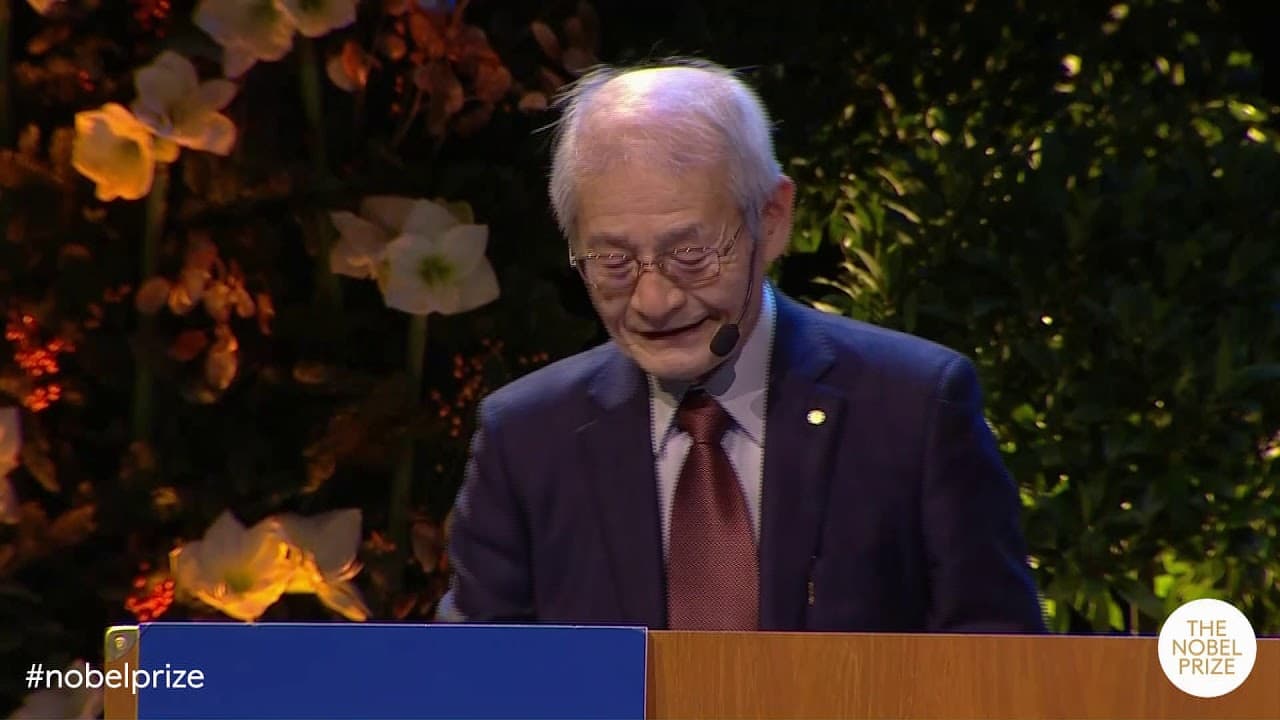
so our third lecture will be given by our next laureate Akira Yoshino and as you can see Akira oshino was born in 1948 in sweta in Osaka Prefecture in Japan and he earned his doctoral degree relatively recently from in 2005 also from Osaka University in Japan but most of his career he has been working as at as an industrial scientist at as I guess ... Read More
Key Insights
- Yoshino's battery research began in 1981 with conductive polymers, materials whose shiny, metallic appearance reflected their electrical conductivity. His initial work examined their possible use in devices such as diodes and solar cells before he pursued their potential as rechargeable battery materials.
- Polyacetylene could store substantial electricity and remain stable after many charging cycles, making it a promising anode material. Its major weakness was very low density, which produced a battery too bulky for practical commercialization and forced Yoshino to investigate alternative carbon materials.
- A workable lithium-ion battery required a cathode containing lithium ions because the proposed anode materials did not contain lithium. Several cathode candidates available at the time lacked lithium, preventing Yoshino from assembling the rechargeable system defined in his lecture.
- Lithium cobalt oxide supplied the missing cathode material after Yoshino encountered John Goodenough's paper while organizing documents at the end of 1982. He recognized its relevance immediately and began experiments in 1983 using lithium cobalt oxide with polyacetylene.
- The early lithium cobalt oxide system was assembled in a discharged state with almost zero cell voltage. It had to be charged before use, at which point it produced a high voltage of around four volts, an unusual characteristic that Yoshino emphasized during the lecture.
- A specialized carbon material solved the polyacetylene anode's bulk problem because it possessed the crystalline structure needed for effective operation. Combining this carbon material with lithium cobalt oxide established the basic lithium-ion battery system, leading Yoshino to file a patent in 1985.
- Safety validation was essential before the new rechargeable battery could proceed toward commercialization. Yoshino conducted impact tests in 1986 at a facility equipped for explosives work, comparing a metallic lithium battery that emitted sparks with a lithium-ion prototype that behaved safely.
- Lithium-ion battery demand initially grew alongside mobile information technology after commercialization in 1990, with 1995 identified as an important year. Electric vehicle applications later expanded rapidly, surpassing mobile applications by 2017 and becoming central to Yoshino's forecast for environmental and energy change.
Install to Summarize YouTube Videos and Get Transcripts
Explore YouTube Video Summarizer or Get YouTube Transcript Extractor
Questions & Answers
Q: How was the lithium-ion battery developed?
The development began with Yoshino's 1981 research into conductive polymers as possible battery materials. Polyacetylene stored substantial electricity and remained stable over repeated charging, but its low density made the battery bulky. He paired a suitable carbon-based anode with lithium cobalt oxide, established the basic configuration, filed a patent in 1985, and completed crucial safety testing in 1986.
Q: Why was lithium cobalt oxide important to the battery?
Lithium cobalt oxide was important because the battery needed a cathode containing lithium ions, while Yoshino's anode materials did not contain lithium. Other cathode materials being studied lacked the required lithium. After finding John Goodenough's paper at the end of 1982, Yoshino recognized lithium cobalt oxide as the missing material and began experiments with it in 1983.
Q: Why was polyacetylene replaced as the anode material?
Polyacetylene was electrically conductive, could store a large amount of electricity, and remained stable after many charging cycles. However, it had very low density, making the resulting battery too bulky for practical use. Yoshino therefore tested other materials and found a carbon material with a special crystalline structure that worked effectively while enabling a more practical battery configuration.
Q: What made the first lithium cobalt oxide battery unusual?
The first system using polyacetylene and lithium cobalt oxide was unusual because it was assembled as a dead, discharged battery. Its initial cell voltage was almost zero, so it had to be charged before it could be used. After charging, it generated a high voltage of around four volts, demonstrating that the material combination could function as a rechargeable battery.
Q: How did Yoshino test lithium-ion battery safety?
Yoshino conducted safety experiments in 1986 because commercialization could not continue without proof that the battery was safe. Since he did not know whether testing might cause a fire or explosion, he used another Asahi Kasei division's explosives test facility. An impact test caused a metallic lithium battery to emit sparks, while the lithium-ion prototype behaved safely.
Q: When did lithium-ion batteries become commercialized?
Yoshino began his basic research in 1981, established the basic lithium-ion battery configuration in 1985, and conducted safety testing in 1986. The technology was commercialized in 1990. He associates its subsequent market growth with the rise of mobile information technology and identifies 1995, the year Windows 95 appeared, as an especially important point in that development.
Q: How did lithium-ion battery applications change over time?
Lithium-ion batteries were initially used overwhelmingly for mobile information technology. Yoshino's market chart indicates that mobile applications accounted for almost all capacity-based demand in 2010. Electric vehicle applications then grew quickly and had become larger than mobile applications by 2017. He forecast that electric vehicles would dominate the battery market by 2025.
Q: How could batteries support a more sustainable society?
Yoshino connects rechargeable batteries with electric vehicles, artificial intelligence, the Internet of Things, connected transportation, autonomous driving, and shared mobility. He argues that these combined technologies could help address the conflict among environmental protection, economic activity, and convenience. His envisioned 2030 society centers on shared autonomous electric vehicles that can be summoned when transportation is needed.
Summary
Akira Yoshino, the 2019 Nobel laureate in Chemistry, gave a lecture on battery research and its impact on society. He discussed his journey in the field, from his early fascination with chemistry to his groundbreaking work on lithium-ion batteries. Yoshino also highlighted the growth of the battery market and its potential for sustainability in the future.
Questions & Answers
Q: When and where was Akira Yoshino born, and where did he earn his doctoral degree?
Akira Yoshino was born in 1948 in Sweta, Osaka Prefecture, in Japan. He earned his doctoral degree in 2005 from Osaka University in Japan.
Q: What was Yoshino's career primarily focused on?
Yoshino's career primarily focused on working as an industrial scientist at a corporation in Tokyo, Japan. He is also currently a professor at Mayo University and Nagoya, Japan.
Q: What did Yoshino mention about his selection for the Nobel Prize in Chemistry?
Yoshino expressed gratitude for receiving the 2019 Nobel Prize in Chemistry and acknowledged the excitement and support from people in Japan. He considered it a great gift to his family who had supported him throughout his career.
Q: When did Yoshino develop an interest in chemistry, and what was his initial area of study?
Yoshino developed an interest in chemistry when he was around nine years old, encouraged by his teacher to explore the chemical history of candle vision by Michael Faraday. He became fascinated with Faraday's chemistry and went on to study inorganic chemistry at Kyoto University.
Q: What is the definition of an ion battery according to Yoshino?
According to Yoshino, an ion battery is a non-access rechargeable battery that operates on the principle of intercalation. It consists of a metal oxide cathode and a carbon-based anode material.
Q: What were some previous Nobel Prize-winning experiments and achievements related to batteries that Yoshino mentioned?
Yoshino mentioned three Nobel Prize-winning experiments and achievements related to batteries. These include the experiments by Kenji Fukui and Roald Hoffmann in 1981 on the theory of chemical reactions, the discovery of conductive polymers by Alan J. Heeger, Alan G. MacDiarmid, and Hideki Shirakawa in 2000, and the development of cobalt oxide as a cathode material in rechargeable batteries.
Q: How did Yoshino begin his research on ion batteries, and what were his initial challenges?
Yoshino began his research on ion batteries in 1981, focusing on conductive polymers as an initial material. However, this material did not work well as an anode, so he needed to find another material. Despite initial frustrations, he eventually discovered cobalt oxide, which became the cathode material for his battery system.
Q: What were the challenges Yoshino faced in commercializing his battery system?
One of the challenges Yoshino faced in commercializing his battery system was the issue of variable capacity due to electrode density. The available carbon-based anode materials at the time did not provide the desired stability. However, he later found a suitable carbon material developed by another group, which resolved this problem.
Q: How did Yoshino ensure the safety of his battery system, and when did he conduct the first safety tests?
In order to proceed with commercializing his battery system, Yoshino needed to prove its safety. In 1986, he conducted the first safety tests on his battery, one involving metallic lithium and the other involving the prototype of the new battery. These tests were carried out at a specialized testing site due to the potential risks involved.
Q: How has the battery market evolved over the years, and what does Yoshino predict for the future?
Yoshino showcased the growth of the battery market, particularly in the mobile IT sector. He emphasized the importance of the 1995 launch of Windows 95, which marked a significant milestone in mobile IT society. Yoshino predicted that the future market will see a dominant shift towards electric vehicles, with increasing applications for batteries in various industries.
Takeaways
Akira Yoshino's lecture provided valuable insights into the development of lithium-ion batteries and their impact on society. His journey from initial research to commercialization highlighted the challenges and breakthroughs in battery technology. Yoshino's vision for a sustainable future, where batteries play a central role, demonstrated the potential of innovation and adaptation in solving global issues. The lecture showcased the significant progress made in the battery market and hinted at the promising future of electric vehicles and shared mobility.
Summary & Key Takeaways
-
Akira Yoshino began basic battery research in 1981 using conductive polymers, particularly polyacetylene. Although the material could store substantial electricity and remained stable through repeated charging cycles, its low density made batteries too bulky. This limitation prompted the search for a more practical carbon-based material with an appropriate crystalline structure.
-
A crucial breakthrough came when Yoshino found research on lithium cobalt oxide, a cathode material containing lithium ions. He combined it with polyacetylene in 1983, then replaced the bulky polymer with a specialized carbon material. This established the basic lithium-ion battery configuration, for which he filed a patent in 1985.
-
Safety had to be demonstrated before commercialization because batteries using metallic lithium could ignite during impact testing. In 1986, Yoshino tested his prototype at an explosives facility and showed its improved behavior. Commercialization followed in 1990, supporting mobile information technology and later the rapidly growing electric vehicle market.
Read in Other Languages (beta)
Share This Summary 📚
Summarize YouTube Videos and Get Video Transcripts with 1-Click
Try YouTube Summary with ChatGPT & Claude or YouTube Transcript Generator
Explore More Summaries from Nobel Prize 📚




Summarize YouTube Videos and Get Video Transcripts with 1-Click
Try YouTube Summary with ChatGPT & Claude or YouTube Transcript Generator