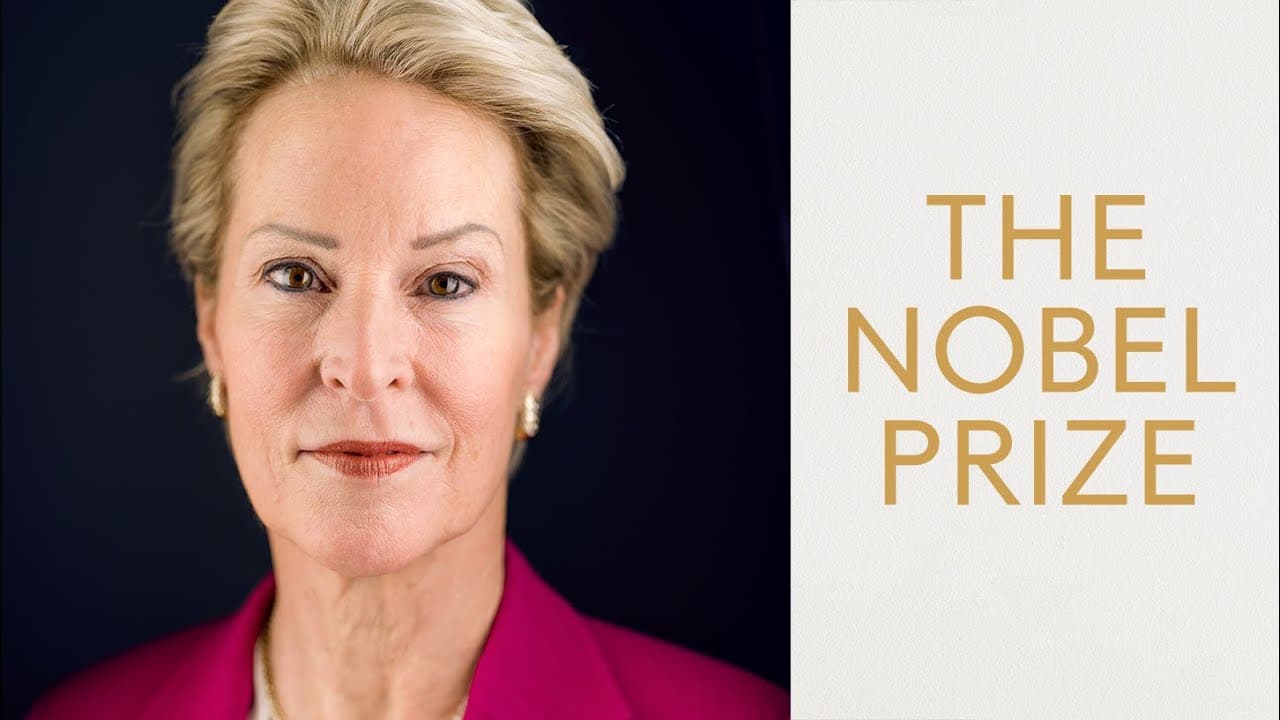
Frances H. Arnold, Nobel Laureate in Chemistry 2018: Official interview
TL;DR
Successful science requires independent creativity, constructive teamwork, resilience through criticism and failure, and the curiosity to keep pursuing worthwhile problems. Frances Arnold describes evolution as a way to create biological things too complicated to design directly, then reverse-engineer them to understand their new traits, while emphasizing that diverse experiences and supportive mentorship can strengthen scientific careers.
Transcript
I think I was an engineer and a scientist from day one I was very surprised and overwhelmed terrified happy thrilled bouncing off the walls I was in a hotel room so I could bounce off the walls and nobody would see me I was walking around in circles because I wasn't allowed to call home and then after I called home I could I was walking around in c... Read More
Key Insights
- Scientific success requires accepting constructive criticism and separating useful feedback from hurt feelings. A researcher should ask whether an idea is weak or merely communicated poorly, then participate openly in the discussion rather than retreating from it.
- Independent creativity and teamwork are complementary scientific skills. Researchers must develop their own questions and solutions, but they also need to persuade colleagues and students to engage with problems, contribute original ideas, and strengthen the work collectively.
- Curiosity-driven research can eventually produce societal benefits even when practical impact is not its starting objective. Arnold argues that understanding the universe, communities, people, and minds can contribute to solving problems without requiring every scientist to pursue the same large challenge.
- Evolution can create biological things that are too complicated to design directly. After evolved traits solve a problem, reverse engineering can reveal how those traits arose and contribute to a deeper understanding of biology and evolutionary processes.
- Diverse experiences can make a scientist's perspective distinctive. Arnold connects her outlook to interests spanning Russian literature, aerospace engineering, chemical engineering, languages, and unrelated work, including driving a taxi before she became a chemical engineering professor at age thirty.
- Career progress does not require knowing the final destination. Arnold advises choosing a path at each fork, doing the work as well as possible, and taking another direction if it proves unsuitable, because life can involve opening new possibilities.
- Effective mentorship provides resources, intellectual freedom, support during failure, and credit during success. Arnold sees teaching as an opportunity to spark creativity in talented students and help them persist when experiments inevitably stop working.
- Collaborative groups can accomplish more than one individual mind. Arnold describes her strength as encouraging twenty good brains to work together, creating an environment where colleagues become friends, share ideas, celebrate successes, and sustain relationships across later careers.
Install to Summarize YouTube Videos and Get Transcripts
Explore YouTube Video Summarizer or Get YouTube Transcript Extractor
Questions & Answers
Q: What traits are important for success in science?
Success in science requires an ability to accept constructive criticism, listen past hurt feelings, and determine why an idea is not being understood. A scientist must consider whether the problem lies in the idea itself or in its communication. Independence, original questioning, teamwork, resilience during failure, and a willingness to join difficult discussions are also central traits.
Q: How should scientists respond to criticism of their work?
Scientists should treat thoughtful criticism as an opportunity to improve both their ideas and their communication. Arnold recommends setting aside the immediate feeling of being hurt and listening carefully to what the critic is saying. The researcher can then ask whether the underlying idea is flawed, whether its presentation caused confusion, or whether further discussion can clarify and strengthen it.
Q: Why are independence and teamwork both important in science?
Independence matters because scientists must formulate their own questions and develop original solutions when exploring something new. Teamwork matters because ambitious research also depends on many people contributing their own creativity. Arnold describes the necessary balance as generating a direction independently, then encouraging students and colleagues to engage with the problem and improve it through their distinct ideas.
Q: How does evolution help Frances Arnold solve scientific problems?
Arnold uses evolution to create new biological things that would be too complicated to design directly. Once an evolved result solves a problem, she can reverse-engineer it and investigate how it acquired its new traits. This process connects practical problem-solving with fundamental research by revealing more about how biology functions and how evolutionary change produces useful characteristics.
Q: Should every scientist work directly on societal problems?
Arnold does not think every scientist must begin with a problem framed around direct societal impact. She notes that curiosity has often led to social benefits and that different researchers have different passions. Efforts to understand the universe, communities, people, or the mind can still contribute to future solutions, even when those solutions were not the researcher's original objective.
Q: How can diverse life experiences benefit a scientist?
Diverse experiences can supply ideas, perspectives, and combinations that distinguish one scientist from another. Arnold's background included Russian literature, aerospace engineering, chemical engineering, several languages, and work as a taxi driver. She says that both positive and difficult experiences made her who she is, while ideas from writers, philosophers, and scientists were later recombined within her own work.
Q: What career advice does Frances Arnold give young people?
Arnold advises young people not to fear choosing a path simply because its destination is uncertain. At a fork, they should take a direction, do something concrete, and perform it as well as they can. If the work proves unsuitable, they can choose another path. She emphasizes that careers need not be understood as opportunities permanently closing behind them.
Q: How does Frances Arnold approach mentoring students and colleagues?
Arnold sees mentorship as creating conditions in which other people can do excellent science. She aims to provide resources, freedom for creative expression, support when work fails, and proper credit when it succeeds. She also values bringing many strong minds together, encouraging them to contribute independent ideas, form lasting relationships, celebrate achievements, and continue into their own careers.
Summary
In this video, the Nobel laureate Frances Arnold shares her experience of winning the Nobel Prize, her journey as a scientist and engineer, and her thoughts on the importance of science and diversity in the field.
Questions & Answers
Q: How did Frances Arnold react when she found out she won the Nobel Prize?
Frances Arnold described herself as surprised, overwhelmed, terrified, happy, and thrilled when she found out she won the Nobel Prize. She was in a hotel room at the time, so she had the freedom to bounce off the walls with excitement. It was a thrilling and emotional moment for her.
Q: Who was the first person Frances Arnold called after winning the Nobel Prize?
Frances Arnold's first phone call was to her son James, but he didn't answer the phone until a couple of hours later due to the early morning hour. When he finally answered, his reaction was a mix of tiredness and excitement. Frances shared the news with him, and he was thrilled for her.
Q: How did Frances Arnold's colleagues and students celebrate her Nobel Prize win?
When Frances finally arrived back at Caltech, her colleagues and students had prepared a warm welcome for her. They had made big posters, worn lab t-shirts, and spread out on the campus to give her a standing ovation. Later, her colleagues gathered in the Chairman's office and toasted her with champagne. It was a lovely celebration of her achievement.
Q: How has winning the Nobel Prize impacted Frances Arnold's life?
Winning the Nobel Prize has meant a lot of work for Frances Arnold. She has had to put together schedules, handle thousands of messages from friends and supporters, and deal with the overwhelming response to her achievement. She has heard from people all over the world, many of whom she's never met, expressing their happiness for her. It has become a shared event, touching the lives of everyone she has ever encountered.
Q: What influenced Frances Arnold to become a scientist and engineer?
Frances Arnold's father, who was a physicist experimentalist, had a significant influence on her. He loved fixing and building things, and he would sometimes allow Frances and her brothers to join him in the workshop. Growing up with four brothers, Frances also developed a competitive spirit and a flair for problem-solving. These factors shaped her interest in science and engineering.
Q: Did Frances Arnold face any challenges growing up as a scientist?
Frances Arnold shared that being a scientist was not initially on her list of things to do while she was growing up. She tried different career paths, such as wanting to be a diplomat or a CEO of a multinational corporation. However, she found her passion in science and engineering, as it allowed her to solve problems and make a meaningful impact.
Q: What traits are important to be successful in science?
According to Frances Arnold, one must possess the ability to accept and benefit from criticism to be successful in science. Criticism is a prevalent aspect of the field, and being open to constructive criticism helps in improving one's work. Developing thick skin and being able to listen and learn from criticism are essential qualities for a scientist. Additionally, independence and teamwork are also important traits to balance in science.
Q: How does Frances Arnold view the importance of solving societal problems through science?
Frances Arnold believes that solving societal problems is not a necessary requirement for scientists. Curiosity-driven research and exploring the unknown can lead to unexpected societal impact. She mentions that just having a passion for understanding the world and being creative in identifying problems is a lovely way to contribute to scientific progress. Solving problems should not be limited to specific issues but should encompass a broader perspective.
Q: How does Frances Arnold approach problem-solving in her work?
Frances Arnold particularly enjoys working on problem-solving in her field, leveraging her engineering background and her love for evolutionary processes. She uses the process of evolution to create new biological systems that have practical applications, even if they are too complex to be designed from scratch. Once she solves a problem using these biological systems, she aims to reverse engineer them and understand how they acquired their new traits. This approach contributes to a deeper understanding of how biology and evolution work.
Q: Who were some of the scientists and philosophers who influenced Frances Arnold's work?
Over the course of her career, Frances Arnold has been inspired by various scientists, philosophers, and writers. She mentions being strongly influenced by Jorge Luis Borges, a writer, and by the philosopher Dan Dennett. In her work, she has recombined ideas from these individuals and many other creative scientists to create something new. Looking back, she values the impact that these ideas had on her work.
Q: How does Frances Arnold's diverse background contribute to her work?
Frances Arnold's diverse background, which ranges from studying Russian literature to aerospace and chemical engineering, has shaped her unique perspective. She speaks multiple languages and has been interested in various subjects throughout her lifetime. She believes that this diversity of experience sets her apart and allows her to approach problems differently. Her broad range of knowledge and experiences has made her who she is today.
Q: What advice does Frances Arnold have for aspiring scientists and engineers?
Frances Arnold advises individuals to not be afraid of taking a path and to make the most out of the opportunities that come along the way. She believes that life is about taking risks, trying new things, and continuously learning. If one doesn't like a certain path, she encourages them to take another one. It's important to keep doors opening and explore one's passions and interests.
Q: Why does Frances Arnold believe everyone should have some understanding of science and engineering?
Frances Arnold believes that science and engineering are the future and that everyone needs to have some knowledge in these areas. Science and technology will play a crucial role in addressing global challenges such as feeding a growing population, providing clean water, and creating sustainable cities. Without a scientifically literate population, these problems cannot be solved effectively. Women, who represent 50% of the population, will play a significant role in shaping the future of science and technology.
Q: How does Frances Arnold view the role of women in science and engineering?
Frances Arnold acknowledges that there are still challenges for women in the field of science and engineering but believes progress has been made. She highlights the importance of encouraging women to pursue careers in these fields and supports the idea that women can excel in science and engineering. She also mentions that diversity, including gender diversity, leads to more creative and innovative solutions to problems.
Q: Has Frances Arnold faced any specific challenges as a woman in science?
Frances Arnold mentions that she has encountered challenges throughout her career but she tends to be blissfully unaware if someone doesn't like her work. Having four brothers growing up also helped her develop a resilient attitude towards criticism. She acknowledges that there is still work to be done regarding gender parity in science and technology. Although progress has been made, she believes there are systemic issues that hold women back from pursuing careers in these fields. However, she is optimistic about the future and the impact women will have.
Q: How does Frances Arnold inspire the next generation of scientists?
Frances Arnold tries to inspire the next generation of scientists by sharing her experiences and insights. As a mentor, she encourages young minds to pursue their passions in science and engineering and supports them in their journey. She understands the challenges and difficulties of the field but believes that the joy and fulfillment outweigh the hardships. She strives to provide an environment that fosters creativity, supports failure, and celebrates success.
Takeaways
Frances Arnold's journey as a scientist and engineer is a testament to the power of passion, problem-solving, and diversity in science. Winning the Nobel Prize, she has realized the impact she has had on the lives of others and the importance of inspiring the next generation. Her work using evolution to solve real-world problems highlights the potential for sustainable solutions. Frances Arnold's advice to pursue interests, embrace failure, and keep doors open serves as a reminder that the path to success in science is unique for each individual. Science and engineering are crucial for solving global challenges, and diversity, particularly gender diversity, plays a pivotal role in driving progress in these fields. Everyone can benefit from understanding and appreciating the value of science in shaping a better future for all.
Summary & Key Takeaways
-
Arnold recalls reacting to the Nobel Prize announcement with surprise, fear, happiness, and intense excitement. After struggling to reach her family, she returned to Caltech, where students welcomed her with posters, lab shirts, and a standing ovation. Colleagues then gathered to celebrate her achievement with champagne.
-
Her path into engineering was exploratory rather than predetermined. Growing up with four brothers encouraged competition, organization, and self-reliance. She considered other careers before studying engineering and discovering that she loved solving problems. Her varied experiences, from Russian literature and languages to engineering and taxi driving, helped shape her distinctive perspective.
-
Arnold presents science as a balance between independence and collaboration. Scientists must formulate original questions, accept criticism, withstand inevitable failures, and communicate ideas clearly. Mentors and supportive institutions help, while research groups multiply individual ability. She advises young people to take a path, work seriously, and change direction when necessary.
Read in Other Languages (beta)
Share This Summary 📚
Summarize YouTube Videos and Get Video Transcripts with 1-Click
Try YouTube Summary with ChatGPT & Claude or YouTube Transcript Generator
Explore More Summaries from Nobel Prize 📚

Summarize YouTube Videos and Get Video Transcripts with 1-Click
Try YouTube Summary with ChatGPT & Claude or YouTube Transcript Generator